

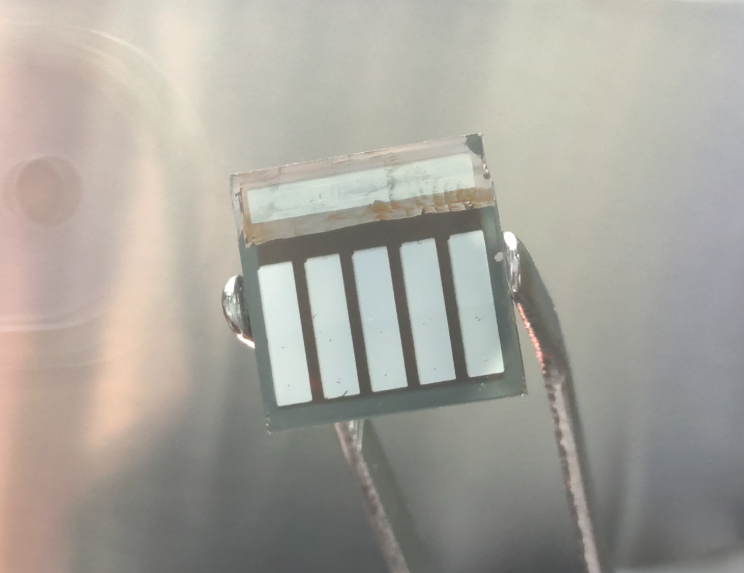
The Chinese manufacturer said the cell uses a multifunctional organic ammonium salt to improve the interfacial engineering between the perovskite absorber and the electron transport layers. The device also achieved an efficiency of 24.5% when scaled up to an active area of 1 cm².
A research team from Chinese module manufacturer JA Solar has fabricated an inverted perovskite solar cell based on a multifunctional organic ammonium salt that reportedly reduces non-radiative recombination and improves carrier transport at the interface between the perovskite absorber and the electron transport layer (ETL).
“Our approach enables dual-site passivation of lead iodide (Pb/I) vacancies while minimizing steric hindrance and thereby increasing carrier extraction efficiency,” the study’s corresponding author Sun Yang shared. pv magazine.
Inverted perovskite cells have a device structure known as “pin”, where hole-selective contact p is at the bottom of the intrinsic perovskite layer i with electron transport layer n at the top. Conventional halide perovskite cells have the same structure, but in reverse: a ‘nip’ arrangement. With nip architecture, the solar cell is illuminated via the electron transport layer (ETL) side; in the pin structure, it is illuminated by the surface of the hole transport layer (HTL).
Optimized for this cell type buckminsterfullerene (C60) is currently the best performing material used for ETL, although it is subject to significant aggregation in solution and requires calibration when combined with the perovskite film. “As is known, the perovskite/C60 interface is plagued by substantial non-radiative recombination, causing significant energy losses that significantly limit the efficiency and durability of the cells,” the research group said.
Image: JA Solar
For this purpose, the scientists used a multifunctional organic ammonium salt known as 2-(4-(aminomethyl)phenyl)ethyl-1-ammonium iodide, or PMEAI, as a passivation layer to improve interface engineering at the perovskite-C60 interface.
The team built the cell with a substrate made of fluorine-doped tin oxide (FTO), a hole transport layer (HTL) made with a self-assembled monolayer known as 4PADCB, a perovskite absorber, the PMEAI passivation layer, the C60 ETL, a bathocuproin (BCP) buffer layer and a silver (Ag) metal contact.
Tested under standard lighting conditions, the device achieved an energy conversion efficiency of 26.7%, an open-circuit voltage of 1.181 V, a short-circuit current density of 26.36 mA/cm2 and a fill factor of 85.8%. In contrast, control devices built with other types of passivation layers achieved a lower efficiency of 24.3%, an open-circuit voltage of 1.156 V, a short-circuit current density of 26.05 mA/cm2 and a fill factor of 80.4%.
The PMEAI-based cell also achieved a certified efficiency of 25.84%, with the result certified by China’s National Photovoltaic Industry Metrology and Testing Center (NPVM). The device also achieved an efficiency of 24.5% when scaled up to an active area of 1 cm2.
Through further analysis, the scientists found that the horizontally aligned PMEAI suppressed both Pb and I vacancy defects and induced a reversal of the built-in electric field at the perovskite/C60 interface, minimizing interfacial recombination losses.
“The interfacial electric field, inverted by PMEAI to point from c60 toward the perovskite, electron extraction significantly accelerates and suppresses recombination, breaking the conventional limitations imposed by passivation layers on both current density and fill factor,” Yang said.
It was also found that the cell retains 97% of its initial efficiency after 1500 hours at 65°C.
The device was described in “Interface Molecular Orientation Engineering Induced Field Reversal for Efficient Inverted Perovskite Solar Cells”, published in Energy and environmental sciences.
“Overall, this work establishes a paradigm for interfacial material design that synergistically integrates low steric hindrance, defect passivation, and suppressed ion-migrated degradation to promote high-performance perovskite photovoltaics,” the research group concluded.
This content is copyrighted and may not be reused. If you would like to collaborate with us and reuse some of our content, please contact: editors@pv-magazine.com.
Popular content

