

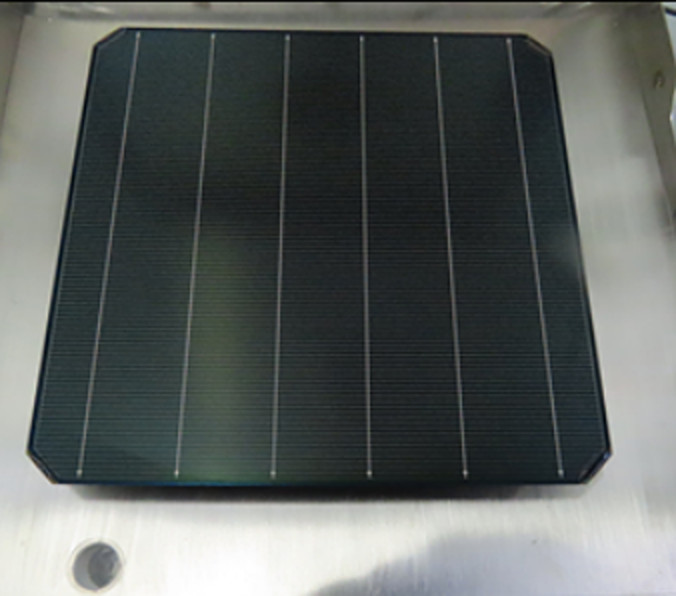
In a new scientific paper, the Chinese solar manufacturer explained that the 27.81% efficient hybrid interdigitated back-contact cell it unveiled in April is based on passivated tunnel contacts and dielectric passivation layers, while also incorporating both n-type and p-type contacts.
A group of scientists from Chinese solar module manufacturer Longi has described in a new scientific paper the 27.81% efficient hybrid interdigitated back-contact (HIBC) solar cell it unveiled in April 2025.
At the time, Longi only said that the device offers the world’s highest efficiency for silicon solar cells, with the result certified by the German Institute for Solar Energy Research Hamelin (ISFH). “By redesigning both cell architecture and material systems, we have achieved simultaneous breakthroughs in optical management and carrier efficiency,” a company spokesperson said. pv magazine at the time, without providing further details.
In the newspaper “Silicon solar cells with hybrid rear contacts”, which was published last week in nature, Longi’s research team, which also includes president and founder Li Zhenguo, explained that the cell is based on passivated tunnel contacts and dielectric passivation layers, while also containing both n-type and p-type contacts.
The scientists used a high-strength half-cut M10 wafer with edge passivation, an optimized n-type contact formed by a combined high-low temperature process, an indium tin oxide (ITO) layer to promote lateral transport, and a multilayer stack of aluminum oxide (AlOx) and silicon nitride (SiNx) on the structured front surface to minimize recombination, and an amorphous silicon (a-Si) layer.
They also reduced the phosphorus doping in the n-type polycrystalline silicon layer (n-poly-Si) by an order of magnitude to limit the dopant diffusion into the wafer. “The high- and low-temperature process, which combines diffusion and deposition, allows wafer edges to be passivated during fabrication,” they explained, noting that this technique is commonly known as in situ passivated edge technology (iPET).
The group also used 8 µm deep grooved metal fingers to collect holes with selective ITO etched away to prevent leakage between n-type and p-type contacts. It also improved the thickness of the a-Si layer to ensure adequate pin junction coverage and full encapsulation of the n-poly-Si sidewalls. To reduce contact resistance, the layer was crystallized via a pulsed green nanosecond laser to maintain edge passivation.
“Achieving an optimal balance between passivation and conductivity requires careful tuning of the thickness of the a-Si layer, its optical properties and laser parameters such as fluence and pulse duration,” the academics pointed out.
The world record energy conversion efficiency of 27.81% was achieved on a cell with an active area of 133.63 cm2. The device also achieved a short-circuit current of 5,698 mA, an open-circuit voltage of 744.9 mV and a fill factor of 87.55%.
“This achievement is driven by the integration of advanced techniques, including laser-induced crystallization, in situ edge passivation and optimized surface treatments, which collectively reduce the ideality factor to less than 1 at maximum power tracking (MPP), significantly improving the fill factor,” the article notes.
The ideality factor measures how closely the electrical behavior of a solar cell matches that of an ideal diode, with values typically ranging from 1 to 2.
Looking ahead, Longi said the new techniques can be easily scaled up for use in the production of heterojunction (HJT) solar cells. “The p-type contact exhibits 50% more resistance loss than the n-type contact, indicating the need for further improvements in contact resistance,” the company said.
This content is copyrighted and may not be reused. If you would like to collaborate with us and reuse some of our content, please contact: editors@pv-magazine.com.
