

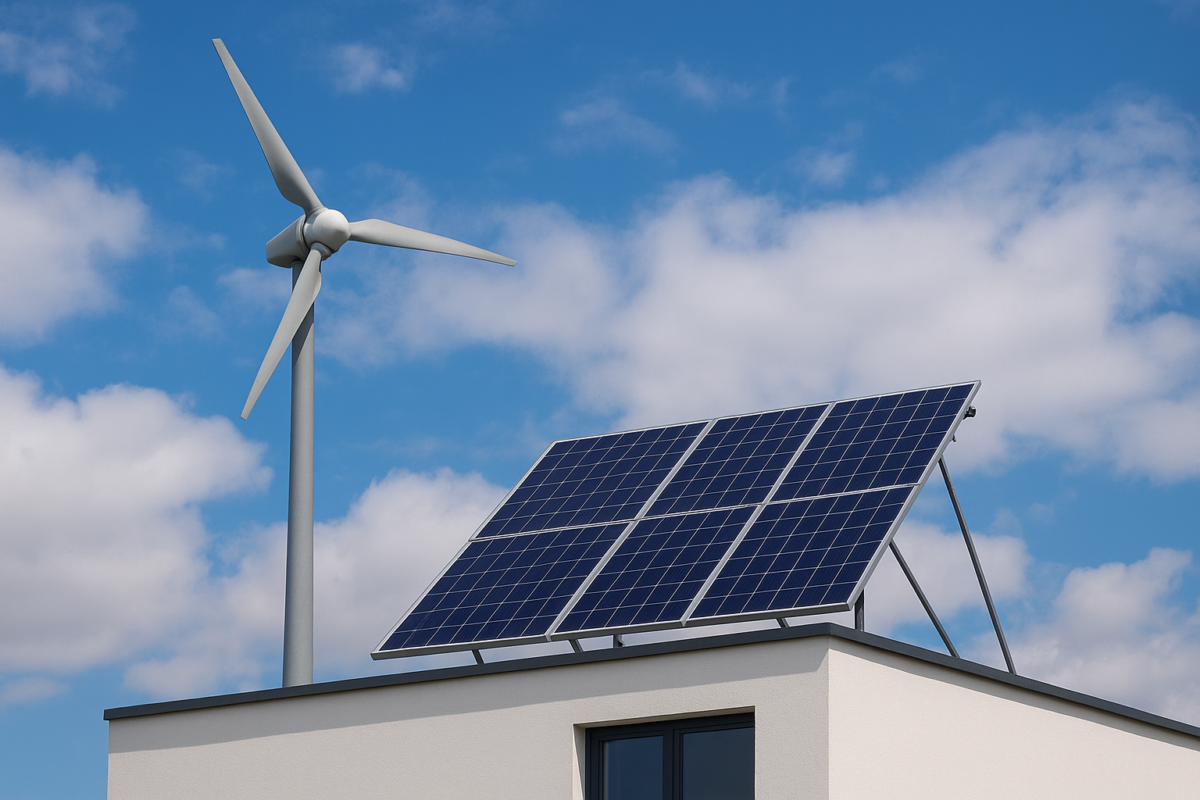
Scientists in China have developed an optimized energy management strategy for a hybrid wind-PV heat pump system that uses both thermal and electrical energy storage. Using different seasonal interaction management strategies, they simulated four operational cases.
A research team in China has developed an optimized energy management strategy for hybrid wind-PV heat pump (HP) systems.
Their approach combines thermal and electrical energy storage with a seasonal energy interaction framework that includes spring pre-cooling, summer pre-cooling, autumn pre-heating and winter heating.
“The novelty of the methodology developed in this work is threefold,” the researchers said. “First, we propose a new energy interaction management strategy. Second, we introduce new indicators to evaluate the power-to-load interaction capacity and the characteristics of a disconnected power grid. Third, we perform two-stage optimizations to determine the optimal system configuration and weekly dynamic interaction control status of power-to-load for both PV-HP and wind/PV-HP systems, taking into account technology, economics and environment.”
The team based its analysis on an energy efficient residential building (LERB) in Shenyang, northeastern China. The two-story, 334.8 m² building was modeled with TRNSYS and SketchUp. Of the approximately 160 m² roof surface, 130 m² was suitable for PV installation. Hourly solar radiation ranged from 0 to 0.3 kWh/m², while ambient temperatures varied between –26.54 C and 32.18 C throughout the year.
The hybrid wind/PV-HP system was also modeled in TRNSYS. It includes 550 W PV modules, 3 kW wind turbines, a ground source heat pump (GSHP), ground source heat exchangers (GSEs), an air source heat pump (ASHP), 40 kWh of batteries and a water tank with phase change materials (PCM). Renewable electricity powers the heat pumps, with excess energy stored in batteries or exported to the electricity grid. The GSHP serves as the primary supply unit, while the ASHP provides secondary heating or cooling.
The researchers evaluated four scenarios: a basic system without advanced interaction strategies (Case 1); Case 1 plus the interaction strategy and ASHP (Case 2); Case 2 plus two-stage optimization and PV (Case 3); Case 3 plus wind generation (Case 4).
In the first optimization phase, the NSGA-II system size algorithm was used; the second applied particle swarm optimization to manage the battery’s weekly charge status.
Seasonal interaction strategies are designed to maximize the use of renewable energy. In spring and autumn, pre-cooling and pre-heating from the ground help regulate the soil temperature. In summer, renewable electricity provides cooling and thermal storage. In winter, day-ahead load forecasting and battery management ensure that heating is maintained while reducing dependence on the electricity grid.
The scientists found that applying the interaction strategy improved the system’s power-load interaction and enabled energy-neutral performance. The power load factor reached 1.45 and 1.34, while the system independence factor decreased by 75.15% and 69.82% in the PV-HP and wind/PV-HP cases, respectively. Leveled energy costs decreased by at least 54.70% and system performance increased by at least 4%. Soil temperatures dropped by just 0.42°C over ten years, mitigating long-term soil imbalances.
The optimal configuration for the wind/PV HP system includes 13.12 kW PV, two wind turbines, 25.46 kWh batteries, a 6.17 kW GSHP and a 2.76 m3 water tank. The PV power in the PV-HP case is 18.14% higher than in the hybrid wind/PV-HP case.
“The second-stage optimization determines the weekly dynamic interaction control status of power-to-load based on the optimized system configuration,” the researchers pointed out. Compared with the first stage, the second stage optimization reduced the SIF by 15.00% and 16.00%, reduced the LCOE by 4.70% and 4.62%, increased the self-consumption ratio by 5.88% and 4.76%, and increased the carbon emissions by 4.70% and 4.62% in the PV-HP and wind/PV-HP cases, respectively.
The system was presented in “An optimized energy management strategy for dual-storage hybrid wind-PV heat pump systems: improving power-load interaction”, published in Energy. Scientists from China’s Shenyang Jianzhu University and Shanghai Jiao Tong University conducted the research.
This content is copyrighted and may not be reused. If you would like to collaborate with us and reuse some of our content, please contact: editors@pv-magazine.com.
