

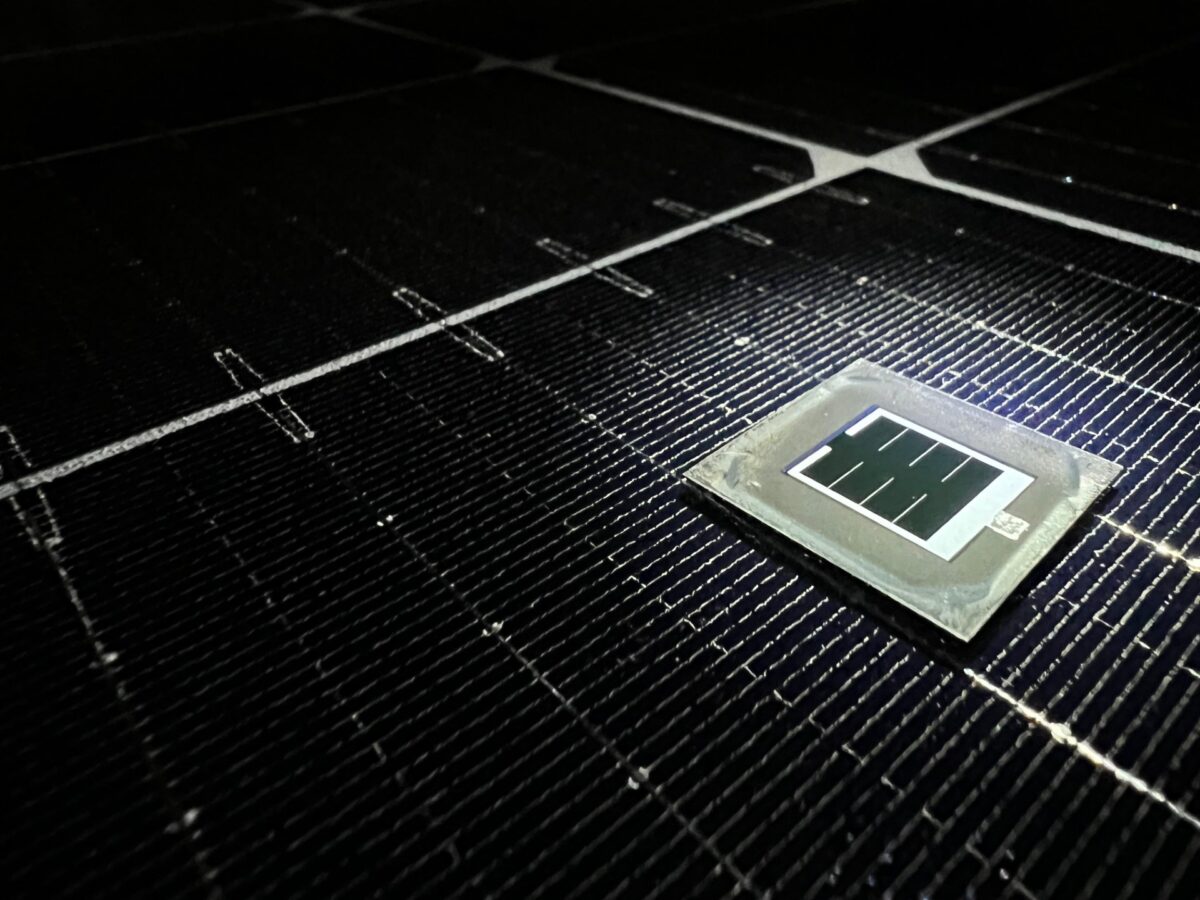
A perovskite-silicon tandem solar cell
Image: KAUST
South Korea’s Minister of Economy and Finance Koo Yun-cheol this week announced a KRW33.6 billion plan to help the domestic PV industry develop commercial perovskite-silicon tandem solar products by 2030.
The plan is part of a broader plan aimed at the development of new construction high-voltage direct current (HVDC) technologies, as well as small nuclear reactors (SMRs), among others.
“The commercialization of the next generation of solar modules will focus on restructuring the solar cell industry ecosystem by securing core technologies for ultra-high-efficiency tandem solar cells,” the minister said in a statement. “Establishing national and international standards and certification systems will also be implemented to create an initial market. Through these efforts, the goal is to achieve world-first commercialization and industry-leading efficiency levels of 35% for tandem cells and 28% for modules within the next five years.”
The government said the funding will initially be spent on unspecified research and development activities, without providing further details.
South Korea-based solar panel manufacturer Hanwha Q Cells has a Investment of KRW 1.5 trillion in 2021 to expand solar panel production capacity and increase research and development in perovskite-silicon tandem technologies.
In November 2022, Qcells and a group of European research institutes led by HZB started a project with the aim of producing highly efficient tandem solar cells and modules. In December 2023, Qcells announced a major breakthrough in perovskite-silicon tandem solar technology, with a solar cell achieving an efficiency of 28.6%, indicating that the technology is ready for mass production.
In September, South Korea-based Flexell Space, a spinoff of Hanwha Systems, a defense and space solutions unit of South Korea’s Hanwha Group, announced it will develop perovskite-copper-indium-gallium selenide (CIGS) tandem solar technology for satellites and other space applications.
This content is copyrighted and may not be reused. If you would like to collaborate with us and reuse some of our content, please contact: editors@pv-magazine.com.
Popular content

