

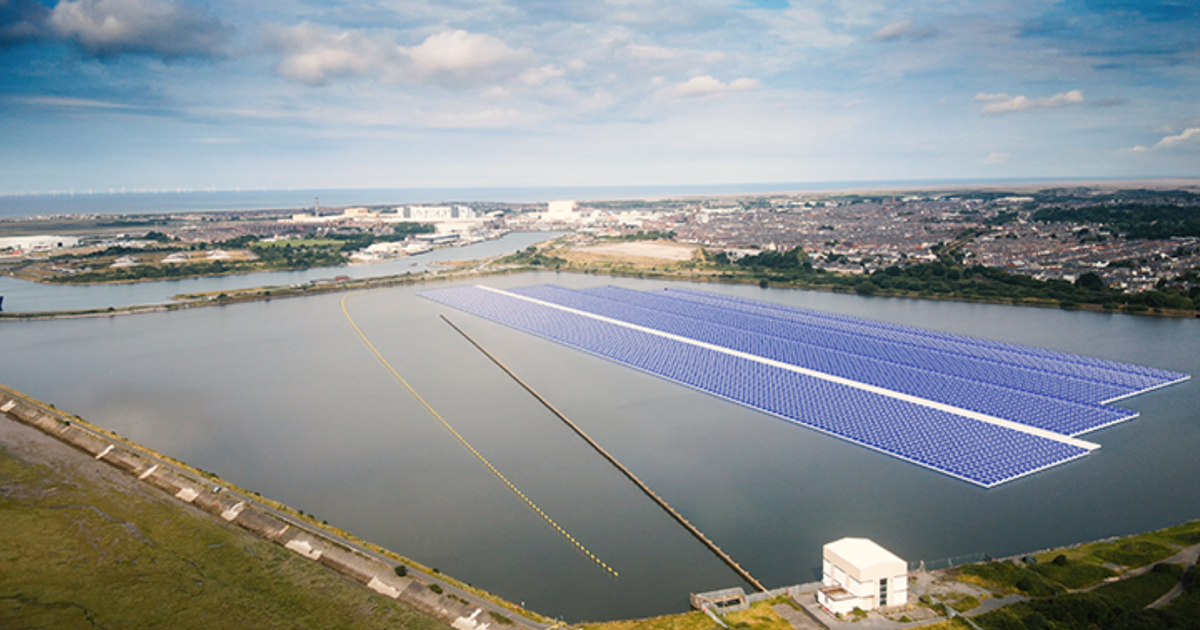
Westmorland & Furness Council’s Strategic Planning Committee has approved plans to develop what will be Britain’s largest floating solar PV (FPV) project at the Port of Barrow in Cumbria.
Port operator Associated British Ports (ABP) will build a 40 MW FPV project at the port’s Cavendish Dock, called the Barrow EnergyDock project. The modules will be mounted on a fixed tilt arrangement and will cover approximately one third of the dock’s water surface. ABP noted that the addition of the FPV project would not hinder “current leisure activities” at the wharf, and would “create potential for future leisure uses in the future”.
“We are delighted to receive approval for this ground-breaking project, which represents an important step towards cleaner, more resilient energy for the region,” said Kirsten Abbott, senior project manager (energy generation and storage) at ABP. “Barrow EnergyDock demonstrates our commitment to delivering innovative solutions that support the industry and reduce carbon emissions.”
In March, ABP submitted a construction permit for the Barrow EnergyDock project for the first timeand the successful deployment of the project would be a significant milestone for the UK FPV sector. Currently the largest FPV project in the country is a 6.3 MW project on the Queen Elizabeth II Reservoir near London, but research from Bangor University and Lancaster University shows that Britain has the potential for up to 2.7 TWh of annual generation from FPV projects.
The news follows ABP’s launch of the Global Floating Offshore Wind Ports Alliance with French and Irish companies BrestPort and Shannon Foynes Port, as part of plans to decarbonise the European ports sector.
At this year’s Clean Power 2030 Summits, Tom Hutchison, CEO of the Montrose Port Authority in Scotland, told our colleagues from PV Tech Premium That “Becoming a bit more autonomous” was one of the priorities for the portas the location of renewable energy generation projects in UK ports could provide a reliable energy source for the facilities that is independent of the national grid.
