

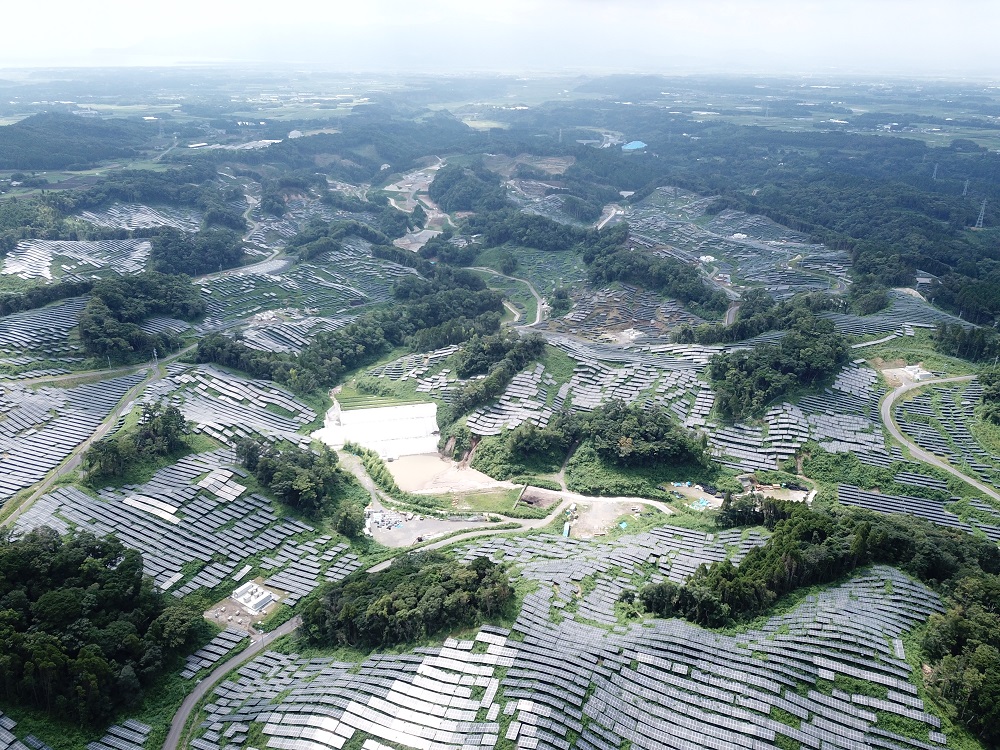
Chinese researchers have proposed a new methodology for designing utility-scale solar projects in mountainous regions. They simulated a 386.4 MW solar farm near Pu’er, a city in southern China, 1037 meters above sea level.
Researchers from Chinese energy company Yunnan Longyuan New Energy have proposed a new methodology for designing utility-scale PV installations in hilly or mountainous areas.
In particular, they conducted a simulation study of a south-facing mountain PV farm in the southern Chinese city of Pu’er, Yunnan province. High-resolution digital elevation model (DEM) data was acquired via unmanned aerial vehicle (UAV) photogrammetry to establish a three-dimensional terrain model.
“A 3D terrain model was constructed using Rhino software, and quantitative PV analysis performed via the PVsyst platform quantifies key operational factors affecting system efficiency, including temperature loss, irradiance loss and shading loss,” the group explained. “These findings provide actionable decision support for the maintenance and optimization of PV arrays in complex terrain areas.”
Meteorological data, including mean annual temperature, precipitation and solar radiation for Pu’er, were obtained from Meteonorm software. The hill had an average height of 1,037 meters above sea level and the simulated solar farm on it was divided into two parts: Region A has a convex terrain of 1,175 m2, with an average slope of 20.378°, and 456 installed PV panels. Region B had a concave terrain with an area of 561 m2 and an average slope of 17,703°. The number of PV panels in this section was 216.
Each panel was an n-type monocrystalline panel with a power of 575 W and an efficiency of 22.3%. The external dimensions of this part are 2,278 mm x 1,134 mm x 30 mm, and the effective light-receiving area is approximately 2.58 m². Four inverters are installed, each connected to twelve PV strings, and each PV string consists of 14 PV panels, forming a complete array design for the entire system. The maximum conversion efficiency of the inverters was 99%.
“The open and well-ventilated terrain in the convex mountain region A shows superior thermal performance, with an annual energy loss of 38.1 kWh per module, compared to 39.5 kWh in the concave mountain region B,” the academics explained. “The overall efficiency of the photovoltaic array in region A is higher than that in region B; the loss caused by the temperature rise of a single photovoltaic panel was reduced by 3.5%.”
The convex region A was found to achieve 65.5% lower shade coverage and 66.9% lower electrical losses compared to the concave region B. Furthermore, the results show that the performance gap is most pronounced in January, with region A producing 66.4 kWh per panel compared to the 64.3 kWh of region B. During the winter solstice, region A maintains minimum losses of 0.1% for both direct radiation and electricity, while region B experiences significantly higher losses of 1.0% and 6.9% respectively.
“System-level evaluation confirms that the open terrain configuration in region A not only improves individual panel performance but also optimizes overall system efficiency,” the researchers emphasized. “The electrical loss associated with shading in region A (-0.4%, 3.57 kWh per panel) is dramatically lower than in region B (-2.9%, 26.3 kWh per panel), demonstrating the importance of considering mountainous terrain when designing photovoltaic arrays.”
According to the group’s economic analysis, the total initial investment in the system is CNY 918,140 ($129,977), with annual operating costs of CNY 15,000. It has a payback period of 6.8 years and produces a net profit of CNY 2,567,853.92 over its 20-year life. In addition, the system generates 10.39 million kWh of electricity, allowing a reduction of CO2 emissions by 10.58 million kg compared to conventional coal-fired power stations.
The scientists presented their findings in “Simulation study of a 386.4 MW mountain photovoltaic power plant: a case study”, published in Scientific reports. Scientists from China’s Yunnan Longyuan New Energy and Yunnan Agricultural University participated in the research.
This content is copyrighted and may not be reused. If you would like to collaborate with us and reuse some of our content, please contact: editors@pv-magazine.com.
