

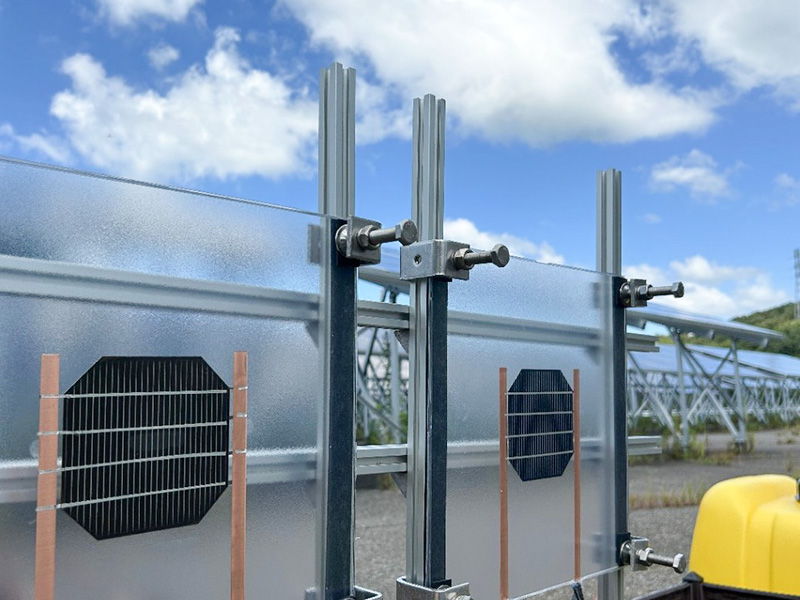
Kanazawa University, in collaboration with Toshiba, has begun long-term outdoor testing of tandem perovskite solar cells. The research project is in line with Japan’s broader push to widely deploy perovskite PV technologies by 2040.
Japan’s Kanazawa University has begun testing perovskite solar cell technologies at a new test field area within the Kakuma Campus North Area solar farm, which has been in operation since April 2024.
The tests are carried out by the university’s researchers in collaboration with experts from the Japanese conglomerate Toshiba, semiconductor manufacturer Choshu Industry and the University of Electro-Communications.
The project will run through December 2026 and involves the installation of tandem perovskite solar cells equipped with lead stabilization technology on modules for outdoor evaluation.
Scientists from Kanazawa University recently conducted a comprehensive study of all types of back-contact (BC) solar cells in an effort to accelerate their commercial development. The researchers categorized the devices based on their designs, charge transport mechanisms, manufacturing approaches and emerging challenges, creating two main groups: interdigitated back-contact (IBC) cells and quasi-interdigitated back-contact (QIBC) devices.
In 2023, Toshiba achieved a power conversion of 16.6% for a 703 cm2 Polymer film-based perovskite solar module. “We have supplied large film-based perovskite PV modules as experimental materials for demonstrations,” a company spokesperson said. pv magazine at the time, referring to a project conducted at Yokohama’s Aobadai station that included analyzing indoor performance.
The Japanese Ministry of Economy, Trade and Industry (METI) said in November that it plans to deploy about 20 GW of new PV systems based on perovskite solar cell technology by 2040.
In October, Japan’s New Energy and Industrial Technology Development Organization (NEDO) launched a six-year R&D program to advance large-scale production technologies and field testing of next-generation tandem perovskite solar cells.
A month earlier, NEDO outlined 24 research themes for a program for the period 2025-2029 to promote the next generation of solar cells, system integration, network stability and recycling. Earlier this year, the energy R&D agency also published a solar strategy to promote next-generation PV cells, site-specific systems, module recycling and long-term operational stability, in support of Japan’s 2050 carbon neutrality goal.
This content is copyrighted and may not be reused. If you would like to collaborate with us and reuse some of our content, please contact: editors@pv-magazine.com.
