

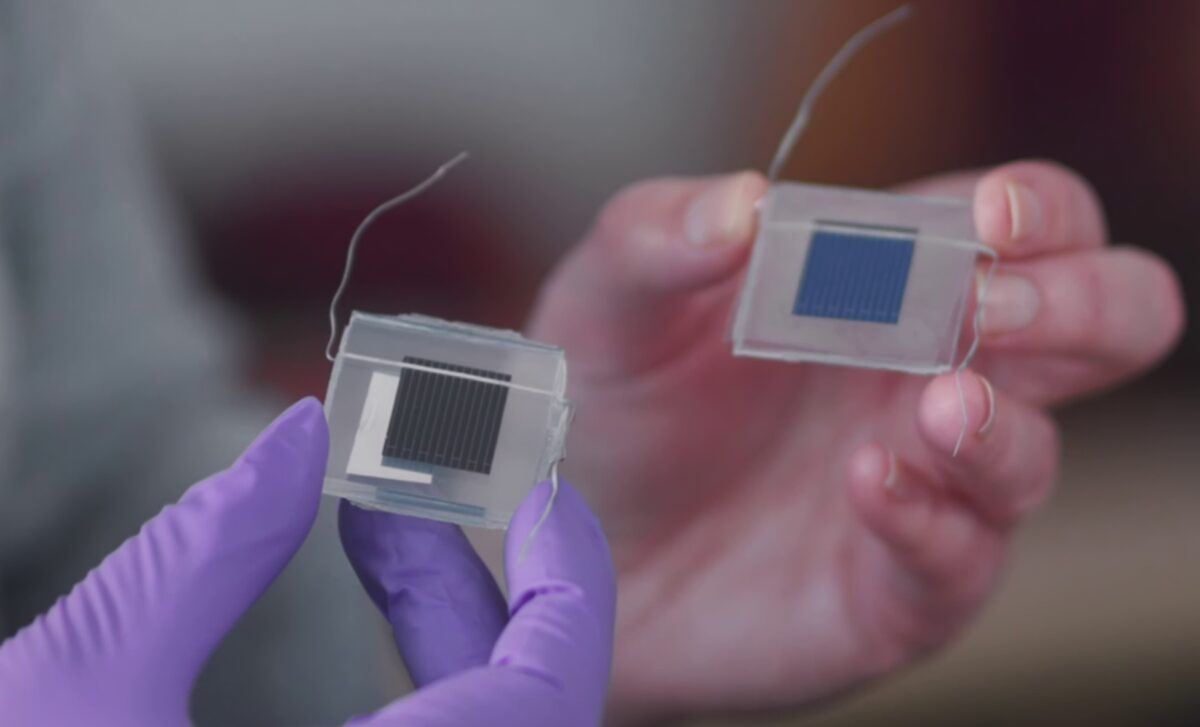
Cambridge Photon Technology is trying to commercialize a photon multiplication technology that splits high-energy photons to increase usable light for silicon cells. The UK-based startup holds three patents related to its technology and has secured pre-Series A funding.
A British startup is trying to commercialize technology it claims can increase solar panel production by up to 15% without disrupting existing manufacturing processes.
Cambridge Photon Technology features a patented photon multiplication material, which the company describes as a drop-in solution that can be easily integrated with existing large-scale module manufacturing processes. CEO Claudio Marinelli said pv magazine The company has already identified multiple outsource manufacturers that can produce its solution at scale.
The photon multiplier works by increasing the number of usable photons at a wavelength usable by silicon PV cells: the wavelengths that the cells can absorb and convert into electrical energy. This is done by splitting high-energy photons – ultraviolet, blue or green photons in the solar spectrum – into two half-energy infrared photons, while allowing other photons to travel through the material unaffected.
The startup uses the quantum mechanical principle known as singlet fission, which allows certain organic molecules to absorb photons, convert them into electrical energy and split that energy into half-energy packets.
“That’s the key,” Marinelli said. “We ensure that those half energy packets are absorbed by a nanomaterial and re-emitted as photons.”
Cambridge Photon Technology uses an organic molecule similar to the dyes used in the automotive industry to absorb the high-energy photons and split them into energy packets. The half-energy packets are then converted into half-energy photons by passing through a nanomaterial.
The startup has two patents related to a photon-multiplying material and one patent for luminescent harvesting of spin triplet excitons. The material is integrated in the production of modules in the encapsulation phase, as an additive in the encapsulation film. It’s a process that Marinelli believes would not require any changes to existing PV production lines.
“The whole point is you won’t change anything,” he said. “When you receive your encapsulation film, instead of the current three additives, you will have four. You can continue with your work as usual, same temperature, same conditions for bonding the top glass.”
Cambridge Photon Technology’s business case is based on providing relative efficiency gains without significantly changing manufacturing processes, according to Marinelli, who said the startup’s photon multiplication technology can increase the efficiency of a solar panel by up to 15%, meaning a panel with an efficiency of 25% would increase to 28.75%.
“We supply and must fit into an industry that produces billions of square meters of panels every year,” says Marinelli. “We found that even our first-generation product – with a relative power boost of just 4% – unlocks a value to the industry that is three times as expensive as our materials.”
The idea has received financial support. Cambridge Photon Technology is a spinout from the University of Cambridge and the startup recently secured GBP 1.56 million ($2.1 million) in funding in a pre-Series A funding round in November 2025. Marinelli said pv magazine the next step is to prove the technology’s performance to the wider industry.
“We want the performance not only to be achieved and measured by ourselves and our laboratories, but also to be validated by the industry. Over the next two years we will demonstrate that we can achieve the performance of the first generation product, integrate our solution into PV encapsulants and therefore present it as a drop-in solution to the module manufacturer,” he said. “It is a journey between now and the end of 2027, during which we will prove the performance and integration of our solution into established industrial processes.”
Cambridge Photon Technology also plans to further investigate the impact of its technology on module temperature and UV degradation. Marinelli said the product economic modeling the startup has done with the industry so far has only looked at efficiency gains. However, splitting high-energy photons to produce more useful photons results in a reduction in unabsorbed energy hitting the module – and therefore less heat, which should mean that more of a PV module’s intrinsic efficiency is retained over time.
“We also act as an ultraviolet photoprotective agent,” says Marinelli. “For example, this also contributes to reducing damage to the encapsulant. Those are two additional value drivers that we have not yet built into our product economics model, but we are doing so now.”
This content is copyrighted and may not be reused. If you would like to collaborate with us and reuse some of our content, please contact: editors@pv-magazine.com.
