

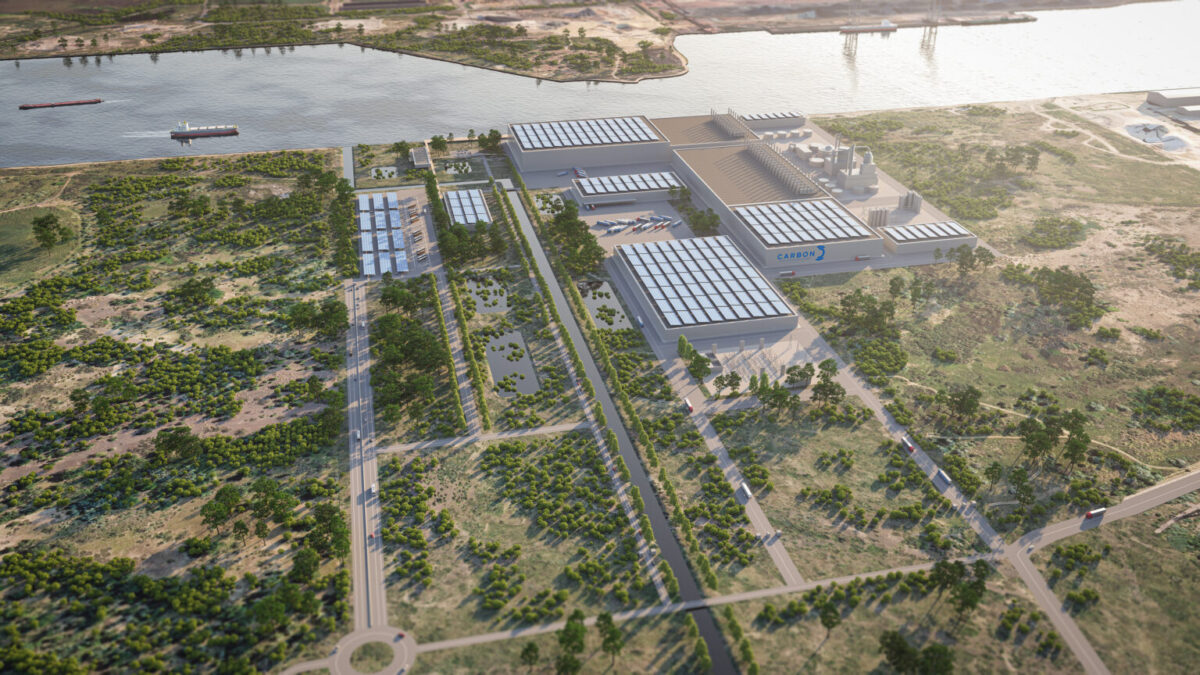
France-based startup Carbon plans to partner with Chinese manufacturer Longi and adopt back-contact (BC) solar technology as it reviews its roadmap for a gigawatt-scale solar panel factory.
Carbon is reviewing plans for its proposed solar panel gigafactory in France, moving from an independent n-type tunnel oxide passivated contact (TOPCon) strategy to partnering with Chinese manufacturer Longi and adopting BC technology, the company said. pv magazine France.
“It is unthinkable to launch a gigafactory in just a few years without relying on players who have already designed and operated these types of industrial facilities,” said Nicolas Chandellier, CEO of Carbon. “Without that support, no project can realistically achieve competitive costs and high levels of quality in less than four years.”
Longi Green Energy Technology will help develop Carbon One, a pilot plant for the assembly of PV modules to test industrial processes, supply chains and start-up scenarios for the planned gigafactory. The pilot will take place on a 16,000 m² site in Miramas in the southern French department of Bouches-du-Rhône, after Carbon failed to acquire an old Photowatt facility in Bourgoin-Jallieu. Carbon said it expects the site to create more than 300 direct jobs.
The pilot facility will have an annual assembly capacity of 700 MW, an increase from the originally planned 500 MW, and will produce modules based on Longi’s BC cell technology.
“The goal is to enter the market with the photovoltaic cell of tomorrow and secure a competitive advantage,” said Chandellier. He added that back-contact designs are expected to be the next big technology wave in the industry.
At the EnerGaïa Forum trade fair, nine developers and independent energy producers – Apex Energies, Arkolia, EDL, See You Sun, Smart Energies, Solstyce, Technique Solaire, Tenergie and Terre et Lac – signed commercial agreements for a total of 180 MW for 2027 and 314 MW for 2028.
“Our module supply for projects awarded under simplified tenders in the range from 100 kW to 500 kW will come wholly or partly from Carbon modules assembled in France, provided that European assembly becomes an eligibility criterion for these tenders from 2026,” the signatories said in a joint statement. “The ball is in the government’s court.”
Chandellier said regulatory clarity is critical to the viability of the project.
“Until the ‘Made in Europe’ preference is clearly enshrined in market access and public financing rules, no industrial photovoltaic project can be fully viable in Europe.” He added that explicit recognition of European assembly would allow higher production costs to be reflected in the project economics without distorting competition.
Industry participants are monitoring the upcoming Industrial Acceleration Act, expected in late January 2026, which could strengthen ‘Made in EU’ requirements for emerging industries, including solar energy production. Last week, Trinasolar signed a partnership agreement with Holosolis, which also plans a gigawatt-scale module factory in France.
This content is copyrighted and may not be reused. If you would like to collaborate with us and reuse some of our content, please contact: editors@pv-magazine.com.
