

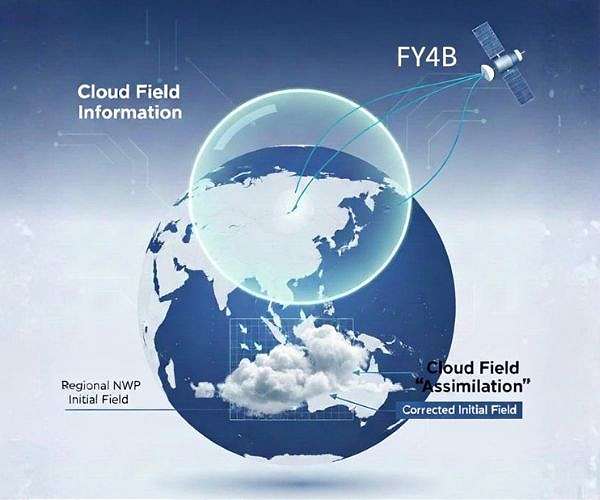
The intermittent production of solar energy poses challenges for grid operators who have to balance supply and demand. Traditional numerical weather prediction models often handle cloud initialization poorly, causing ultra-short-term solar irradiance predictions to deteriorate over time.
Researchers Min Chen and Liangchen Guo from the Institute of Urban Meteorology of the China Meteorological Administration have built a 0-6 hour ultra-short-term global horizontal radiation forecast system for China by combining data from the Fengyun-4B satellite with the regional numerical forecast model RMAPS-ST. Their work appears in Atmospheric and Oceanic Science Letters in an article titled “Ultra-short-term global horizontal irradiance forecasts in China based on satellite and numerical weather prediction models.”
The group tested two methods to initialize clouds in the model. In a passive mode, the system only takes into account advection and diffusion of hydrometeors, while in an active mode it gives a boost to hydrometeors during the first forecast hour.
Both strategies reduced forecast errors by more than 7 percent in the first 15 minutes of forecasting, with the passive mode providing the best performance within the first 4 hours. Error reductions average about 9.41 percent in summer, with some regions, such as Sichuan, seeing improvements of more than 20 percent.
Corresponding author Min Chen noted, “By correcting the initial cloud fields with real-time satellite data, we have essentially given the forecast system a ‘live cloud map’. This is not only a technical breakthrough, but also provides a practical tool for grid planning and China’s dual-carbon strategy.”
The current system performs best in warm seasons and short lead times, while prediction errors increase as the range increases. Future developments will add time-varying aerosol data and artificial intelligence methods to improve the representation of cloud-radiation interactions, with the aim of supporting independent and highly accurate solar energy forecasts across China.
Research report:Ultra-short-term global horizontal radiation forecasts in China based on satellite and numerical weather prediction models
