
Close Menu
  • News
  • Industry
  • Solar Panels
  • Commercial
  • Residential
  • Finance
  • Technology
  • Carbon Credit
  • More
    • Policy
    • Energy Storage
    • Utility
    • Cummunity
What's Hot

Tesla launches three-phase Powerwall 3P – SPE

April 23, 2026

Why the UK solar industry needs to own its safety story

April 23, 2026

Fraunhofer ISE develops colored film technology for patterned solar panels

April 23, 2026
Facebook X (Twitter) Instagram
Solar Energy News
Thursday, April 23
  • News
  • Industry
  • Solar Panels
  • Commercial
  • Residential
  • Finance
  • Technology
  • Carbon Credit
  • More
    • Policy
    • Energy Storage
    • Utility
    • Cummunity
Solar Energy News
Home - News - 3D maps show how passivation stimulates perovskite solar cells
News

3D maps show how passivation stimulates perovskite solar cells

solarenergyBy solarenergyJanuary 3, 2026No Comments3 Mins Read
Facebook Twitter Pinterest LinkedIn Tumblr Email
Share
Facebook Twitter LinkedIn Pinterest Email


Perovskite solar cells are gaining attention as cheaper, high-efficiency alternatives to silicon solar cells, but defects in their thin films hinder charge transport, waste energy and reduce device stability.

One approach to reducing these defects is a passivation treatment, in which simple salts or organic molecules are introduced into the perovskite film so that small molecules or ions bind to defect sites and limit their impact on electrical conduction. However, most existing characterization techniques only examine the film surface or provide average macroscopic measurements, making it difficult to confirm how well different passivation strategies work within the film volume.

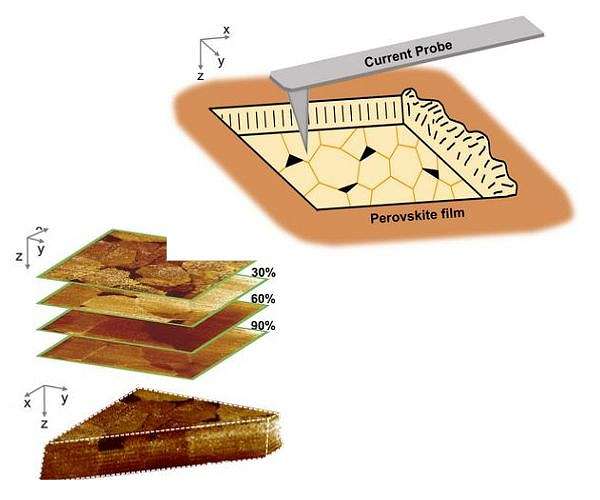
Researchers from the Ningbo Institute of Materials Technology and Engineering (NIMTE) of the Chinese Academy of Sciences have now developed a three-dimensional electrical imaging method that directly visualizes how defect passivation works within perovskite layers. The study, published December 31 in the journal Newton, reports that this method can map charge transport throughout the film and link these microscopic features to solar cell performance.

The technique is based on tomographic conductive atomic force microscopy, or TC-AFM, which measures local electrical conductivity as the instrument successively removes ultrathin layers of the perovskite film. By stacking the conductivity data acquired at each depth, the team reconstructs a three-dimensional map of the current distribution and charge transport pathways with nanoscale spatial resolution.

Using TC-AFM, the researchers compared perovskite films processed with different passivation strategies and directly observed changes in their internal electrical behavior. Films without passivation showed widespread regions of low conductivity that hinder charge flow, while bulk passivation reduced these resistive domains in the film, especially along grain boundaries.

See also  Reuse unused satellite dishes in solar systems - PV Magazine International

Surface passivation produced a different profile, especially improving the conductivity near the upper interface of the film, which is important for integration into complete device architectures. When both bulk and surface passivation were applied together, the films exhibited the most uniform and continuous conductive networks, with the remaining low conductivity zones largely confined to the surface.

“These microscopic electrical characteristics are closely correlated with the resulting solar cell performance, establishing a direct link between 3D charge transport within the film and the overall efficiency of the device,” said Prof. XIAO Chuanxiao, a corresponding author of the study.

By providing a direct three-dimensional view of charge carrier migration in perovskite layers, the new method provides a tool for assessing and refining passivation strategies. The authors report that this approach can guide the rational design of higher quality perovskite materials and support the development of more efficient and stable perovskite solar cells, as well as other thin-film electronic and optoelectronic devices.

Research report:Three-dimensional mapping of electrical behavior in perovskite films using tomographic conductive atomic force microscopy


Source link

cells maps passivation perovskite show solar stimulates
Share. Facebook Twitter Pinterest LinkedIn Tumblr Email
solarenergy
  • Website

Related Posts

Why the UK solar industry needs to own its safety story

April 23, 2026

Fraunhofer ISE develops colored film technology for patterned solar panels

April 23, 2026

The federal court has halted Trump administration orders that hinder solar and wind energy development

April 23, 2026
Leave A Reply Cancel Reply

Don't Miss
Energy Storage

Why BESS insurers are sweating transformers and contractor errors due to battery fires – SPE

By solarenergyMarch 20, 20260

The risk profile of BESS insurance is shifting. In an exclusive interview, Tokio Marine GX…

Gresham House Floor agreements replaced Octopus Tol, Switching Augments on

July 27, 2025

The scoop for solar policy: August 2024

August 5, 2024

Oregon approves largest solar and storage project in the US

December 6, 2024
Stay In Touch
  • Facebook
  • Twitter
  • Pinterest
  • Instagram
  • YouTube
  • Vimeo
Our Picks

Tesla launches three-phase Powerwall 3P – SPE

April 23, 2026

Why the UK solar industry needs to own its safety story

April 23, 2026

Fraunhofer ISE develops colored film technology for patterned solar panels

April 23, 2026

Thermoacoustic heat pumps are on the verge of commercial breakthrough – SPE

April 23, 2026
Our Picks

Tesla launches three-phase Powerwall 3P – SPE

April 23, 2026

Why the UK solar industry needs to own its safety story

April 23, 2026

Fraunhofer ISE develops colored film technology for patterned solar panels

April 23, 2026
About
About

Stay updated with the latest in solar energy. Discover innovations, trends, policies, and market insights driving the future of sustainable power worldwide.

Subscribe to Updates

Get the latest creative news and updates about Solar industry directly in your inbox!

Facebook X (Twitter) Instagram Pinterest
  • Contact
  • Privacy Policy
  • Terms & Conditions
© 2026 Tsolarenergynews.co - All rights reserved.

Type above and press Enter to search. Press Esc to cancel.