

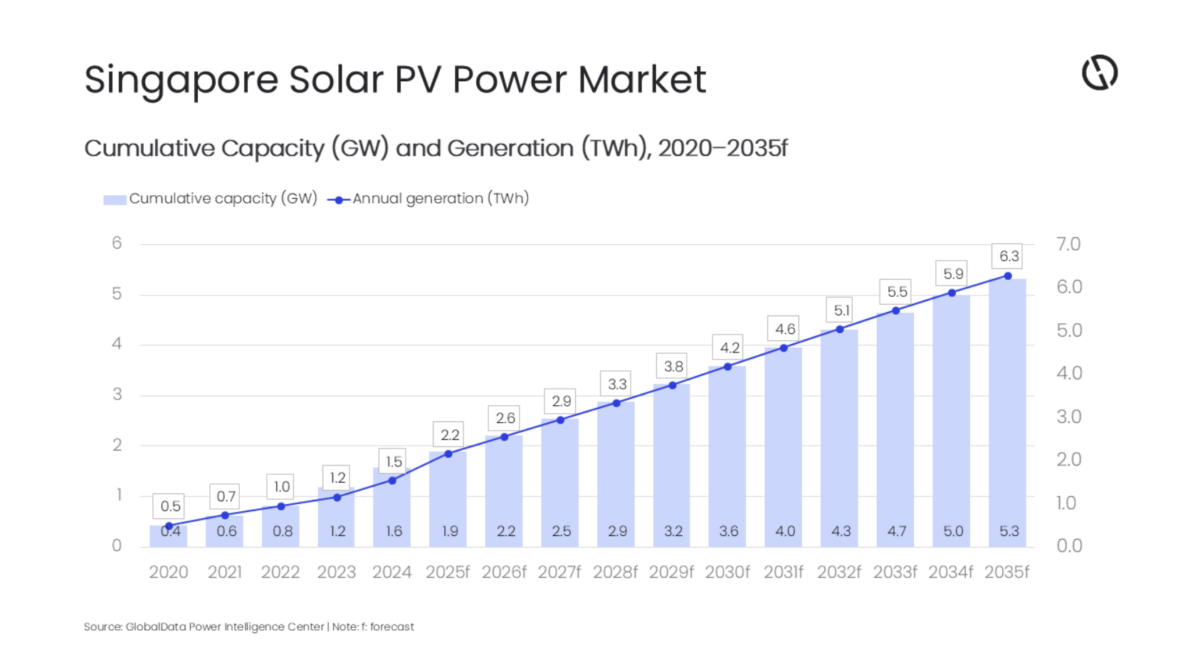
British consultants GlobalData say Singapore could add between 300MW and 400MW of solar power annually by 2035, taking its cumulative capacity to the 5GW threshold from about 1.9GW today.
Singapore According to analysis from GlobalData, the company is on track to deploy 5.3 GW of solar energy by the end of 2035.
The British consultancy expects Singapore to deploy around 300 MW of solar energy by 2025, increasing its cumulative capacity from 1.6 GW to around 1.9 GW by the end of 2024.
The analysts expect annual deployments of between 300 MW and 400 MW in 2026, 2027, 2028 and 2029, bringing Singapore’s solar capacity to 3.2 GW by the end of the decade. This is before the intended 2 GW under the Singapore Green Plan 2030.
A similar growth trajectory is expected until the early 2030s, which will see Singapore surpass 4 GW of solar in 2031 and 5 GW in 2034, before reaching 5.3 GW in 2035.
GlobalData’s analysis places Singapore’s solar capacity development at a compound annual growth rate of about 11.7% from 2024 to 2035. The analysts say growth is supported by sustainable deployments on rooftops, floating and utility-scale installations, as well as government programs that prioritize the integration of solar energy in urban and industrial environments.
Mohammed Ziauddin, energy analyst at GlobalData, said solar energy is the cornerstone of Singapore’s domestic sustainable growth.
He added that Singapore’s clean energy strategy reflects the limitations of a dense, import-dependent system. “Solar PV is scaled up within physical limits through targeted policy mechanisms and urban deployment models, while parallel investments in storage, gas modernization and regional connections support reliability and system balance,” Ziauddin explains.
The country’s electricity system is heavily dependent on natural gas, which currently accounts for approximately 95% of energy generation. GlobalData expects gas-based capacity to increase from approximately 10.38 GW in 2024 to approximately 14.82 GW in 2035.
Singapore is also working to promote conditional approvals for cross-border, low-carbon electricity imports. In October she conditionally agreed to one 1 GW hydropower import project from Malaysia.
Singapore and Indonesia in June plans revealed developing a solar panel industry in Indonesia’s Riau Islands as part of broader cross-border clean energy trade initiatives. Since then Singapore’s Equator Renewables Asia and China’s CRE International Co. Ltd have agreed to jointly develop a 900 MW solar and 1.2 GWh battery project in Indonesia, of which 400 MW (AC) is planned for export to Singapore.
This content is copyrighted and may not be reused. If you would like to collaborate with us and reuse some of our content, please contact: editors@pv-magazine.com.
