

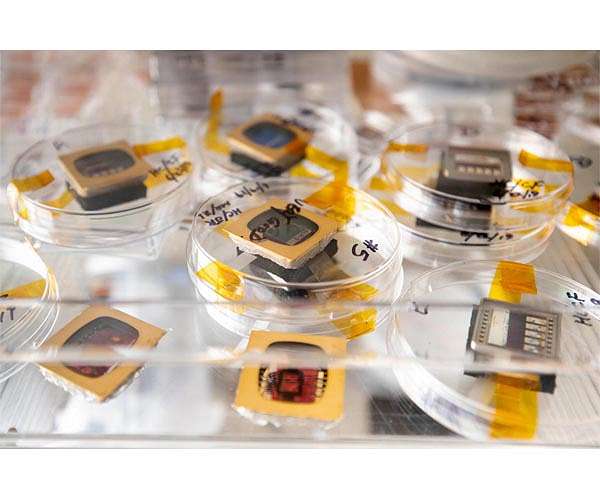
The performance of single-component organic solar cells is highly dependent on the spacing units built into their molecular design. The mounting position of spacers on a dual cable polymer backbone has received much less attention than other structural parameters, even though it can influence how the material is arranged and functions in a device.
To close this gap, researchers adopted a spacer isomerization engineering strategy and created two isomeric, double-cable conjugated polymers by changing where the spacer attaches to an indenone benzene ring. By shifting this bond position, they were able to precisely regulate molecular packing and film crystallinity, both of which play a central role in exciton dissociation efficiency, charge transport, and overall energy conversion efficiency in single-component organic solar cells.
The team reports that this structural alignment effectively optimizes molecular packing, leading to more ordered films and improved charge carrier pathways. Better packing and crystallinity help separate excitons more efficiently at internal interfaces, which in turn supports higher current and voltage outputs from the devices.
When used as the active layer in single-component organic solar cells, the isomeric polymers provide improved photovoltaic performance compared to structures that do not employ spacer isomerization. The same materials also show strong results when introduced as a third component in ternary organic solar cells, where they help refine the donor-acceptor interface and promote balanced charge generation and transport.
In both roles, whether as the sole active component or as an additive in ternary systems, the polymers exhibit excellent thermal stability. The device characteristics remain robust under high temperature conditions, indicating that the structural changes introduced by spacer isomerization do not compromise stability and can help support long-term operation.
The authors describe spacer isomerization technique as a simple and effective design strategy for the next generation of double-cable conjugated polymers. They suggest that careful control over the mounting position of the spacers can guide the development of high-performance and stable single-component organic solar cells, offering an alternative to more complex multi-component mixtures.
Research report:Spacer isomerization technique in double-lead conjugated polymers for optimized molecular packing and improved photovoltaic performance
