

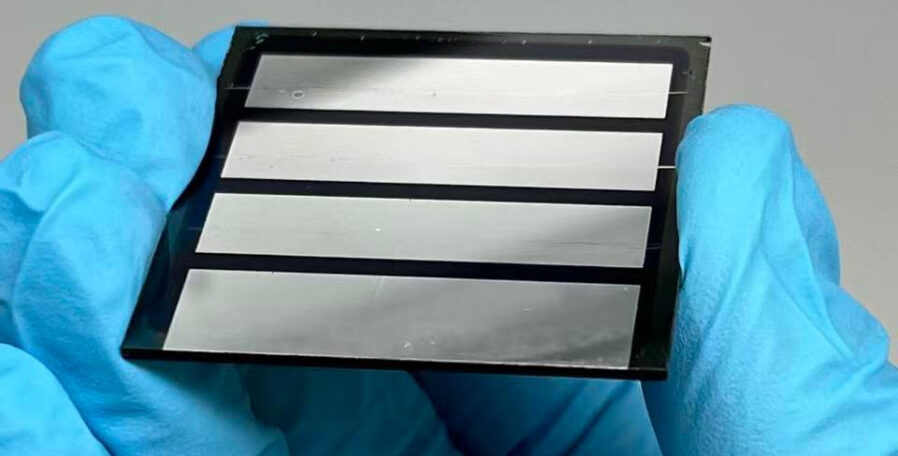
Researchers have used multivalent amidinium ligands to increase the efficiency of perovskite solar cells up to 25.4%, achieving a stability of more than 95% after 1100 hours at 85 C. The proposed approach enables controlled low-dimensional passivation layers, providing a practical route for durable, large-area perovskite devices.
An international group of researchers has used multivalent amidinium ligands as an alternative to conventional monovalent ammonium ligands for passivation of perovskite films. When used in a large-area inverted 2D/3D perovskite solar cell, the ligands helped achieve a cell power conversion efficiency of 25.4%, with the device maintaining more than 95% of initial efficiency after 1,100 hours of continuous use at 85 C under 1-sun testing.
The researchers focused on a controllable one-dimensional (1D) to two-dimensional (2D), 1D to 2D, structural transition strategy that could be applied to three-dimensional (3D) perovskite absorbers.
“The novelty of this work lies in the controllable transformation of low-dimensional (LD) passivation layers using amidinium ligand-induced 1D to 2D structures through precise modulation of intermolecular hydrogen bonds and π-π stacking,” said Randi Azmi, co-corresponding author of the study. pv magazine.
“In short, we have shown that choosing the right molecular ligand chemistry, or designing better ligands, taking into account their acidity and functional groups, to form more robust low-dimensional perovskite layers, is critical for overcoming the fundamental instability issues when using conventional organic ammonium ligands,” Azmi said. “This structural control changes the dimensionality of the LD phase while providing highly uniform and stable interfaces that deliver high performance even in large-area devices,” Azmi explains, noting that this is “a possibility not realized in previous amidinium-based studies.”
By gaining a more detailed understanding of the mechanism, the researchers can now investigate more advanced organic ligands, either commercially available ligands or newly synthesized organic ligands that have the desired structures, Azmi said.
The processing is reportedly straight forward. “We used a common solution process that anyone can follow to form low-dimensional structures in situ using large-area spin-coating or dip-coating methods, where the molecular ligand design is important to enable the formation of uniform and controllable passivation layers,” Azmi said.
The technology was demonstrated in a 1.1 cm2 inverted 2D/3D perovskite solar cell device with a certified efficiency of 25.4%. The device retained more than 95% of its initial efficiency after 1,100 hours of continuous use at 85 C under 1 sun test, which the researchers say meets industrial requirements. Furthermore, a 4cm x 4cm mini module achieved an efficiency of 24.2% according to the study.
Reviewing the results, the researchers said the work “established multivalency plus basicity-guided conformation of ligands as a general rule for building robust 3D/2D heterojunctions,” highlighting that it provides a “practical passivation route” for durable, high-efficiency, large-area perovskite optoelectronics.
“The amidinium ligands we have developed and the new knowledge gained enable the controlled growth of high-quality, stable perovskite layers. This could overcome one of the last major hurdles facing perovskite solar cell technology and ensure its longevity for large-scale deployment,” said co-corresponding author Thomas Anthopoulos in a statement.
The research is described in detail in “Multivalent ligands regulate dimensional engineering for inverted perovskite solar panels”, published in Science. The certification was provided by the National Institute of Metrology of China (NIM).
The study was led by researchers from the University of Manchester and the Chinese University of Hong Kong Shenzhen, along with King Abdullah University of Science and Technology (KAUST), Korea University, Shaanxi Normal University, National University of Singapore and National Technical University of Athens.
This content is copyrighted and may not be reused. If you would like to collaborate with us and reuse some of our content, please contact: editors@pv-magazine.com.
