
Close Menu
  • News
  • Industry
  • Solar Panels
  • Commercial
  • Residential
  • Finance
  • Technology
  • Carbon Credit
  • More
    • Policy
    • Energy Storage
    • Utility
    • Cummunity
What's Hot

A deep learning model tracks the status of the EV battery with high precision

March 6, 2026

Mitsubishi Electric Trane announces new heat pump line for hydronic heating – SPE

March 6, 2026

Origis is developing a 413 MW solar portfolio in West Texas

March 6, 2026
Facebook X (Twitter) Instagram
Solar Energy News
Friday, March 6
  • News
  • Industry
  • Solar Panels
  • Commercial
  • Residential
  • Finance
  • Technology
  • Carbon Credit
  • More
    • Policy
    • Energy Storage
    • Utility
    • Cummunity
Solar Energy News
Home - Solar Industry - Self-assembling molecule for organic solar cells
Solar Industry

Self-assembling molecule for organic solar cells

solarenergyBy solarenergyJanuary 23, 2026No Comments3 Mins Read
Facebook Twitter Pinterest LinkedIn Tumblr Email
Share
Facebook Twitter LinkedIn Pinterest Email

A research team from Osaka Metropolitan University has developed a donor-acceptor-donor molecule that can spontaneously self-assemble into nanoscale structures, providing a more stable route to built-in p/n heterojunctions in organic solar cells.

January 23, 2026
Patrick Jowett

Scientists from Osaka Metropolitan University have developed a molecular architecture that provides a new design strategy for the production of more efficient organic thin-film solar cells.

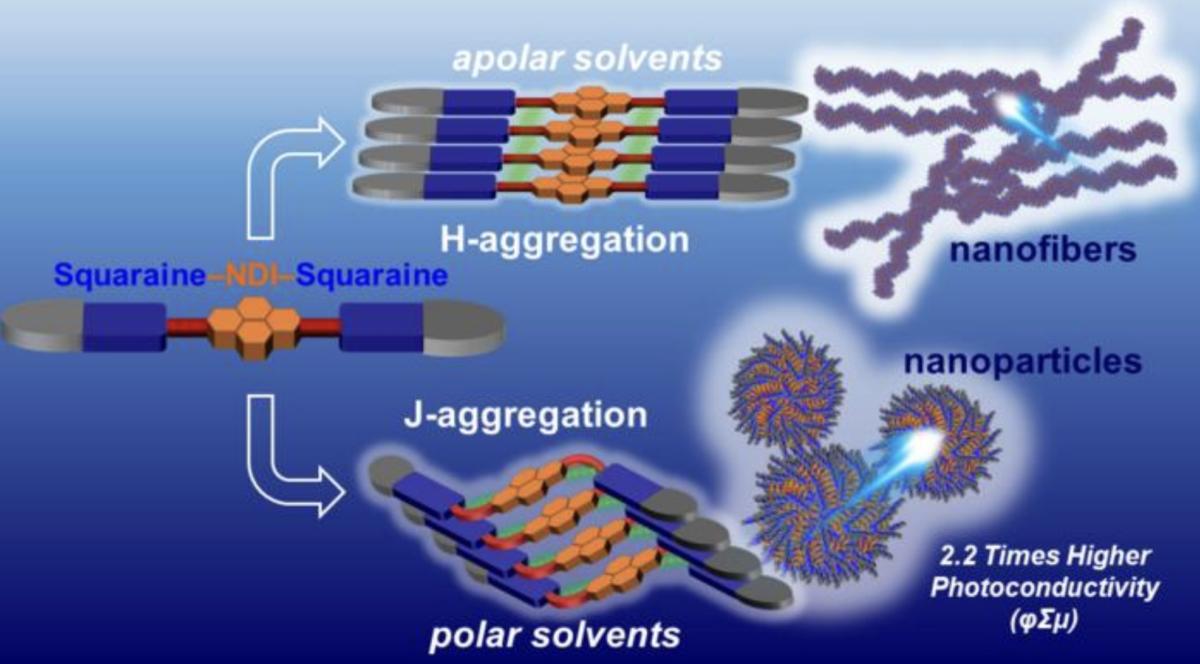
Their donor-acceptor-donor (DAD) molecule, known as TISQ, integrates a squaraine-based p-type segment and a naphthalene diimide n-type segment within a single molecule. It is able to naturally form p/n junctions, also known as the interface between p-type and n-type semiconductors.

The two segments are linked via amide groups that promote hydrogen bonding, meaning TISQ can spontaneously self-assemble into various nanoscale structures, which the scientists say could provide a more stable route to built-in p/n heterojunctions.

Takeshi Maeda, associate professor at the university’s Graduate School of Engineering and lead author of the study, explained that depending on the solvent, TISQ can spontaneously organize into nanoparticle-like J-type or nanofibrous H-type aggregates.

The university’s press release explains that polar solvents cause TISQ to form nanoparticle-like J-type aggregates via a cooperative nucleation-extension process, while low-polarity solvents cause it to assemble into fibrous H-type aggregates via an isodesmic mechanism. “Both exhibit different electronic behavior, especially in how efficiently they transport charges when light hits them,” Maeda said.

The team’s research fabricated organic thin-film solar cells incorporating TISQ as a single-component photoactive material in a test of the device’s applicability. The molecule was shown to form nanoscale p/n heterojunctions through self-assembly, which the scientists say highlights the feasibility of molecular designs that autonomously organize into functional electronic structures.

See also  Pennsylvania solar installer works through cancer diagnosis on the roof

Because the energy conversion efficiency of the fabricated cells remains low, the team recognized that further research is needed before putting it into practice. Nevertheless, they concluded that their findings demonstrate how differences in nanoscale self-assembled p/n heterojunction structures directly influence the photocurrent response in a single-component system.

“Our focus is on developing molecular design strategies that use self-assembly to connect nanoscale p/n heterojunction structures with photoelectronic responses in single-component organic systems,” said Maeda. “By deepening this understanding of structure and function, we aim to broaden the design space of organic thin-film solar cells and related optoelectronic materials.”

The new molecule is described in the research article “Solvent-controlled supramolecular polymerization and morphology-dependent photoconductivity modulation in a squaraine-naphthalene diimide-squaraine bulk p/n heterojunction”, available in the magazine Angewandte Chemie International Edition.

This content is copyrighted and may not be reused. If you would like to collaborate with us and reuse some of our content, please contact: editors@pv-magazine.com.

Popular content

Source link

cells molecule organic Selfassembling solar
Share. Facebook Twitter Pinterest LinkedIn Tumblr Email
solarenergy
  • Website

Related Posts

Origis is developing a 413 MW solar portfolio in West Texas

March 6, 2026

New Jersey expands state community solar program by 3 GW

March 6, 2026

How to address imbalance datasets in solar panel dust detection

March 5, 2026
Leave A Reply Cancel Reply

Don't Miss
News

DTE Energy problems RFP for 450 MW independent energy storage

By solarenergyMarch 17, 20250

DTE Energy has submitted a request for proposal (RFP) for new independent energy storage projects…

Chinese scientists build ‘ultra-stable’ polymer solar cell with an efficiency of 19.1%

February 27, 2026

Jordan’s subsidy scheme for solar panels and water heaters, supported by banks – SPE

November 29, 2024

West – African platform for climate financing is looking for local experts – PV Magazine International

March 16, 2025
Stay In Touch
  • Facebook
  • Twitter
  • Pinterest
  • Instagram
  • YouTube
  • Vimeo
Our Picks

A deep learning model tracks the status of the EV battery with high precision

March 6, 2026

Mitsubishi Electric Trane announces new heat pump line for hydronic heating – SPE

March 6, 2026

Origis is developing a 413 MW solar portfolio in West Texas

March 6, 2026

New Jersey expands state community solar program by 3 GW

March 6, 2026
Our Picks

A deep learning model tracks the status of the EV battery with high precision

March 6, 2026

Mitsubishi Electric Trane announces new heat pump line for hydronic heating – SPE

March 6, 2026

Origis is developing a 413 MW solar portfolio in West Texas

March 6, 2026
About
About

Stay updated with the latest in solar energy. Discover innovations, trends, policies, and market insights driving the future of sustainable power worldwide.

Subscribe to Updates

Get the latest creative news and updates about Solar industry directly in your inbox!

Facebook X (Twitter) Instagram Pinterest
  • Contact
  • Privacy Policy
  • Terms & Conditions
© 2026 Tsolarenergynews.co - All rights reserved.

Type above and press Enter to search. Press Esc to cancel.