Researchers at TU Delft have developed a liquid-based encapsulation of solar modules that is comparable to conventional EVA panels while offering improved recyclability and circularity. The approach is compatible with silicon and tandem perovskite/silicon cells and could support thermal management and integration into photovoltaic-thermal modules.
A research team from Delft University of Technology (TU Delft) has developed a new encapsulation technology for solar modules that uses a liquid and an edge sealant instead of ethylene vinyl acetate (EVA).
“Our liquid encapsulation technology can be applied to all solar cell technology, as the solar cell is compatible with the liquid. In this work we have used crystalline silicon (c-Si) solar cells and we plan to extend this to c-Si/perovskite tandem solar cells,” the study’s lead author, Urvashi Bothra, said pv magazine. “Currently, we have determined that the technology is robust for 4-cell mini-modules. At the same time, our collaborator Biosphere Solar has been working on scaling up the technology to full-size modules.”
For the experiments, the researchers used front and back glass plates measuring 50 cm x 50 cm, supplied by the Japanese glass manufacturer AGC Glass.
They tested various liquids, including a silicone oil from the American Dow; Hydrocarbon-E from Engineering Fluids of Florida; an ester oil from the British MIDEL & MIVOLT Fluids; Hydrocarbon-O from Texas-based DSI Ventures; SP glycol from the Dutch supplier InnogreenChem; glycol from Germany-based Labshop; glycerol from Labshop; and deionized water.
Polyisobutylene from the German supplier Kömmerling-HB Fuller was used as edge sealing. Commercially available ethylene vinyl acetate (EVA) served as the encapsulant for the reference modules.
The researchers also used 12.5 cm x 12.5 cm Maxeon Gen III interdigitated back-contact (IBC) solar cells supplied by SunPower Corporation, dogbone connectors from Chinese specialist Qinhuangdao Donwoo Electronic and rails from Ulbrich.
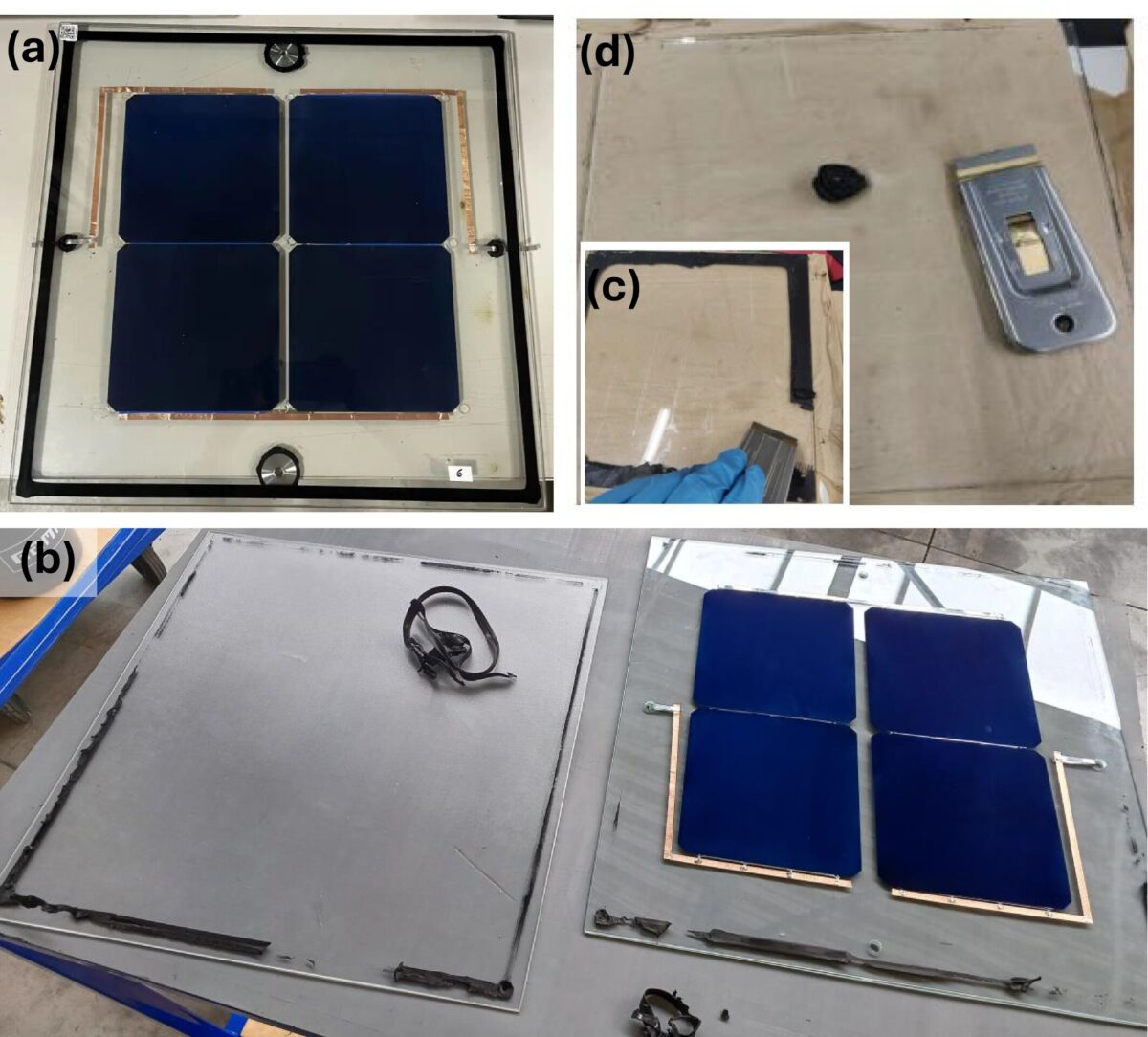
Image: TU Delft, Progress in Photovoltaics, CC BY 4.0
The researchers soldered the cells with dog-bone connectors and rails and applied a polyisobutylene (PIB) edge sealant around the bottom glass. The soldered cells were then placed between two glass plates and laminated in a PV laminator at 95 °C and 400 mbar to completely seal the module without damaging the cells.
Fluid was injected into the air-filled modules through the PIB seal using a syringe, while a second needle allowed the trapped air to escape. After injection, the needles were removed and the PIB seal was resealed with a heat gun.
Modules produced using this method, along with EVA-based panels, were tested under standard lighting and analyzed using electroluminescence (EL) imaging. The researchers also conducted accelerated aging tests, including moist heat, thermal cycling and humidity freezing, to assess the module’s reliability.
The analysis showed that liquid-filled PV modules performed comparably to EVA-based modules in terms of efficiency and stability under accelerated aging. They showed no performance loss and offered additional benefits in terms of recyclability and circular design.
The approach also proved suitable for improving perovskite/c-Si tandem PV stability, enabling thermal management, and integration into PV-T modules via a fluid heat exchange loop.
“For a single-cell module, we estimate that the cost of a liquid-encapsulated module is the same as an EVA-encapsulated module. So the modules cost similarly,” Bothra said, when asked about production costs.
The new encapsulation technology was presented in the paper “Liquid PV module encapsulation to enable circular design”, published in Progress in photovoltaics. “With this study, we aim to advance new technology for encapsulation and demonstrate that an efficient circular PV module can be achieved with ongoing research,” the scientists said.
This content is copyrighted and may not be reused. If you would like to collaborate with us and reuse some of our content, please contact: editors@pv-magazine.com.
Popular content