

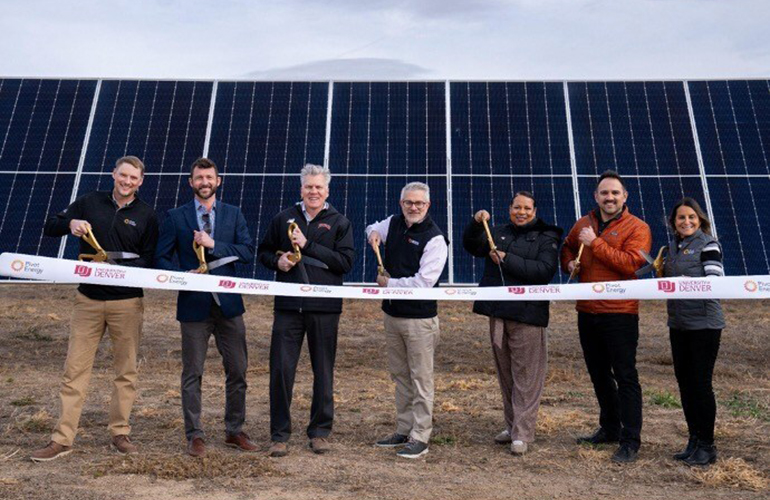
Turn energya national renewable energy provider headquartered in Denver, and the University of Denver (DU), have completed the state’s first off-site net-metered solar project.

From left to right: Matt Brenn, Director of Community Solar Subscriptions, Pivot Energy; James Pedric, account manager, Xcel Energy; Lynn Bailey, director of Energy, Sustainability and Utilities, DU; Mark DeLorenzo, senior vice chancellor for business and finance affairs, DU; Stephanie O’Malley, associate vice chancellor for public relations, DU; Mat Elmore, SVP, Strategic Accounts, Pivot Energy; Marci Grossman, director of communications, Pivot Energy.
This project contributes to DU’s goal to offset 100% of its electricity with renewable energy. The 3.28 MWdirect current project, located in Johnstown, began producing renewable energy earlier this month.
Under a 2024 agreement, Pivot is developing a portfolio of on-campus and off-campus solar projects for DU, totaling more than 27 MWdirect current of renewable energy. The first completed off-site project will virtually provide solar energy for DU facilities. On January 13, Pivot and DU representatives celebrated the project’s completion with a ribbon cutting.
The completed site is the first of a total of six off-site projects in the Pivot-DU agreement and is located in Adams, Mesa and Weld counties. The completed Johnstown project consists of approximately 7,000 solar panels and will also include sheep grass on site. Construction of the remaining five locations will be completed in 2027.
“This is an exciting first step in the University of Denver’s pursuit of carbon neutrality,” said Chancellor Jeremy Haefner. “Our partnership with Pivot Energy has allowed us to expand the number of rooftop solar installations we have on campus and develop the remote net metering projects in Colorado. This is our commitment to building a better world and a better future for our students.”
Virtual net metering projects were permitted in the state following the passage of Senate Bill 21-261, landmark legislation that expanded access to off-site solar generation for customers with multiple meters or space limitations. The law allows organizations such as universities, businesses and hospitals to receive bill credits for electricity generated by off-site solar projects – places that often have limited on-site access for solar installations.
“The completion of this solar project signals to institutions, businesses and organizations across Colorado that accessing cost-savings and emissions-reducing renewable energy is easier by locating solar projects off-site and receiving the benefits virtually,” said Mat Elmore, senior VP of strategic accounts for Pivot. “This milestone between Pivot Energy and the University of Denver shows what is possible when innovative policy and local leadership come together.”
News item from Pivot Energy
