

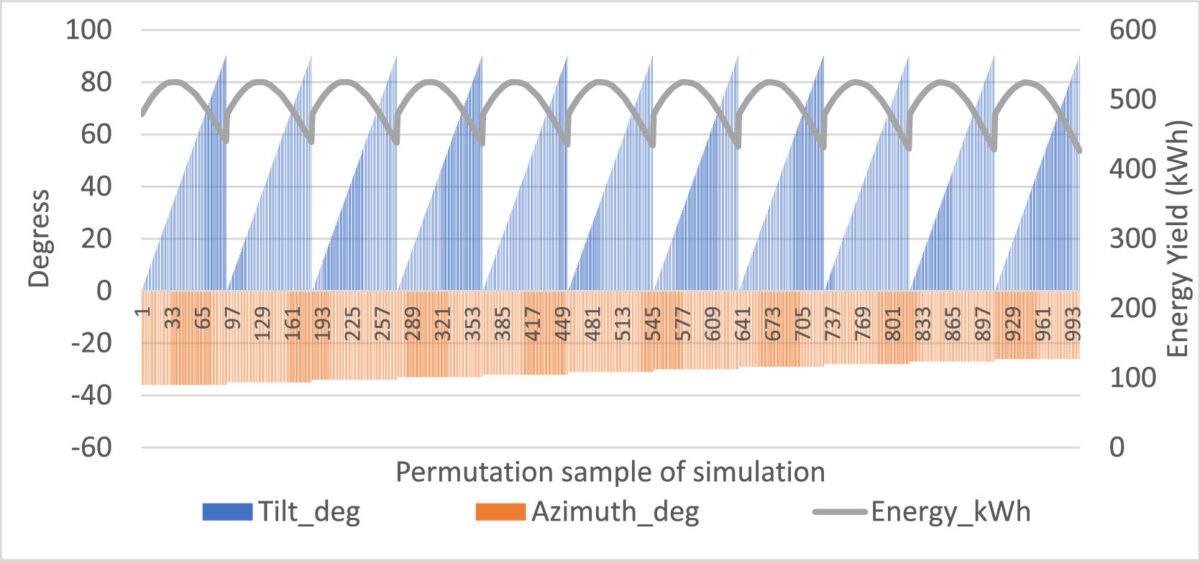
A new bifacial PV optimization model for 18 Saudi Arabian cities identifies optimal tilt and azimuth, showing that backside irradiation can increase annual energy yield by 8–12% and shift tilt 3°–11° higher than monofacial modules. The framework validates previous studies, highlights high and low performing locations, and serves as an early-stage planning tool prior to detailed project simulations.
Researchers at Jubail Industrial College in Saudi Arabia have created an orientation optimization framework for bifacial PV that links bifacial backside irradiation, albedo, and module geometry to optimal module implementation without relying on project-specific layout inputs.
“The model is very useful and suitable for all locations in Saudi Arabia and with minor adjustments to the model, using local and location data such as solar radiation, ambient temperature and albedo values, the model can accurately represent the energy yield of bifacial solar PV systems,” the study’s lead author, Hassan Z. Al Garni, said. pv magazine. “The proposed approach is intended to complement, rather than replace, in-depth software-driven sensitivity analyses, providing clear and regionally scalable insights that support early-stage feasibility studies and cross-site comparisons.”
Unlike previous approaches, the model includes accurate diffuse irradiance, bifacial amplification, bifaciality and realistic module heights, providing more accurate estimates of annual energy yield, the research team said.
Join us on April 22 for the 3rd SunRise Arabia Clean Energy Conference in Riyadh.
The event will spotlight how solar and energy storage solutions are powering sustainable and reliable infrastructure, with a particular focus on powering the country’s fast-growing data center sector.
For their assessment, the scientists used hourly meteorological data on solar radiation and air temperature in 18 cities in Saudi Arabia. They also conducted a comparative evaluation of bifacial and monofacial PV systems, examining spatial variations in bifacial gain and annual energy yield under desert surface conditions. “The solar modules examined in our study are n-type monocrystalline bifacial panels with an efficiency of 22%,” Al Garni said.
Using this improved modeling approach, the team identified the optimal tilt and azimuth angles for both bifacial and monofacial systems. Bifacial modules required consistently higher tilt angles than monofacial modules, ranging from 3° to 11°, highlighting the importance of posterior irradiation in maximizing energy production.
High-performing locations included Riyadh (36° tilt, 525 kWh/m²), Tabuk (58° tilt, 546 kWh/m²), Taif (43° tilt, 538 kWh/m²) and Wadi Addawasir (38° tilt, 524 kWh/m²). In contrast, lower yield regions such as Medina (45° tilt, 495 kWh/m²), Dammam (31° tilt, 489 kWh/m²) and Al Khafji (33° tilt, 469 kWh/m²) showed limited performance.
A monthly analysis in Riyadh also showed that bifacial modules maintain a higher slope angle in summer than monofacial modules, maintaining the rear contribution, which accounts for 8-12% of total production and increases in spring and autumn due to higher ground-reflected irradiance.
“This study found that the optimal tilt angle for bifacial modules does not strictly follow the conventional latitude used for monofacial systems,” the researchers explained. “Instead, the annual optimal orientation ranges broadly from latitude +4° to latitude +30°, maximizing energy harvest. This wider range is the result of diffuse and ground-reflected radiation, which enhances energy collection at the rear and influences module orientation.”
Overall, cross-validation of the bifacial optimization results with previous monofacial and suitability studies confirms both the accuracy and practical relevance of the framework. The team highlighted that the proposed model not only identifies optimal orientations and locations for energy maximization, but also provides a valuable early-stage decision support tool, allowing planners to prioritize locations before running detailed project-level simulations with software such as PVsyst, HOMER or NREL SAM.
This content is copyrighted and may not be reused. If you would like to collaborate with us and reuse some of our content, please contact: editors@pv-magazine.com.
Popular content
