

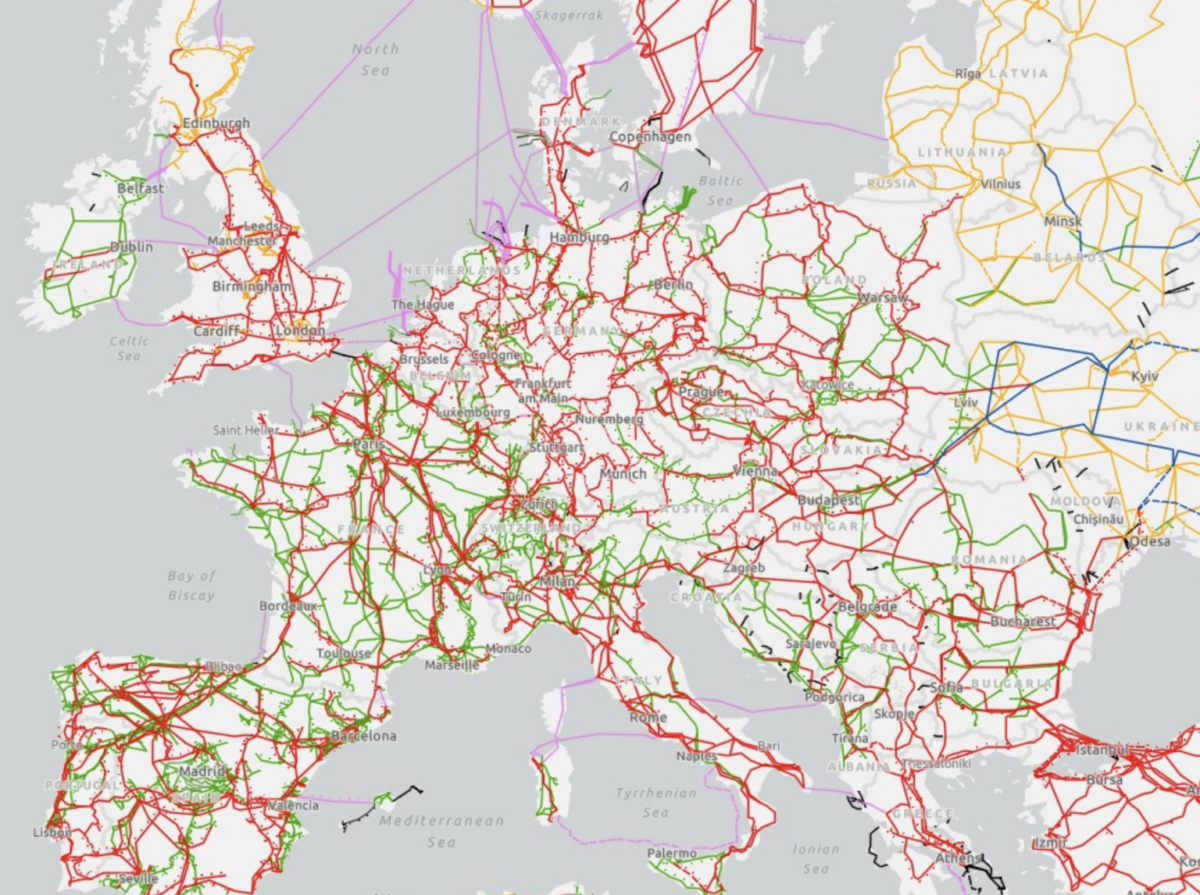
The European Network of Transmission System Operators for Electricity has published a report on instability detection technologies to help countries with a high share of renewable energy maintain electricity grid reliability. The study highlights key tools, research priorities and the need for collaboration with stakeholders to advance real-time monitoring and data-driven decision-making.
The European Network of Transmission System Operators for Electricity (Entso-E) has released a report describing energy system instability detection technologies that countries with a high share of renewable energy can use to improve the stability and reliability of the electricity grid.
While the report does not explicitly refer to last year’s massive power outages in Spain, it cites unspecified “experiences in operating large energy-electronic coupled new renewable parks,” which showed how renewable energy-driven oscillations can cause “critical modes of operation of the energy system.”
“In 2024 alone, Europe installed 16.4 GW of new wind capacity and 65.5 GW of new solar capacity. The energy system is evolving towards networks that are increasingly dependent on devices with power electronics interfaces to enable greater energy flow between distant areas, and to provide stability, robustness and manageability of the electricity grid,” the report states, noting that the system will also face challenges from integrating high electricity demand from data centers, electrolysers and charging stations for electric vehicles. that are connected to each other via power electronics.
The “Technologies for instability detection in power electronics dominated systems” report outlines methodologies such as measurement-based modal analysis, voltage and current monitoring, wide-area monitoring systems (WAMS) using phasor measurement units (PMUs), and point-on-wave (POW) measurements. These tools can reportedly help operators of power electronics-dominated networks make “informed decisions” about the stability of the power grid.
For each approach, Entso-E describes the physical devices currently available, the applicable simulation methods and the associated monitoring tools. Experts also review the main stability phenomena of the energy system, potential preventive and corrective measures and the technological limitations of current measurement-based devices, while highlighting future research directions for their development.
The report further identifies research priorities and makes recommendations, highlighting the importance of collaboration with stakeholders to advance real-time monitoring, harmonized data sharing and the development of advanced analytics algorithms.
Key areas of focus include strategies for managing data transfer, storage, and system architecture within broad units of measurement (WMUs), with an emphasis on resilience and scalability. The report also highlights the need to standardize formats, protocols and metadata for data exchange to ensure reliable communication between systems.
It calls for evaluation of emerging stability phenomena and their interactions with measurement-based devices and control systems, in addition to the development and validation of online algorithms capable of detecting large-scale oscillations and system instabilities in real time. Creating algorithms that provide actionable decision support is seen as a critical step for operational efficiency, supported by robust time synchronization solutions and clearly defined accuracy requirements for multi-sensor networks.
This content is copyrighted and may not be reused. If you would like to collaborate with us and reuse some of our content, please contact: editors@pv-magazine.com.
