

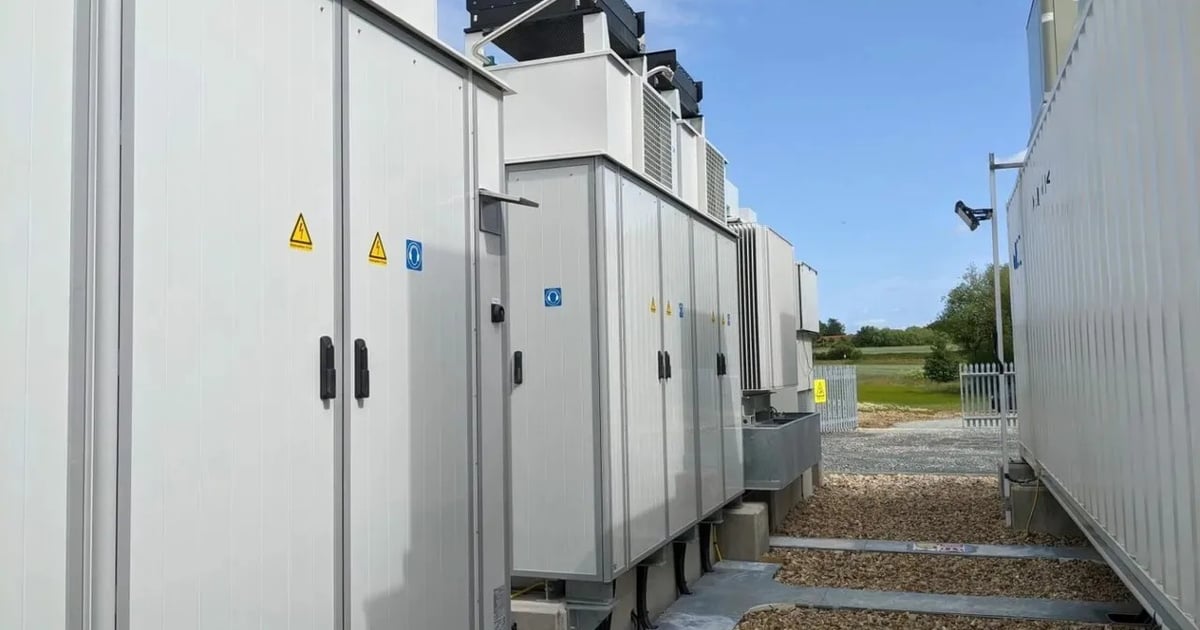
This contributed article by Kevin Byrne, BESS consultancy manager at global consulting, engineering and quality control firm Enertis Applus+ addresses the key challenges that slow BESS deployment in the UK, suggesting various systemic actions to equip the planning system to better support developers.
The United Kingdom’s ambitious 2050 Net Zero targets have created an urgent need for energy storage and government policy describes it as “essential infrastructure”. Yet, developers find themselves trapped in a planning system defined by inconsistent regulation, scarce technical expertise and rising local opposition.
As a result, battery energy storage system (BESS) projects are delayed for years, or blocked, and costs are inflated, even as the UK’s renewable generation expands and grid constraints deepen.
This article examines the three interconnected challenges most responsible for slowing BESS deployment: a technical knowledge gap within planning authorities, inconsistent policy frameworks across regions, and a surge in public opposition rooted in safety concerns and misinformation.
Unlike wind farms or solar parks, battery storage projects represent genuinely novel infrastructure for many local councils. The lack of a specific, unified planning classification for BESS leads to inconsistent decisions as most local planning officers have never encountered a BESS application before.
This knowledge gap manifests in numerous ways with planning officers applying inappropriate conditions or requirements, such as:
-
rigid firefighting methodologies that do not consider the design being proposed;
-
unachievable noise emission limits.
BESS technology demands specialised technical understanding, but many councils lack the resources to commission independent external advice, therefore these inappropriate requirements often result from applying generic planning policies.
Adding to the complexity, BESS projects, that are often hundreds of megawatts in scale, are typically excluded from the Development Consent Order (DCO) regime. Therefore, many of these BESS projects significantly exceed the power capacity of other developments the councils may have assessed previously.
Supporting developers as technical advisors, we have found that early engagement with planning officials, supported with clear and complete project information, can help ensure the decision made is aligned with the interests of all parties.
The absence of explicit inclusion of BESS in the National Planning Policy Framework has created a situation in which local authorities adopt their own approaches. Due to this significant inconsistency, similar BESS applications frequently receive opposite outcomes in adjacent council areas.
Regional variations in approvals
In 2025, Horsham District Council rejected a BESS application, while Mid Sussex District Council approved a similar proposal located 600m away. In Scotland, the Energy Consents Unit has historically never refused a standalone BESS application, while local authorities often express greater resistance, leading to calls for all decisions to be moved strictly to the local level to ensure transparency.
Green Belt and agricultural land use
Some councils, such as Walsall Metropolitan Borough Council, have aggressively challenged BESS developments on Green Belt land, citing noise and alternative site assessment concerns. However, planning inspectors and the High Court have frequently upheld appeals against these refusals when grid connection requirements leave no viable alternative sites.
This inconsistency extends to agricultural land protection policies. Councils like Staffordshire County Council have adopted a firm stance against BESS on council-owned “County Farm” land to protect agricultural productivity, whereas other councils prioritize these same sites due to their proximity to substations.
Fire safety consultation is optional and highly variable
There is no legal obligation for local authorities to consult with the relevant fire services for BESS applications. This has led to inconsistent engagement; while some councils require a comprehensive Fire Management Plan as a condition of approval, others consider safety to be outside the scope of planning.
Some authorities strictly enforce the National Fire Chiefs Council recommendation of 6 m spacing between battery units, while others permit closer proximity if developers suggest alternative mitigation, leading to varied site densities and safety profiles.
Buffer zones and visual impact requirements
Some councils require extensive landscape screening for projects with minimal visual impact, while others focus on detailed fire safety assessments that duplicate regulatory requirements.
Buffer zone requirements vary, from 20 m in some areas to over 500 m in others, often with little technical justification. The National Planning Policy Framework provides limited guidance on energy storage, leaving local authorities to develop their own approaches. This has created a complex mosaic of different requirements that developers must navigate on a case-by-case basis.
BESS technology is unfamiliar to many residents; therefore they struggle to understand or quantify BESS risks. Fire safety, electromagnetic fields, and noise concerns dominate public consultations, often amplified by misinformation that overinflate the safety risks associated with lithium-ion technology.
Local opposition groups frequently cite overseas incidents that would not comply with UK safety standards. To date, there have been only two incidents at UK BESS sites as per the EPRI BESS Failure Incident Database:
-
Carnegie Road (2020), a thermal runaway event that required 59 hours of direct control by the fire service to manage and resulted in significant damage to the site;
-
Thurrock (2025), a fire that required 24 hours of control and observation by the fire service but did not require any direct action by the fire service to contain.
The differences in the outcome of these two incidents is representative of the shift in UK industry to adopt passive and active measures to limit the fire risks at BESS sites. Despite the seven‑fold increase in UK installed BESS capacity between 2020 and 2025 (from 1 GW to 7 GW), incidents have not scaled proportionately. International data shows a tenfold improvement in system safety, from one incident per 0.15 GWh (2020) to one per 1.5 GWh (2024).
EPRI BESS Failure Incident Database (Source: storagewiki.epri.com/index.php/BESS_Failure_Incident_Database)
Yet, this fear factor persists, particularly in rural communities, where BESS projects are often proposed for agricultural land or former industrial sites. Parish councils and local residents may view battery storage as industrialisation of the countryside, despite minimal visual impact compared to traditional power infrastructure.
Recent project rejections due to local opposition
-
Devon (Stoneworthy Energy Storage, 2024). Developer RES was denied planning approval for a 49.9 MW project in Devon, despite the planning officer to the case recommending it. Local councillors voted 6-2 against it, overriding professional advice due to local objections regarding the “desecration of rural Devon”. The project was delayed and ultimately blocked despite having no objections from technical bodies like the Environment Agency.
-
West Yorkshire (Heath, 2025). A 99.9 MW project faced a three-year delay in receiving a decision from the local council. The application was rejected in 2025 by councillors largely due to community and council fears over fire risks and visual impact. However, the project was proposed to be located on farmland away from immediate residential areas. The developer, Harmony Energy, lodged an appeal, adding significant time and costs to the project and throwing its viability into question.
-
Kent (Dartford Energy Hub, 2025). A 300 MW project in Kent was withdrawn by developers in 2025 after council officers recommended refusal. Local opposition, combined with concerns regarding the intensity of the development and its impact on the rural landscape, made planning permission unviable. The project was withdrawn to avoid a formal rejection, wasting years of development work.
A rapidly changing safety landscape
Concerns over fire risk have historically originated from a lack of standardised testing protocols, often resulting in overly conservative setback distances and density restrictions that limited project viability.
Today, however, major industry suppliers are now voluntarily adopting more stringent fire safety tests, most notably:
-
NFPA 855, the Standard for the Installation of Stationary Energy Storage Systems, provides comprehensive installation, commissioning, and operational safety requirements that complement testing protocols. Proposed updates to the standard in 2026 include the adoption of large-scale fire testing of complete BESS units.
-
UL 9540A, which established the methodology for thermal runaway fire propagation testing at cell, module, unit, and installation levels, has become a foundational reference point for demonstrating system safety characteristics.
-
CSA C800-2025 subjects the complete BESS unit to extreme thermal events and documenting their behaviour under controlled conditions, manufacturers can now provide quantifiable evidence of fire containment capabilities, toxic gas management, and the effectiveness of integrated safety systems.
These standards provide comprehensive tools for the evaluation of BESS products under thermal runaway and fire propagation scenarios, going beyond traditional cell-level testing to assess the effectiveness of system-level performance of the fire suppression systems, thermal management, and containment strategies. This multi-tiered approach offers a more realistic assessment of real-world safety performance and addresses the concerns articulated within guidance documents such as the National Fire Chiefs Council’s guidance for BESS applications.
These frameworks enable developers to present empirical, system-level data to planning authorities, fire services, and the Health and Safety Executive, rather than theoretical models. The National Fire Chiefs Council guidance, which specifically addresses emergency response to BESS incidents, has elevated the importance of demonstrable safety performance, making compliance with recognised testing standards increasingly essential for gaining stakeholder confidence.
For BESS developers navigating the UK’s complex planning regime, compliance with these safety standards offers a compelling pathway to securing approvals for higher-density installations with reduced setback distances. Planning authorities and fire services often look to recognised third-party testing and certification as a basis for decision-making.
Technical advisors play a critical role in helping developers interpret these standards, select compliant technologies, and generate the system‑level evidence needed to build confidence with planning authorities, fire services, and the public at application stage. As specialist BESS engineers, we support developers through design reviews, safety assessments, and performance validation to ensure their projects meet the highest safety and compliance benchmarks.
The path forward: reform, guidance and professionalisation
The planning profession is beginning to respond to the BESS challenge through specialist training and guidance development. The Royal Town Planning Institute has started offering energy storage modules, and planning consultancies are developing internal BESS expertise. Some councils have begun developing supplementary planning documents specifically for energy storage projects.
However, a more systemic action is needed to ensure lasting improvement:
-
National policy updates to clarify how BESS should be assessed.
-
Centralised technical guidance for planners and fire services.
-
Funding for training within local authority planning departments.
-
Clearer frameworks for risk assessment and setback justification.
Specialist technical advisors can help bridge these gaps today, supporting developers and councils with independent safety reviews, planning documentation, risk assessments and technical training. Our team works closely with stakeholders across the development cycle to ensure that BESS projects are designed, assessed and delivered to best‑practice standards.
What comes next
The UK has made substantial progress in deploying grid‑scale batteries, but planning barriers now threaten to stall momentum at precisely the moment storage is most needed. Eliminating the current patchwork of requirements, improving technical capacity within councils, and strengthening communication with communities will be essential to accelerating deployment.
BESS is no longer an emerging technology. It is a cornerstone of the UK’s clean energy future. The planning system must be equipped, and empowered, to support it.
Solar Power Portal’s publisher Solar Media is hosting the Energy Storage Summit EU 2026 in London, UK, on 24-25 February 2026 at the InterContinental London – The O2. See the official website for more details, including agenda and speaker lists.
