

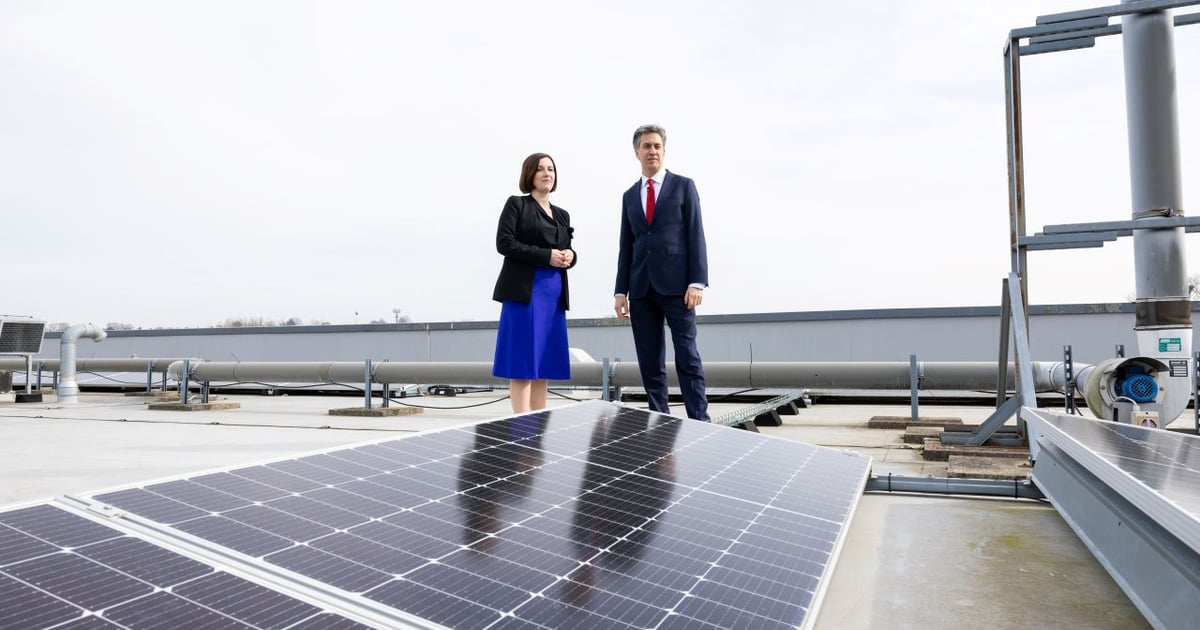
The Government will pledge up to £1 billion to support community ownership of new clean energy projects.
The Local Power Plan will be managed by government-backed Great British Energy (GBE) and the Department of Energy Security and Net Zero (NESNZ) to expand local and community ownership of renewable energy plants across the UK.
It will provide direct financing through a combination of grants, loans and local investments to community energy groups, local and devolved governments and community members in what Energy Minister Ed Miliband called “the largest public investment in community energy in the history of this country.”
GBE said it is currently “exploring” financing models for the program, including early-stage project development grants, targeting both community energy groups and partnerships between those groups and local governments; construction and operating loans, including a shared ownership loan; and a “Local Investment Fund” to identify and finance viable project opportunities.
“Our ambition must reach every part of Britain, which is why we have set the bold target of supporting more than 1,000 local and community projects in the first phase of our strategic plan to 2030,” said Dan McGrail, CEO of GB Energy.
In addition to direct funding, the government said GBE would provide expertise and advice to communities looking to install energy projects and DESNZ will “address policy and regulatory barriers” to local energy development. This includes changes to network interconnection policies and market access for small-scale renewable energy projects. DESNZ said it is working with Ofgem and DNOs to address the grid connection process as a “key reason for project delays.”
“This is about working hand in hand with community groups, local authorities and the devolved governments across Britain to deliver a bottom-up vision, not just of state-owned power, but of power owned and controlled by the communities themselves,” Miliband said.
As part of the Local Energy Plan, DESNZ will assess a “mandatory shared ownership” offer for renewable energy projects, which could require local communities to be given the option to own some of the energy infrastructure in their area.
“Property is a transformative tool for building the wealth of local areas – giving people a stake in the places they live and generating pride, respect and local prosperity that cannot be dismantled,” Miliband added. Communities already own energy projects across Britain, with around 1.9 GW of projects already under construction or development by grassroots groups, according to Solar Energy UK.
The industry welcomes the Local Energy Plan
The plan received broad support from a number of bodies in the energy sector. “It is encouraging to see a clear commitment to providing funding to communities, which will be vital in helping them kick-start the development and delivery of local projects,” said Graham Ayling, senior project manager at the Energy Saving Trust. The organisation’s head of external affairs, Stew Horne, added that the plan “sets out a strong and ambitious vision”.
Simon Francis, coordinator of the End Fuel Poverty Coalition, said the plan “has real potential to help drive down bills while keeping the benefits of clean energy rooted in local places.”
In a statement, Solar Energy UK welcomed DESNZ’s plans to “reform the costly red tape around grid connections, power more community energy installations on public sector buildings and make it easier to sell power to the grid at scale.”
Chris Hewett, head of Solar Energy UK, said: “The £1 billion local energy plan will put sustainable energy at the heart of communities across the country, meaning lower bills for schools, community centres, village halls and much more. Our members look forward to advising community energy companies on potential projects and delivering them to everyone’s benefit.”
‘Concerns’ about shared ownership
However, Solar Energy UK – a representative group for solar and energy storage companies – said it was “concerned” about the potential shared ownership mandate.
“We are concerned that forcing developers to hand over some of their projects will discourage investment at a time when Britain needs to grow its renewable energy generation capacity at an unprecedented pace,” said Gemma Grimes, director of policy and delivery at Solar Energy UK. “Alongside the recent change to the indexation of legacy subsidy payments and expectations of a mandatory community benefits framework, the proposal does not send the right signal to the sector.”
The government has conducted an investigation mandatory community benefits frameworksincluding funds, since May. Plans were discussed to set minimum community benefit amounts based on the size of infrastructure projects, which would go towards new facilities, investment and transport links.
Community involvement and opposition are an important part of the solar project development process, especially as political rhetoric in Britain has broadly opposed major developments in the field of renewable energy.
