

Australian researchers developed a low-cost reflective coating for semi-transparent solar roof tiles that reduces surface temperature by up to 20 C and increases power output by up to 11.7%. Simulations in five global cities showed energy savings of up to 5.85%, highlighting the coating’s strong potential for improving both building cooling efficiency and solar energy performance in BIPV systems.
An Australian research team has developed a reflective coating strategy for semi-transparent solar-integrated roof tiles, aiming to improve both thermal regulation and electrical performance in building-integrated solar photovoltaics (BIPV).
According to corresponding author Mohammad A. Alim, the research focuses on the specific thermal, optical and structural challenges associated with roof-integrated PV systems, rather than window-based applications that dominate previous research.
“Unlike previous studies that primarily focused on window-integrated PV, this study focuses on the unique challenges of roof integration,” Alim said. pv magazine. “Our development demonstrates a dual benefit by simultaneously reducing roof area and internal temperature while improving the electrical performance of the solar cells through temperature control.”
The researchers say the approach supports energy-neutral building goals by combining thermal and electrical optimization in one system. Most previous studies have examined cooling coatings or PV performance separately.
Experimental setup
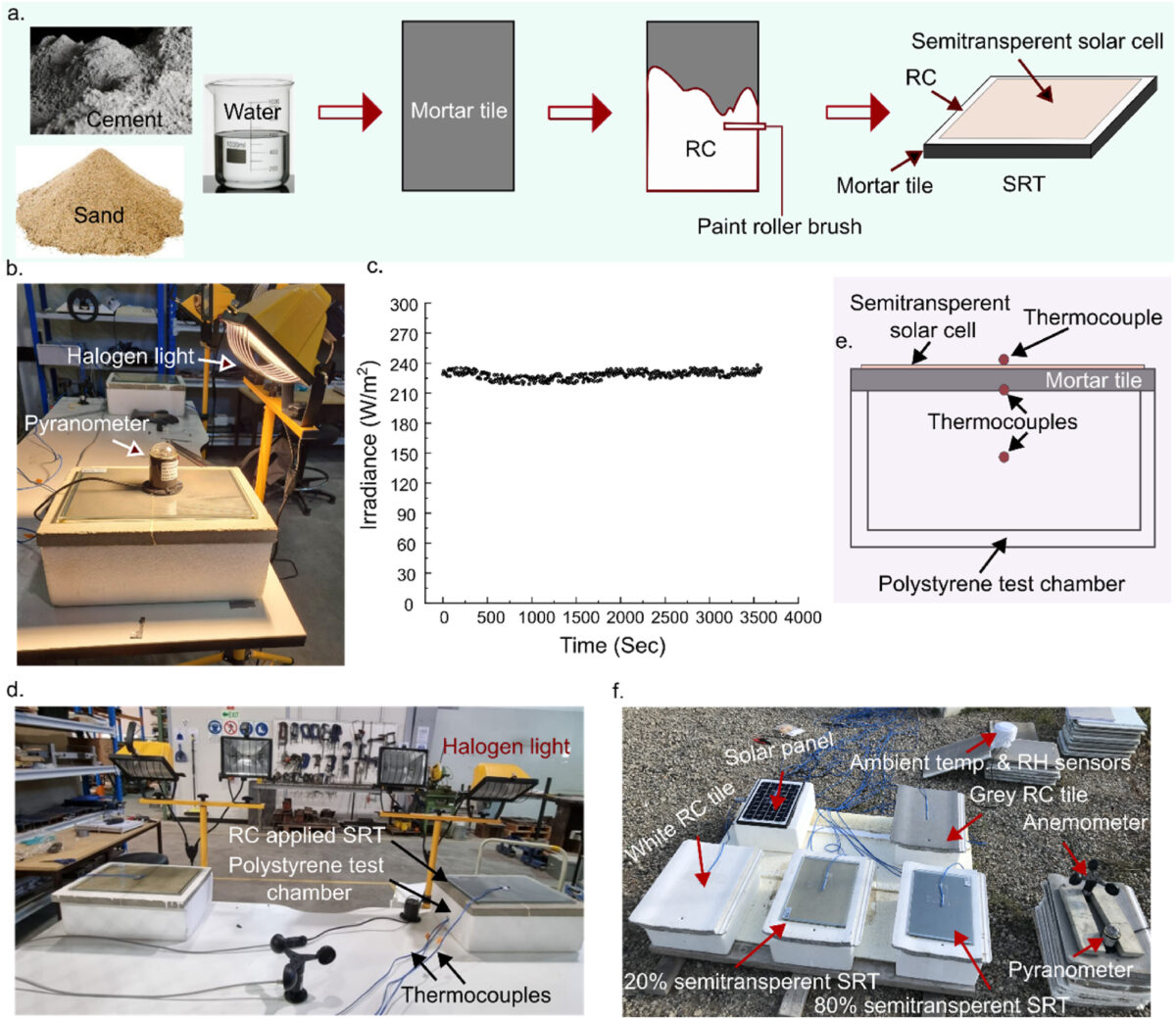
The team fabricated solar roof tiles (SRTs) using 390mm x 290mm x 27mm mortar slabs, cured for 28 days. Two coats of commercially available white reflective coating (RC) were applied. Semi-transparent cadmium telluride (CdTe) solar cells with transparency levels of 20%, 40%, 60% and 80% were then installed.
The first tests were carried out under halogen lamps with an average irradiance of 228.1 W/m2. Outdoor experiments were then conducted in Sydney from December 4 to 7, 2023, using tiles with 20% and 80% transparency.
The team also ran EnergyPlus simulations to evaluate energy savings in buildings. A model office building of 511 m2 was tested under climatic conditions for Sydney; New York City; Karachi, Pakistan; Dhaka, Bangladesh; and Beijing. Simulations compared SRTs with 20% and 80% transparency with reference reflective coated conventional roof tiles.
Thermal and electrical performance
The researchers found that reflective coatings reduced surface temperatures by 5.4 C to 10.8 C under laboratory and outdoor conditions. Tiles with higher transparency provided stronger cooling effects.
In outdoor tests, white semi-transparent tiles with 80% transparency were found to be 8.5 C cooler than tiles with 20% transparency and up to 20 C cooler than uncoated tiles.
The temperature reduction translated into electrical gains, increasing cumulative power by 5.6% to 11.7%.
“Perhaps quite unexpectedly, these significant thermal and electrical improvements were achieved using a simple, inexpensive, passive coating,” said Alim. “This shows that cooling based on reflective coatings can outperform more complex BIPV cooling strategies, while simultaneously boosting energy generation and reducing cooling demand.”
EnergyPlus simulations showed that solar roof tiles (SRTs) with 20% transparency delivered modest improvements in building energy performance, with gains of 0.69% in Sydney, 0.38% in Karachi, 0.57% in Beijing, 0.73% in New York and 0.47% in Dhaka. However, when transparency was increased to 80%, performance gains increased significantly, to 5.73% in Sydney, 2.99% in Karachi, 4.46% in Beijing, 5.85% in New York and 3.49% in Dhaka.
These findings suggest that the level of transparency plays a crucial role in improving cooling performance and maximizing overall energy savings in buildings under different climate conditions.
“In addition to the curved roof tiles, we also plan to investigate how the roof tilt angle affects the thermal behavior and electrical performance of these semi-transparent roof tiles under real operating conditions,” concludes Alim. “Additionally, future work will assess coatings with alternative colors and tailored spectral reflectance properties, allowing for both performance optimization and greater architectural flexibility.”
The study findings are presented in “A new strategy for reflective coatings for semi-transparent solar cell-integrated roof tiles in energy-efficient building design”, published in Energy. Researchers from Australia’s Western Sydney University and Charles Sturt University participated in the study.
This content is copyrighted and may not be reused. If you would like to collaborate with us and reuse some of our content, please contact: editors@pv-magazine.com.
