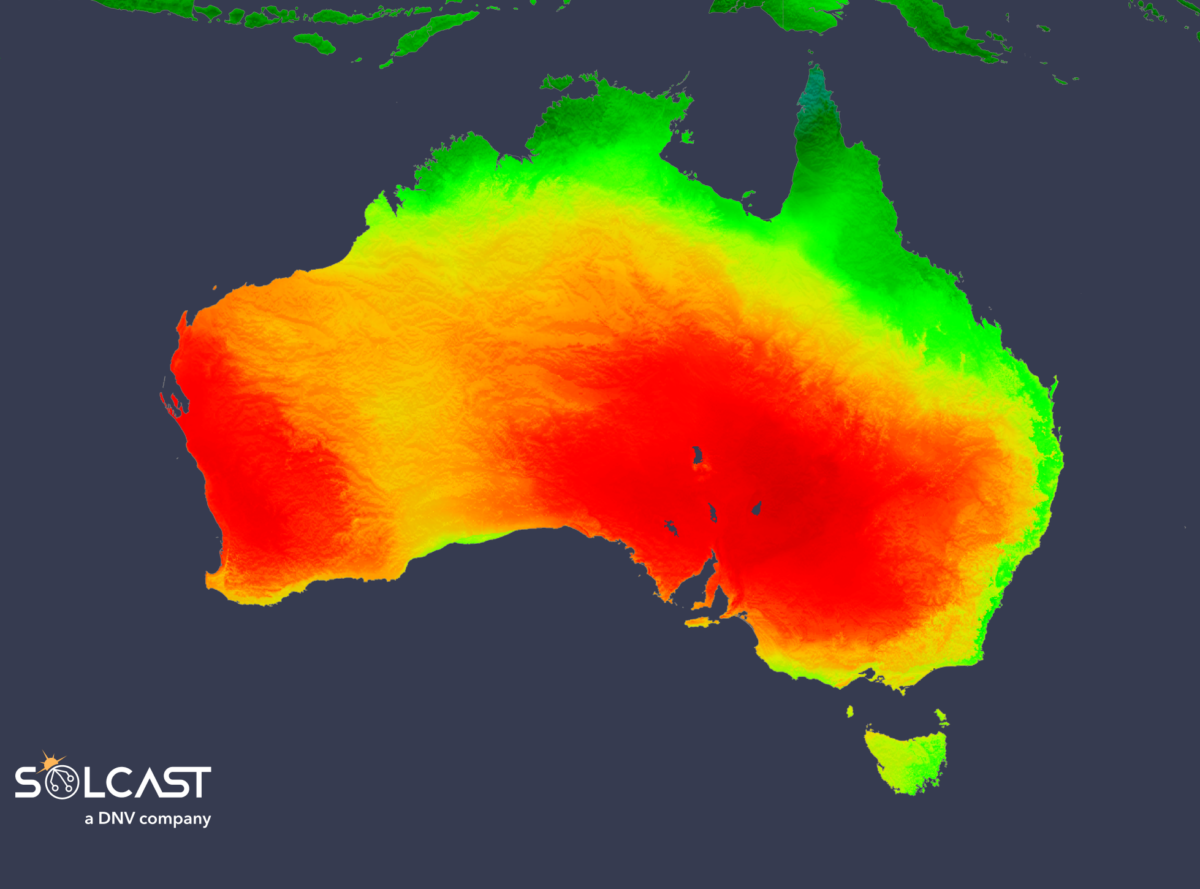
In a new weekly update for pv magazineSolcast, a DNV company, reports that most of Australia experienced above-average solar radiation in January 2026 due to a hot, dry air mass and clear skies, boosting PV generation despite operational challenges from high temperatures, bushfire smoke and dust. In contrast, northern Queensland and far northern regions experienced significant irradiance deficits due to persistent monsoon clouds and Tropical Cyclone Koji, which caused widespread rainfall and localized power outages.
Most of Australia recorded above-average insolation in January 2026, while a hot, dry continental air mass dominated the month, despite local reductions in smoke, dust and an active monsoon in the tropical north, according to analysis using the Solcast API. While widespread sunshine supported strong conditions for PV generation, higher temperatures, smoke and dust pollution posed operational challenges. In contrast, northern Queensland and far northern Australia experienced significant irradiance deficits under persistent monsoon clouds and Tropical Cyclone Koji.
Dry conditions prevailed across most of the continent, causing monthly average insolation to be 10% to 15% higher than in January, especially inland New South Wales, Queensland, South Australia and Western Australia. These clear-sky conditions were accompanied by a slow-moving pattern at upper levels that supported the development of a persistent heat dome over the continent. This feature suppressed the formation of clouds and rainfall, while the hot northerly winds were periodically directed towards southeastern Australia, ahead of the cold fronts. Nationally, monthly average temperatures were 2.3C above normal, and more than 3C above average in parts of inland New South Wales and south-west Queensland. Although clear skies aided irradiation, module operating temperatures would have been higher, reducing panel efficiency during peak heat periods. The magnitude of above-average warmth is consistent with broader trends observed in a warming climate.
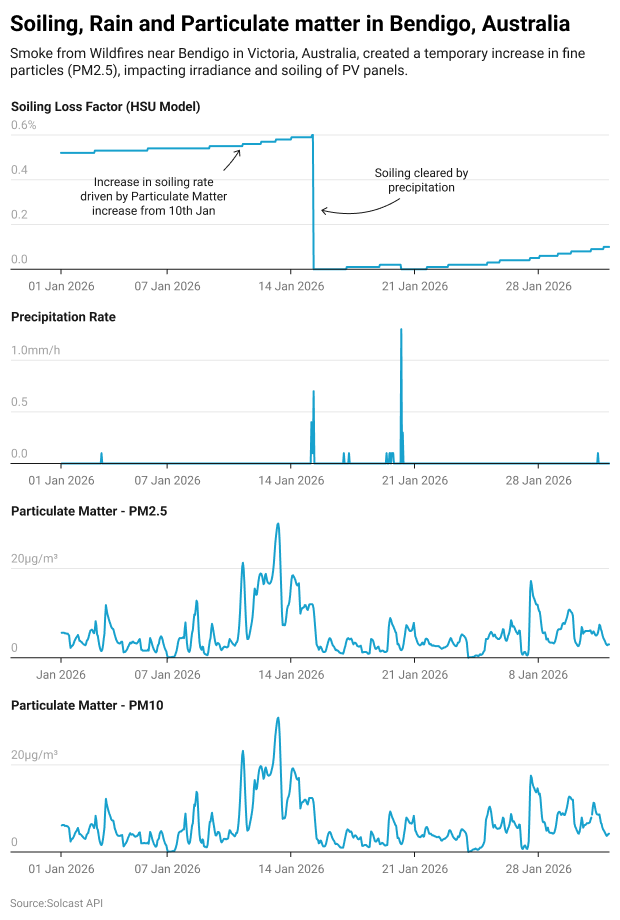
The hot and dry pattern also increased the risk of wildfires and dust mobilization, creating additional complexity for PV operations. Strong northerly winds ahead of southerly cold fronts created dangerous fire conditions in Victoria and New South Wales, with smoke temporarily reducing radiation at nearby locations. In Bendigo, analysis of particulate matter concentrations and rainfall indicates a noticeable increase in estimated pollution losses around January 11, coinciding with nearby fire activity. The subsequent rainfall helped clear the panels, limiting ongoing losses. Although fire episodes reduced irradiation locally and temporarily, they did not materially change the overall monthly above-average signal, as similar events occur in the January historical baseline.

Further inland, prolonged drought allowed dust to rise. In Alice Springs, elevated PM10 concentrations on January 12 and 13 were associated with a marked increase in estimated pollution losses. With minimal rainfall to offset the accumulation, losses increased from 0.024 to 0.032 over the month, equivalent to approximately 0.8% additional reduction due to dust deposition. A major dust storm at the end of the month, which reached western New South Wales, highlighted the vulnerability of central Australian locations during extended dry spells.

Contrary to the national trend, tropical regions experienced significant irradiance deficits. Cape York Peninsula recorded values about 20% below average, while far north Australia and parts of northeastern Queensland near Townsville and Mackay were about 10% below normal. A persistent monsoon trough brought widespread cloud and rain to northern Australia. Tropical Cyclone Koji, which was named in the Coral Sea on January 10, further reduced radiation as thick clouds blanketed the Queensland coast between Townsville and Mackay. As the system weakened inland, heavy rainfall and flooding followed, with more than 22,000 homes experiencing power outages due to wind and rain damage.
Solcast produces these figures by tracking clouds and aerosols worldwide at a resolution of 1-2 km, using proprietary satellite data AI/ML algorithms. This data is used to drive irradiance models, allowing Solcast to calculate high-resolution irradiance, with a typical deviation of less than 2%, as well as cloud tracking predictions. This data is used by more than 350 companies that manage more than 300 GW of solar energy worldwide.
The views and opinions expressed in this article are those of the author and do not necessarily reflect those of the author pv magazine.
This content is copyrighted and may not be reused. If you would like to collaborate with us and reuse some of our content, please contact: editors@pv-magazine.com.
Popular content