

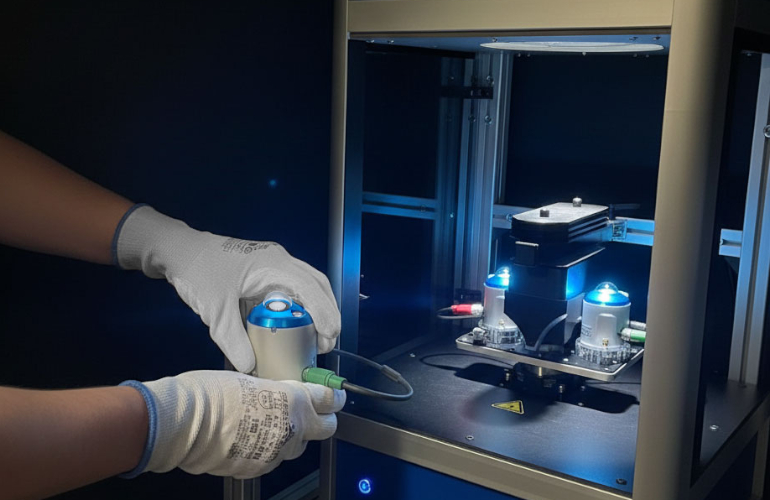
EKO Instruments USA has one US-based pyranometer calibration service. The service brings a new level of accuracy, cost-effectiveness and turnaround speed to pyranometer calibration for large-scale, commercial and industrial solar applications. The service supports SCADA companies, O&M teams and developers, owners and operators of solar projects. Proper calibration allows pyranometers to accurately perform their key role throughout the entire solar energy life cycle, including planning phases, installation and ongoing monitoring and maintenance.
 EKO’s newly developed Indoor Calibration Facility (ICF-02) calibration system is the core of the service. The Indoor Calibration Facility is a turnkey, fully automated calibration system designed to perform highly accurate and repeatable indoor calibrations of ISO 9060 spectrally planar pyronometers, in full compliance with ISO 9847:2023. The facility allows direct comparison of a test pyranometer with a reference pyranometer of the same model, ensuring traceability and consistency in line with international calibration standards.
This new calibration service has been developed to meet the International Electrotechnical Commission (IEC) 61724-1:2021 calibration frequency standards.
“Amid solar project deadlines that are tighter than ever, we are pleased to launch a faster, more cost-effective calibration service in the United States that minimizes stress for our customers while maximizing the accuracy of their solar sensors,” said Wayne Burnett, Chief Strategy Officer and Chief Technology Officer at EKO Instruments. “EKO’s long tradition of calibration expertise and dedication to accuracy makes this possible.”
The US-based calibration service, performed domestically, reduces the cost of shipping solar sensors to offshore laboratories, avoiding logistical delays that can arise from international supply chains. EKO’s service also accelerates calibration turnaround time compared to many alternative providers, allowing customers to return instruments to use more quickly. The service guarantees an industry-leading sensitivity value – the final checkpoint before reinstalling the sun sensor in the field, where calibration accuracy is difficult to assess.
Errors due to poor calibration are often subtle and even undetectable by end users, but the cumulative effect of power loss can impact the productivity and profitability of larger sites. ISO 9847:2023 solar sensor calibration involves comparing the readings of a test solar sensor with a reference solar sensor under controlled conditions. Understanding measurement uncertainties is critical to the solar sensor calibration process, regardless of whether the calibration is performed indoors or outdoors. Periodic recalibration of solar sensors is necessary to ensure that solar energy systems can be tested and assessed consistently.
“ICF-02 is designed as a scalable tool for fully automatic calibrations, allowing users to easily operate the system while achieving highly consistent and repeatable results. As acceptance grows, our vision is to expand a global calibration network in close collaboration with trusted partners operating ICF-02 facilities,” explains Kees Hoogendijk, Managing Director, EKO Technology. “This approach ensures harmonized calibration practices worldwide. Decades of practical experience measuring and calibrating solar radiation form the basis of this system. That expertise is embedded in ICF-02’s advanced automation, control software and data processing, making reliable, traceable and standards-compliant calibrations accessible without compromising quality.”
News item from EKO
