

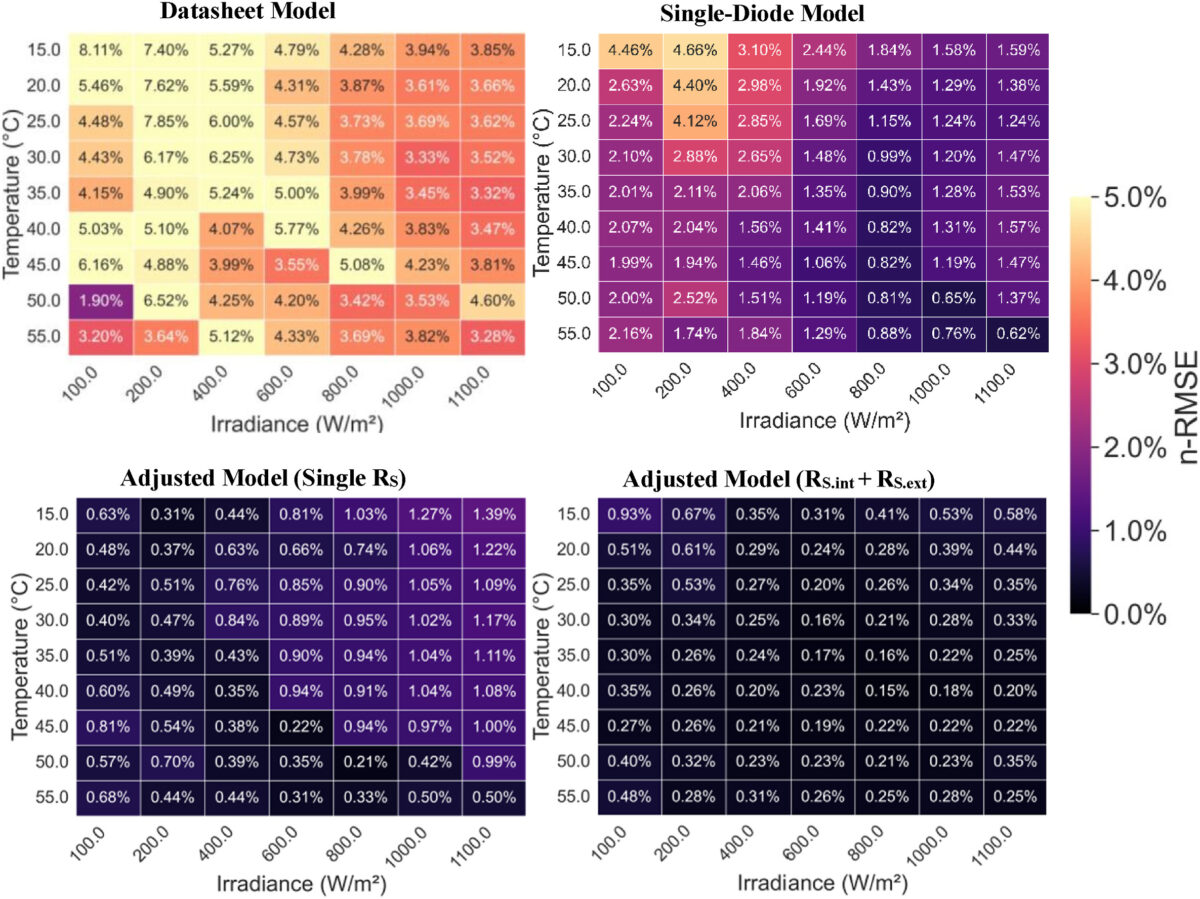
UNSW researchers have developed an intrinsically modified single-diode model that explicitly takes into account radiative and Auger recombination, improving the accuracy of the IV curve and reducing the root mean square error by up to a factor of three. It is claimed that the model can better predict performance near no-load voltage and maximum power point.
The single-diode model (SDM) is an electrical equivalent circuit used to represent the behavior of solar cells and is widely used to simulate and predict the current-voltage (IV) characteristics of solar panels under different conditions. It consists of a current source, one diode and usually a series and shunt resistor to model internal losses. The diode represents the p-n junction behavior of the solar cell, while the resistors are responsible for practical inefficiencies.
Despite its widespread application, the SDM is also known to adopt ideal diode behavior and not fully capture the complex recombination mechanisms within a solar cell. In addition, it may be less accurate under low irradiation conditions and near open-circuit voltage.
To address these limitations, a research team from the University of New South Wales (UNSW) has developed a modified version of the SDM that can reportedly reduce the root mean square error (RMSE) for IV data measurements by a factor of three.
“As commercial silicon solar cells approach their intrinsic efficiency limits of more than 26%, the SDM is increasingly failing to accurately describe device behavior, especially near open-circuit voltage and the maximum current point,” said lead author Bram Hoex. pv magazine. “As silicon PV approaches its physical efficiency ceiling, explicitly incorporating solid state physics into yield models is no longer optional; it becomes necessary for accurate simulation of field performance.”
The research team said the intrinsically adapted extension of the single-diode model can explicitly account for radiative and Auger recombination in the silicon bulk.
Radiative recombination occurs when an electron recombines with a hole and emits a photon. It represents an intrinsic loss mechanism in solar cells, limiting the maximum achievable voltage and overall efficiency. Auger recombination, on the other hand, is a non-radiative process in which the recombination energy is transferred to a third carrier instead of being emitted as light. This energy is then dissipated as heat, further reducing the device’s performance.
The proposed SDM also requires parameters such as dopant concentration and silicon volume. It splits the series resistance into internal and external components, separating different physical loss mechanisms within the solar cell.
The modified method involves correcting the voltage for external resistance, calculating radiation and Auger recombination currents, applying a custom fit to one diode, and combining all contributions into a final equation.
To assess its performance, the team compared two intrinsically matched models based on different resistance treatments using a datasheet-based method and a standard single-diode fit. Curve fitting was performed using weighted RMSE minimization, with particular emphasis on short-circuit current and maximum power point (MPP) accuracy.
“For high-efficiency simulated device data, the intrinsically adjusted model reduced the RMSE by an order of magnitude compared to the standard SDM,” Hoex said. “For measured IV data, the modified model reduced the RMSE by approximately a factor of three, with remarkably improved accuracy near open-circuit voltage and MPP.”
The team added that separating internal and external series resistance further improved fit quality and avoided artifacts near open circuit conditions. The model also captured key effects on temperature coefficients and low-light behavior, as Shockley-Read-Hall (SRH) recombination, a non-radiative process that reduces strain and efficiency, became ‘negligible’.
“Most yield simulation tools are based on classical SDM, which implicitly assumes SRH-dominated recombination,” Hoex emphasizes. “In ultra-efficient devices, the intrinsic recombination becomes non-negligible and the voltage and fill factor behavior changes. Accurate modeling near the intrinsic limit is essential for reliable yield predictions, mismatch simulations, and bankability assessments of next-generation TOPCon and heterojunction (HJT) modules.”
The new version of the SDM was presented in “The intrinsically adapted single-diode model: Solid State Physics meets accurate yield simulation”, published in Solar energy materials and solar cells.
This content is copyrighted and may not be reused. If you would like to collaborate with us and reuse some of our content, please contact: editors@pv-magazine.com.
