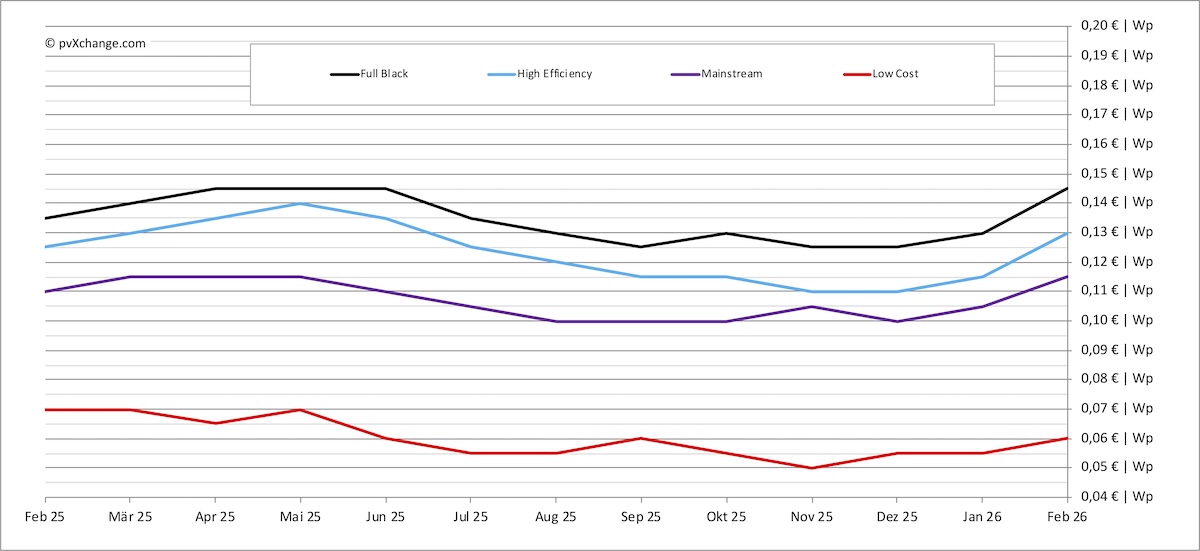
Solar module prices rose €0.01 ($0.012)/W to €0.015/W in February, leaving levels 15% to 18% above the December 2024 low, despite falling wafer costs as manufacturers try to restore margins after prolonged losses.
Module prices rose more than expected in February across all major technology classes. Most products increased by approximately €0.01/W to €0.015/W. Modules for small roof systems showed a greater increase than utility-scale products. Prices have risen above January 2025 levels and are now 15% to 18% above the December 2024 low.
The increases are not related to higher raw material costs or changes in Chinese export subsidies. Wafer prices fell again during the month, while silver prices continued to normalize. The price adjustments appear to reflect manufacturers’ efforts to improve margins after a long period of losses. Approaches vary, with some suppliers making gradual increases, while others make incremental increases of 20% to 30%.
Manufacturers with greater exposure to the utility segment have taken a more cautious approach. Project economics in this segment remain highly sensitive to component costs, and significant price increases risk delaying investment decisions. In the residential and commercial roofing markets, changes in module pricing typically squeeze margins for installers rather than directly impacting end-customer demand. However, market conditions remain subdued and a further contraction in demand cannot be ruled out.
Political uncertainty also affects sentiment. In the United States, President Donald Trump has signaled a shift in federal climate policy priorities, creating uncertainty around renewable energy deployment. In Germany, early details of the federal government’s proposed grid package have drawn criticism from business representatives and environmental groups concerned about possible delays in expanding the grid and integrating renewable energy sources. The scope and implementation of the proposed measures remain unclear.
The sector is entering an adjustment period. After several years of rapid expansion, supported by favorable policy frameworks, manufacturers and developers are adapting to a more uncertain regulatory environment. Trade unions are preparing policy responses and considering legal options to defend existing frameworks. Public demonstrations have resumed, including a protest outside the German Federal Ministry of Economic Affairs and Energy, where decommissioned wind turbine blades and discarded solar panels were put on display to call for continued support for the energy transition.
Industry representatives say coordinated action will be needed to maintain deployment targets and investment stability. Rooftop and ground-mounted PV installations continue to grow, alongside growing interest in battery storage and vehicle-to-grid applications, although policy uncertainty remains a key variable for investment planning.
Module price points by technology on February 18, 2026, including monthly changes
About the author
Martin Schachinger studied electrical engineering and has been active in the field of photovoltaics and renewable energy for 30 years. In 2004, he founded his own company and founded pvXchange.com. Through the internationally renowned online trading platform, wholesalers, installers and service companies can purchase standard components for new installations, as well as solar panels and inverters that are no longer produced but are urgently needed to repair defective PV systems.
The views and opinions expressed in this article are those of the author and do not necessarily reflect those of the author pv magazine.
This content is copyrighted and may not be reused. If you would like to collaborate with us and reuse some of our content, please contact: editors@pv-magazine.com.
Popular content