

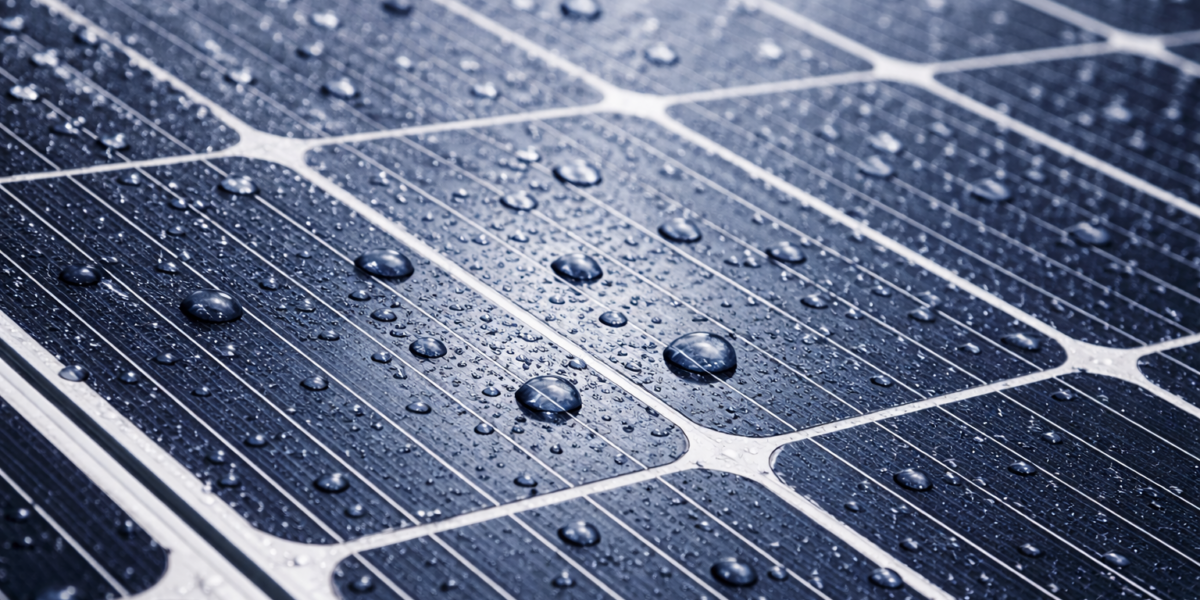
Researchers from ICMS in Seville have developed a hybrid perovskite-solar cell that generates electricity from both sunlight and raindrops, using photovoltaic and triboelectric effects. A fluorinated CFₓ polymer layer enables water resistance, triboelectric energy harvesting and high light transparency without reducing the efficiency of the solar cells.
Researchers at the Institute of Materials Science and Technology (ICMS) in Seville, Spain, have developed a hybrid cell that simultaneously converts solar radiation and the impact of raindrops into electricity. While the perovskite component relies on the photovoltaic effect, the conversion of raindrops to electricity uses the triboelectric effect.
The triboelectric effect occurs when two different materials come into contact with each other and then separate, creating an electric charge. During contact, electrons exchange between the materials, creating a charge difference when they separate, creating an electrical potential. For example, when a water droplet hits a suitable polymer surface, the contact and subsequent flow or detachment create a charge separation that can be captured via electrodes as an electrical pulse.
The team’s key innovation is a fluorinated polymer layer, known as a “CFₓ layer,” which performs multiple functions. It encapsulates the perovskite layer and protects it from moisture, increases the hydrophobicity of the surface to reduce water interaction and exhibits triboelectric properties. Importantly, it maintains a high optical transparency of over 90% so that photovoltaic performance is not compromised.
The CFₓ layer is deposited at room temperature under vacuum using plasma technology. According to the researchers, the coating leaves the performance of solar cells virtually unchanged, with the best cells achieving an efficiency of 17.9%.
The chemical composition of the CFₓ layer was optimized for the generation of triboelectric energy. In one variant, the raindrop-driven generator achieved no-load voltages up to 110 V and a maximum power density of approximately four mW/m2.
The coating does not affect the performance of solar cells. In a hybrid setup combining photovoltaic and triboelectric generation, the system achieved a short-circuit current density of 11.6 mA/m2 at 0.5 suns of illumination. Voltage peaks of up to 12 V per colliding drop were also measured.
In a demonstrator, the hybrid perovskite solar cell was used to charge a supercapacitor, where a specially developed boost converter enabled the continuous operation of a red LED strip. The authors note that the charging speed is mainly determined by the solar cell, while the triboelectric generator makes an additional contribution. Whether this concept can be scaled beyond laboratory prototypes remains uncertain.
This work is part of the 3DScavengers project, funded by the European Research Council (ERC Starting Grant), and the Drop Ener project, co-funded by the Next Generation Fund.
The researchers published their findings in “Water-resistant hybrid perovskite solar cell – droplet triboelectric energy harvester”, published in Nanoenergy.
This content is copyrighted and may not be reused. If you would like to collaborate with us and reuse some of our content, please contact: editors@pv-magazine.com.
