

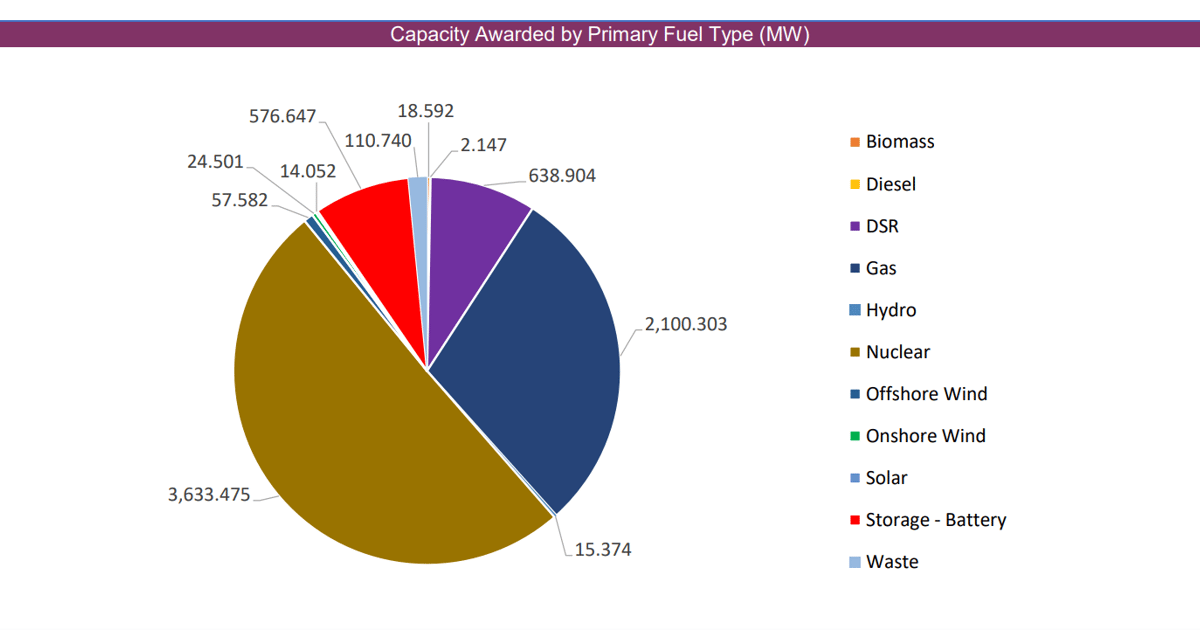
The National Energy System Operator’s (NESO) one-year Capacity Market (CM) auction has concluded, securing 7,192 MW of commitments, of which approximately 8% was battery storage.
The T1 auction applies to delivery year 2026/2027 and saw 80% of the capacity obligations fulfilled by gas and nuclear energy, as shown in the table below.
The CM pays operators for their availability during specific stress periods, predicted based on NESO models on when capacity shortages in the electricity system may occur.
The clearance price was £5/kw/year, three quarters lower than last year.
Battery energy storage system (BESS) projects have generated 576 MW of commitments, 8.02% of the total allocated capacity.
Wind and solar have also attracted small amounts of commitments, although their role as non-dispatchable technologies in the CM has always been very small. Offshore and onshore wind energy together gained 82 MW of commitments, just over 1% of the total, while solar energy gained 14 MW, 0.2% of the total.
Demand side response (DSR) was another relatively big winner, with 638 MW of rewards for a total of 8.88%.
The mix of technologies is similar to last year, when BESS won slightly more, 725 MW, accounting for about 9% of the total.
Notable owner-operators with BESS projects that won at the auction include Amp Clean Energy, EDF, Engie, Greencoat, Gresham House, Harmony Energy, Low Carbon, Pulse Clean Energy, RWE, Statera and many others.
The average size of approximately 10 MW per BESS asset is much smaller than the average BESS project size. While operators may have bid for smaller projects, the CM is typically used to cover a small portion of a BESS project’s revenue.
NESO is about to hold its T-4 auction, for delivery four years in advance, which will provide much more capacity overall (last year it acquired 43.1 GW of commitments for delivery in 2028/2029).
