

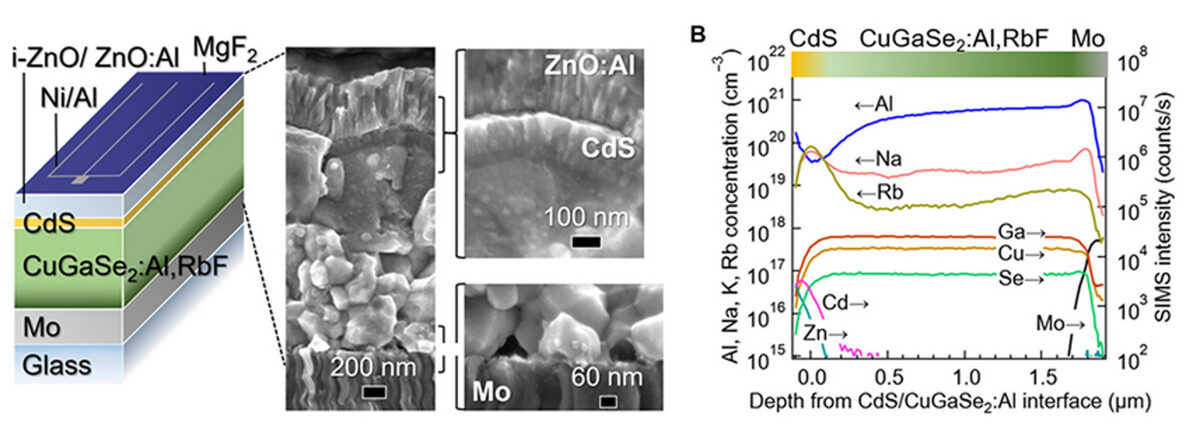
Researchers in Japan have achieved an efficiency of 12.28% in a copper gallium selenide solar cell, the highest reported for wide bandgap indium-free chalcogenide absorbers in the 1.65–1.75 eV range. The device uses backfield aluminum films and optimized cadmium sulfide buffer layers to improve strain, reduce recombination and improve overall performance.
Researchers from the National Institute of Advanced Industrial Sciences and Technology (AIST) in Japan have achieved an energy conversion efficiency of 12.28% in a solar cell based on an absober made of copper gallium selenide (CuGaSe2).
CuGaSe₂ is a chalcogenide semiconductor belonging to the chalcopyrite family and closely related to cupper indium gallium selenide (CIGS) solar cell materials. It is a promising material for solar cell absorbers because it has a direct bandgap semiconductor with a bandgap of about 1.68 eV, which allows efficient absorption of visible sunlight. In addition, CuGaSe₂ has a high absorption coefficient, which means that even very thin films can absorb a large portion of incoming solar radiation. The material also exhibits good defect tolerance, which reduces charge carrier recombination and allows the solar cell to perform well even if the crystal structure is not perfectly defect-free.
“The The achieved efficiency can be considered as the highest reported efficiency for wide bandgap chalcogenide solar cells in the range of 1.65–1.75 eV, especially among indium-free chalcopyrite or CIGS-related wide bandgap solar cells,” shared the study’s lead author Shogo Ishizuka. pv magazine. “It exceeds the previously reported performance of CuGaSe₂ aluminum solar cells listed in Table 3 of the Efficiency Tables – Version 67 – published in the latest Progress in photovoltaics.”
“The device’s performance has been independently certified by an accredited testing laboratory, the Photovoltaic Calibration, Standards and Measurement Team of the Renewable Energy Advanced Research Center, AIST”, he continued.
The device builds on an earlier cell design developed by AIST researchers in 2024. It contains aluminum (Al) on the back of CuGaSe₂ films, which improves the open-circuit voltage, fill factor and overall efficiency of the cell. This improvement is mainly due to the formation of a back-surface field (BSF), which promotes the collection of minority carriers.
The world record solar cell uses a CuGaSe₂ absorber grown via a three-stage process, with Al and RbF supplied during the early first stage and additional RbF introduced in the latter part of the third stage. The new design aims to increase open-circuit voltage without compromising efficiency, by carefully controlling the aluminum distribution in the absorber.
The cell is built on a soda lime glass (SLG) substrate covered with molybdenum (Mo) as a back contact. Above this is an indium-free chalcopyrite absorber, a 150 nm cadmium sulfide (CdS) buffer layer, a zinc oxide (ZnO) window layer and a metal grid electrode.
Fabrication begins by sputtering the Mo back contact onto the SLG substrate. The CuGaSe2 absorbent layer is then deposited by high-temperature deposition and selenization, where Al is incorporated near the backside to form the BSF. The absorber undergoes an alkaline post-deposition treatment to passivate defects and improve electronic properties. The CdS buffer layer is added via chemical bath deposition, forming the p-n junction, followed by sputtering of intrinsic and Al-doped ZnO window layers and the front electrode.
Optimizing the absorber with steeper Al gradients and a thicker CdS layer compared to the previous cell increased the open-circuit voltage and reduced interfacial recombination. The device achieved an efficiency of 12.28%, an open-circuit voltage of 0.996 V, a short-circuit current of 17.90 mA/cm² and a fill factor of 68.8%.
For comparison, the 2024 device achieved an efficiency of 12.25%, an open-circuit voltage of 0.959 V, a short-circuit current of 17.64 mA/cm² and a fill factor of 72.5%.
The cell was described in “Bulk and interface engineering of 1.7 eV bandgap chalcogenide solar cells enabling record efficiency”, published in ScienceProgress.
“Us The work focuses on the fundamental research and development of wide bandgap devices intended for use as top cells in tandem solar cells. Furthermore, the fabrication of a prototype device would require the development of a suitable soil cell and tandem technologies. Therefore, this research is not yet at the stage where mass production can be considered” said Ishizuka. “A detailed cost analysis has not yet been conducted as the current work is still in the basic research phase.”
This content is copyrighted and may not be reused. If you would like to collaborate with us and reuse some of our content, please contact: editors@pv-magazine.com.
