

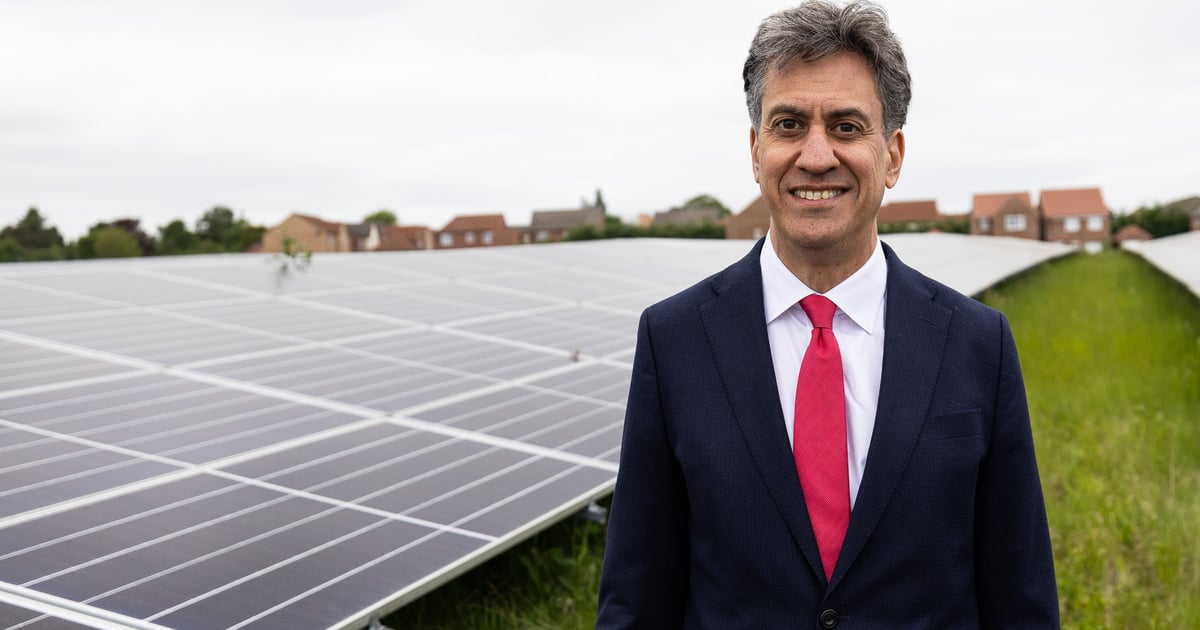
The British government is focusing on solar power generation in its drive for energy security in response to price shocks caused by conflict in the Middle East.
On March 15, Energy Secretary Ed Miliband outlined a package of measures to go “further and faster” in the pursuit of national energy security. These measures are intended to accelerate existing plans for the rollout of renewable energy sources.
The interventions are:
-
Bringing forward the next Contracts for Difference (CfD) allocation round (AR8), which will take place in July this year
-
To accelerate the adoption of ‘plug-in solar’ for the UK domestic market
-
Apply the lessons from the Fingleton Review (which discussed how to accelerate the development of nuclear power stations) to other infrastructure, such as renewables
The rollout of the Warm Houses planwhich will provide grants and interest-free loans for solar, batteries and other home energy upgrades, will also be accelerated.
The next auction for sustainable energy has been brought forward
The seventh allocation round (AR7) of the government’s flagship CfD program concluded last month. It secured A total of 4.9 GW of solar energy and 13.3 GW of sustainable generation capacitythe largest ever around.
According to Miliband, bringing forward the next renewable energy auction will “[give] security for clean energy investors.”
The support scheme provides financial security for renewable energy sources and in turn makes generation projects more attractive to investors.
Miliband also said: “Global events show that there is not a moment to lose in our pursuit of clean energy, because there can be no energy security while we are so dependent on fossil fuels.”
The consequences of the American-Israeli attacks in Iran could impact the UK energy market due to the country’s dependence on gas-fired generation. Gas prices, set at an international level, have soared, and many are drawing parallels with Russia’s invasion of Ukraine, which caused the energy crisis from which domestic and industrial energy prices are still recovering.
The UK energy market uses marginal pricing, where energy is priced at the expense of the most expensive unit at a given time, usually gas. The amount of gas in the energy system was the reason the energy crisis between Russia and Ukraine was felt so keenly in Britain.
Last week, the Climate Change Committee (CCC) published an analysis showing that the total The cost to Britain of transitioning to Net Zero by 2050 would be less than a single fossil fuel price shock like the 2022 energy crisis.
As more renewable energy comes onto the market, gas will disappear into the market, meaning prices will fall. A in-depth explanation of this is given by Simon Evans op Carbon short.
Of the measures announced, solar industry trade body Solar Energy UK (SEUK) said the “unexpected” imposition of AR8 before July 2026 “will have the biggest impact” and help push “expensive” natural gas off the grid to “lower bills for us all”.
‘Plug-in solar’ is sold in supermarkets
As prices rise in the wholesale market, small-scale solar energy is an important way for consumers and businesses to reduce their energy costs. Homeowners with rooftop PV panels see their energy bills drop significantly, especially when combined with battery energy storage.
The government’s Great British Energy Company has done just that funded rooftop solar installations for public buildings in Great Britain as a way to reduce pressure on energy bills for schools and hospitals.
To make the solution more widely available, especially to people living in homes where conventional roof installations are not possible, and at a lower cost, so-called plug-in panels will be sold in supermarkets, the government said.
One of the actions from the UK solar energy roadmap was to investigate the safety of the technology, which was banned in Britain but widely used in other countries including Germany and the Netherlands.
SEUK noted that the savings from this technology are smaller than those from traditional installations.
Still, SEUK CEO Chris Hewett said he is “delighted to see solar energy will be central to the government’s response”, describing the technology as “the fastest and cheapest solution to rising energy bills, on the smallest and largest scale”.
Following the Fingleton Review, preventing price gouging
In November 2025, economist John Fingleton’s Nuclear Regulatory Review was published on behalf of the government. It found that an ‘overly complex’ and ‘bureaucratic’ system that prioritized processes over safe outcomes was holding back the nuclear industry.
Late last week, the government published plans to implement the study’s findings to improve efficiency and accelerate the rollout of nuclear power in Britain. Miliband’s claim since then is that the same practice can be applied to other major infrastructure.
In addition to the solar measures, the government said it is working with the Competition and Markets Authority (CMA) to step up oversight of the fuel sector to ensure companies do not take advantage of rising oil prices to price customers.
The higher cost of refueling internal combustion engine (ICE) vehicles has warned consumers to drive as little as possible, which has also prompted the electric vehicle (EV) industry to highlight the relative insulation against price shocks that driving an electric car provides.
