

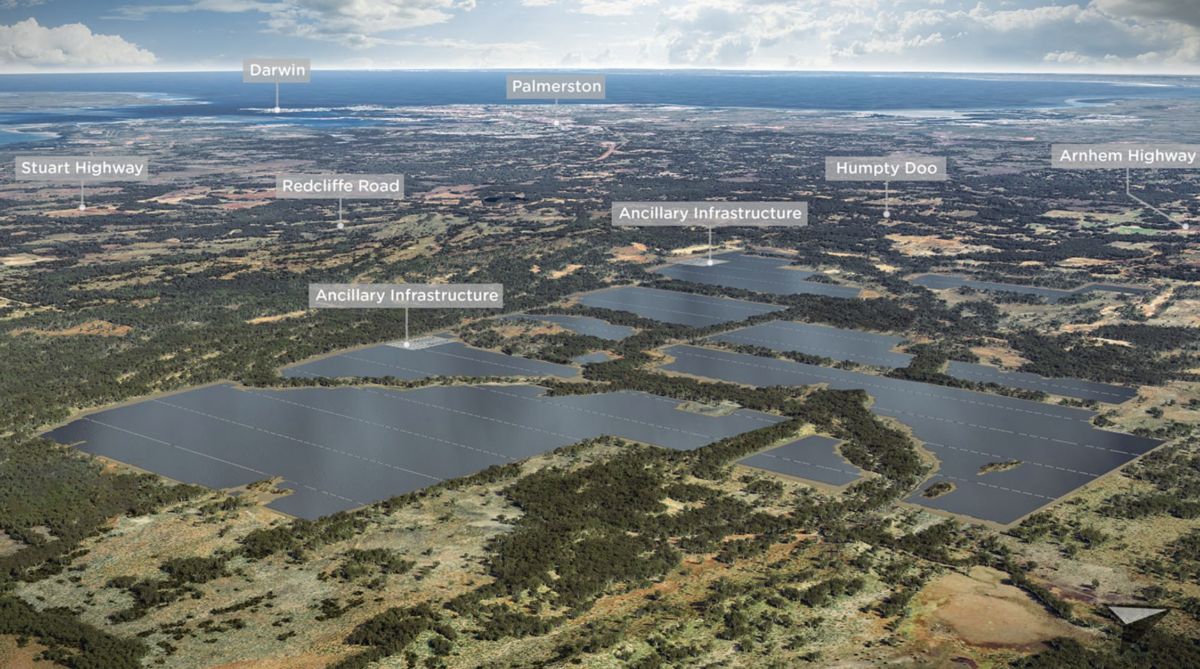
French renewable energy developer TE H2 has submitted a government application for approval to build a 2.7 GW solar farm and 6 GWh battery energy storage in Australia’s Northern Territory.
TE H2, a joint venture between French oil giant TotalEnergies and Paris-based renewables producer Eren Groupe, has submitted plans for one of Australia’s largest solar and battery energy storage projects for assessment under the Environment Protection and Biodiversity Conservation (EPBC) Act.
The federal government runs EPBC assessment process aims to protect nationally endangered species and ecological communities.
The AUD2.8 billion ($1.9 billion) Wak Wak project, proposed for a 3,400 hectare site near Humpty Doo, about 48 km south of Darwin, will include a 2.7 GW solar farm that would “enable an optimized year-round energy supply to potential electricity customers.”
In documents referred for review under the federal EPBC Act, TE H2 said the concept design also includes 6 GWh of battery energy storage to “enhance the renewable energy provided and balance solar energy generation with electricity consumption at downstream facilities, provide local grid stability services and serve as a backup to ensure safe shutdown of the facility when necessary.”
TE H2 said that although “the project is currently in the concept design stage”, the aim of the proposal is to generate and store renewable solar energy for both existing industry in the greater Darwin region, as well as potential for renewable green hydrogen generation.
“The ultimate end use of the solar energy is as a critical input to initially produce a robust sustainable energy supply to existing industrial end users at Middle Arm and to power green hydrogen production at the Middle Arm Precinct at a later stage,” said TE H2.
EPBC referral documents say renewable energy generated at the Wak Wak facility will be sent via a planned overhead high-voltage transmission line to Middle arm where TE H2 has the Darwin H2 Hub under development, potentially connecting to the Darwin Katherine network.
TE H2 has been proposed Darwin H2 Hub There will be a 1 GW electrolyzer capable of producing more than 80,000 tons of green hydrogen per year for the national and international markets.
Construction of the Wak Wak solar and battery facility is expected to begin in 2027, pending project approvals. It is likely that the solar farm will be developed in phases, with the first phase expected to be in the region of 900 MW.
TE H2 said energy for construction will include a combination of temporary solar and on-site battery storage, likely supplemented by diesel generators during the erection and early work phases.
The project is expected to create up to 900 jobs during the construction phase.
This content is copyrighted and may not be reused. If you would like to collaborate with us and reuse some of our content, please contact: editors@pv-magazine.com.
