

The European Network of Transmission System Operators for Electricity (Entso-E) has published its final root cause report on the April 28, 2025 blackout in Spain and Portugal, identifying faults in network management, generation and regulation and making 22 recommendations to strengthen the resilience of the European network.
A 440-page report published on Friday by an Entso-E expert group has identified systemic failures in voltage control, reactive energy management and regulatory frameworks as the root causes of the blackout that knocked out power to mainland Spain and Portugal on April 28, 2025. The report divides responsibility among Spanish grid operator Red Eléctrica, conventional and renewable generation facilities, and the regulations in which they operated.
The report found that key voltage control equipment was being manually connected and disconnected, slowing down response times, and that operators had no real-time monitoring of the gap between the reactive power required by the system and the power actually delivered by the generators. Several conventional generators also failed to meet system operator-requested reactive power set points, reaching less than 75% of required power at critical times.
Renewable installations have contributed to the cascade. Many operated on a fixed power factor schedule, limiting their ability to respond to voltage fluctuations, and a significant number automatically disconnected before reaching the voltage thresholds specified at their grid connection points – some with surge protection below regulatory limits.
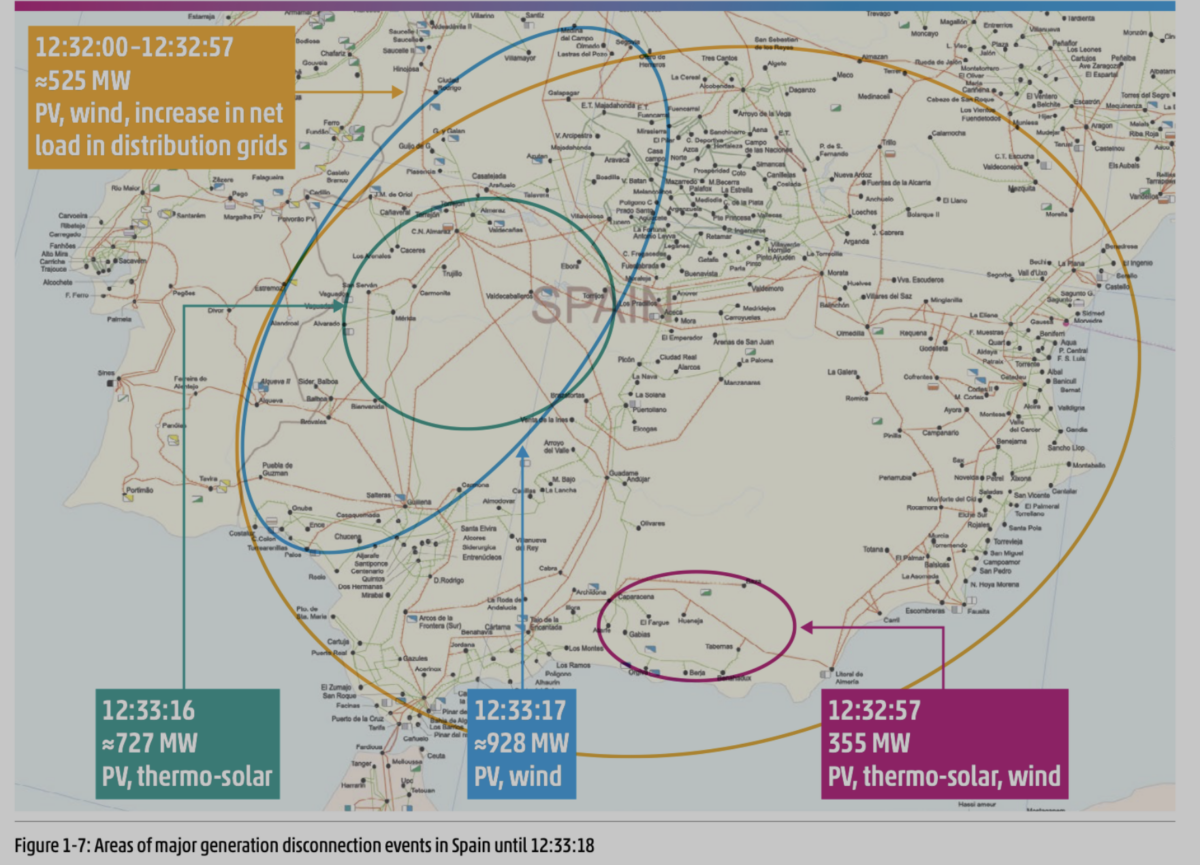
The series unfolded quickly. Between 12:32 p.m. and 12:32:48 p.m. on the day of the power outage, production from large renewable plants – those larger than 5 MW – in Spain fell by around 500 MW. As of 12:33:16, shutdowns in the Badajoz region had eliminated 727 MW of photovoltaic and concentrated solar power generation. Within the next two seconds, another 928 MW was disconnected in five provinces. In total, more than 2.5 GW of generation was lost, with voltages of more than 435 kV. At 12:33:19, the Spanish and Portuguese systems lost synchronization with the European power grid. Automatic load shedding and defense mechanisms activated between 12:33:19 and 12:33:22 failed to prevent the collapse.
ENTSO-E said the investigation was hampered by incomplete data. Distribution system operators (DSOs) did not have access to actual production data from generators of less than 1 MW – mainly rooftop solar – and several power generation unit owners cited a lack of outage records as the reason they could not provide information on disconnections that occurred before the outage. Two inverter manufacturers provided voluntarily collected data; The report notes that data gaps prevented the expert group from identifying the cause of some disconnects.
The report’s 22 recommendations are structured around four areas: voltage regulation and reactive power, oscillatory stability, decoupling behavior, and defense and recovery. In the field of voltage control, Entso-E calls for sufficient reactive energy sources, improved real-time visibility and a shift from fixed power factor schemes to active voltage control. It also recommends harmonizing operating voltage ranges across Europe from 380 kV to 420 kV.
On the issue of disconnection, calls for a review of protection settings and stricter surge control requirements, especially for small-scale generation. In defense and recovery, it recommends adaptive relief arrangements and better coordination between operators. Across all areas, it calls for standardized data collection frameworks to ensure investigators have access to complete and consistent data after future incidents.
This content is copyrighted and may not be reused. If you would like to collaborate with us and reuse some of our content, please contact: editors@pv-magazine.com.
