

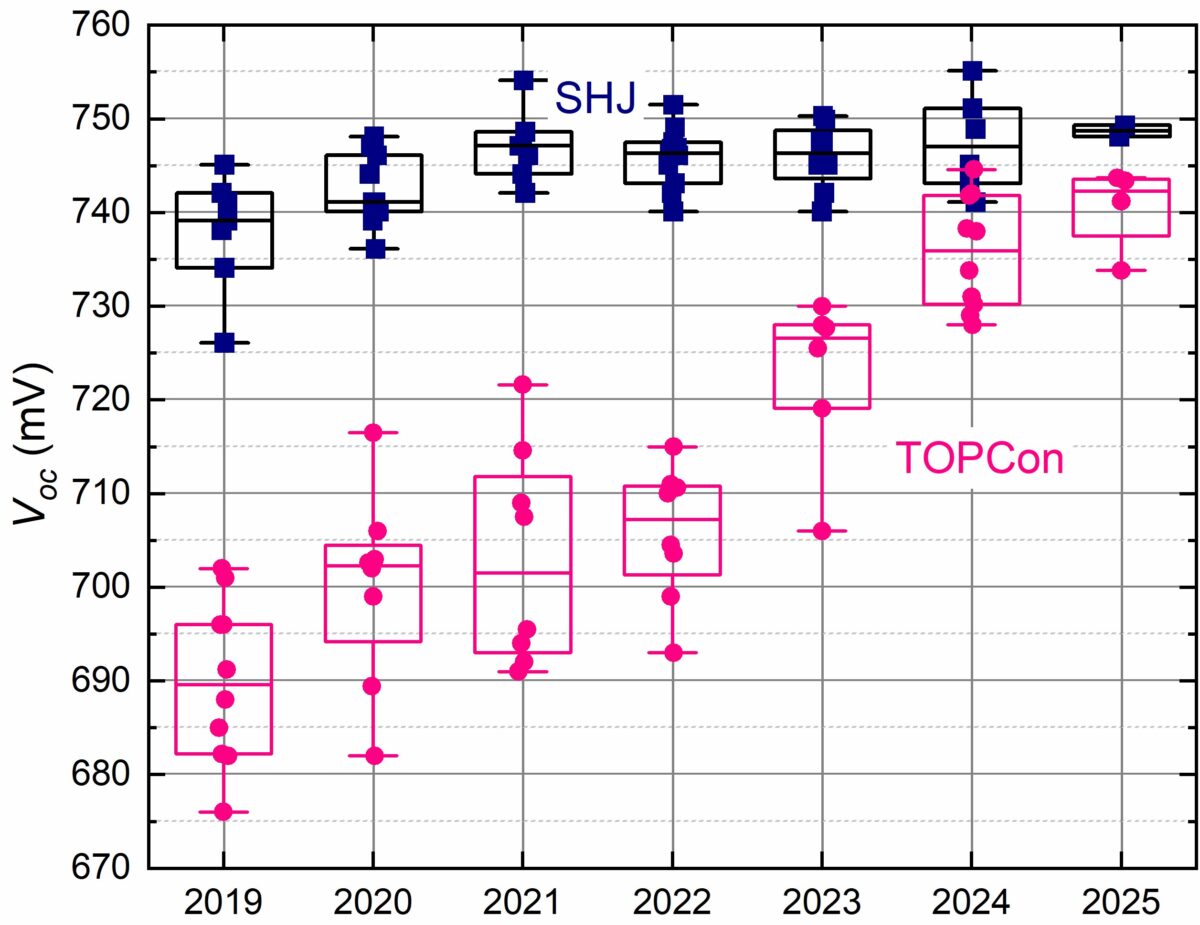
Scientists in Australia claim that TOPCon cells are rapidly closing the open-circuit voltage gap with heterojunction counterparts, now below 10 mV, while offering greater wafer tolerance and high industrial scalability. Despite the slightly lower efficiency, TOPCon-based perovskite/silicon tandems can achieve a levelized energy cost comparable to heterojunction-based tandems, thanks to lower manufacturing costs, the researchers said.
Heterojunction (HJT) solar cells generally achieve slightly higher open-circuit voltage than TOPCon devices, reflecting differences in surface passivation and recombination losses.
The advantage of HJT comes from the use of intrinsic amorphous silicon layers, which provide excellent surface passivation and reduce carrier recombination. Although TOPCon technology has significantly reduced the gap through advanced tunnel oxide passivated contacts, a small performance difference remains, contributing to HJT’s marginally higher efficiency potential.
With this in mind, researchers from the The Australian National University (ANU) has sought to quantify this distance and provide a realistic roadmap for TOPCon to remain competitive as a bottom cell technology in the emerging perovskite-silicon tandem segment.
Open circuit voltage difference
“We analyzed recent incremental innovations in TOPCon technology and show that the traditional open-circuit voltage advantage of HJT cells is rapidly decreasing and is now approaching a gap of less than 10 mV,” said the study’s corresponding author Rabin Basnet. pv magazine. “Building on this, we presented quantitative models of the tandem efficiency potential, benchmarking TOPCon and HJT bottom cells under realistic assumptions. This allowed us to identify the origins of the current performance gap and the conditions under which TOPCon-based tandems can become competitive.”
“Our research provides a systematic analysis of the device-level tradeoffs, including surface passivation, optical performance, and contact recombination, specifically in the context of TOPCon-based tandem architectures,” he continued. “We also propose a technology roadmap tailored to TOPCon tandems, highlighting key research directions such as double-sided texturing, poly-Si thickness reduction and contact optimization, along with their expected impact on device performance.”
In the newspaper “TOPCon-based bottom cells for perovskite/silicon tandem solar cells”, published in JouleBasnet and his colleagues explained that over the past two years, TOPCon cells have been able to reduce the open-circuit voltage gap with HJT counterparts to less than 10 mV, with the laser-assisted firing (LECO) process improving front contact passivation and enabling an open-circuit voltage of 740 mV in recent mass-produced TOPCon cells.
Additionally, they noted that innovations in contact optimization and metallization have increased TOPCon fill factors above 84%, approaching HJT performance. However, simulations of two-terminal (2T) perovskite/silicon tandems still indicate that HJT-based tandems achieve higher power conversion efficiency due to superior fill factor and short-circuit current.
Mass production
The research team highlighted that mass production of TOPCon cells is less demanding in terms of wafer quality due to poly-Si gettering, while HJT requires high-purity wafers and pre-getter steps to reduce defects, increasing cost and complexity. It also highlighted that TOPCon fabrication involves 8 to 10 steps, including boron-diffused front emitters and n⁺ poly-Si back contacts with silicon oxide (SiOx) interlayers, while HJT involves only 4 to 6 low-temperature steps, although it also requires amorphous and doped silicon layers, TCO deposition and low-temperature metallization.
“Despite requiring fewer process steps, the production of HJT cells remains more expensive than TOPCon,” the academics said. “The Capex per GW for TOPCon production lines is approximately two to three times lower than that of HJT lines and remains competitive with that of previous mature PERC technology based P-type waffles. This cost advantage is mainly due to equipment differences: TOPCon relies on low costs low pressure chemical vapor deposition (LPCVD) instruments, while HJT requires relatively expensive plasma-enhanced Chemical Vapor Deposition (PECVD) instruments, which account for the majority of the investment in the HJT line.”
LCOE
Sustainability and scalability are also presented as additional constraints for HJT, especially due to indium-based transparent conductive oxides (TCOs), which may limit production above 40 GW. TOPCon’s combination of lower costs, industrial compatibility and high efficiency makes it more suitable for large-scale production of perovskite/Si tandems, according to the researchers.
Furthermore, stratified energy cost (LCOE) modeling showed that despite slightly lower efficiency, TOPCon-based tandems can achieve comparable or lower LCOE than HJT-based tandems due to lower manufacturing costs. “These findings are reflected in the strategic focus of some of the leading PV manufacturers, such as JinkoSolar, Trinasolar and Hanwha Qcells, on developing tandem solar cells with TOPCon as the bottom cell,” the academics pointed out.
Despite these promising developments, some challenges still remain for TOPCon as the silicon bottom cell in tandem architectures. These include maintaining effective passivation on structured surfaces, reducing parasitic absorption in poly-Si contacts, and ensuring stability during top cell integration at high temperatures. Overcoming these challenges is critical to fully realize the optical and electrical gains needed to increase the efficiency of 2T tandems and will require innovative approaches in materials engineering such as sub-micron texturing, optimization of thinner doped poly-Si layers and the integration of hydrogen-rich capping layers.
“Overall, our work reframes TOPCon as a realistic, industry-compatible pathway for the scalable production of perovskite/silicon tandem solar cells,” Basnet concluded.
This content is copyrighted and may not be reused. If you would like to collaborate with us and reuse some of our content, please contact: editors@pv-magazine.com.
