

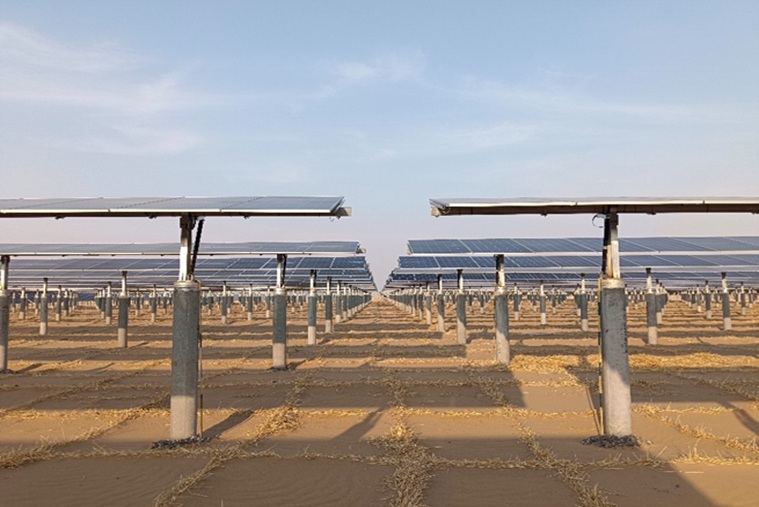
Researchers in China found that PV installations in arid regions create a measurable cool island effect that varies widely depending on season, location and plant design, affecting surrounding vegetation in complex and spatially uneven ways. They showed that cooling intensity and distance between locations differ greatly and are mainly determined by plant morphology.
Researchers from the Chinese Academy of Sciences (CAS) have investigated the photovoltaic plant-induced cool island effect (CIE) in arid areas and found that it significantly affects surrounding vegetation, with the direction and magnitude of impact determined by geographical context and seasonal factors.
CIE refers to a condition in which a specific area is cooler than the surrounding area due to differences in surface properties and energy balance. In PV installations this can occur due to shading on panels, reduced solar absorption at ground level, conversion of sunlight to electricity and enhanced convective heat dissipation.
“We analyzed eight PV installations in China’s arid areas using Landsat-8 land surface temperature, kernel normalized difference vegetation index, buffer analysis and partial least squares structural equation modeling (PLS-SEM),” the group explained. “Eight PV power plants located in the arid areas of China, mainly in Xinjiang, Inner Mongolia, Gansu and Qinghai, were selected for this study.”
The scientists used 2022 land surface temperature (LST) data derived from seasonal images captured by the Landsat 8. These LST datasets were used to quantify the cool island effect induced by photovoltaic (PV) installations using two key metrics: cooling intensity (XD), defined as the temperature difference between the area of the PV installation and the surrounding environment, and cooling distance (Dist), which describes how far the cooling influence extends outward from the installation.
Furthermore, the same remote sensing data were used to calculate vegetation indices, specifically kernel normalized difference vegetation index (kNDVI), to evaluate vegetation responses both within the cooled zone and in adjacent areas outside its influence. This allowed the researchers to assess not only the spatial extent of the cooling effect, but also its ecological impact on plant growth dynamics in different zones.
The results showed that the cooling intensity (XD) reached the highest value of 3.1 C in summer in Wuzhong City (WZ), while the lowest value of 0.02 C was observed in autumn in Hongshagang Town, Minqin County, Gansu Province (HSG). Moreover, the cool island effect (CIE) was not present in certain seasons at several locations, including Urad Banner (WLTQ) in spring, Huanghuatan Town (HHT) in autumn, and Hami (HM) in winter.
Furthermore, the results indicated that summer generally showed elevated XD values, including 2.1 C in Dalad Banner (DLT) and a peak of 3.1 C in Wuzhong City. In contrast, winter conditions showed greater spatial variability: Gonghe County (GH) recorded a relatively high XD of 2.6 C, while Huanghuatan Town and Dalad Banner remained significantly lower, at 0.31 C and 0.9 C, respectively.
At all eight study sites, cooling distance was found to vary significantly, ranging from 120 m to 540 m, highlighting strong site-specific differences in the spatial extent of the cool island effect.
Partial least squares structural equation modeling (PLS-SEM) further revealed that morphological complexity is the dominant driver of the cooling effect, while larger photovoltaic installations exert a strong suppressive influence. The climatic conditions also appeared to make a positive contribution, albeit to a lesser extent. Collectively, these factors explained approximately 63% of the observed variation in cooling intensity and magnitude.
The analysis additionally suggested that vegetation responses are highly heterogeneous between locations and seasons, depending on both local climatic conditions and the strength of the cooling effect.
“We have proposed a geographically differentiated ‘PV CIE vegetation response’ framework. Medium-sized, decentralized plants with superior shape complexity are preferred in relatively dry and warm areas,” the academics concluded. “However, in cold areas at high altitudes, adjusting the tilt and reducing panel density can reduce vegetation risks.”
Their findings appeared in “Quantification of photovoltaic power plant-induced cool island effect and vegetation response in arid areas”, published in Ecological indicators. Researchers from the Chinese Academy of Sciences, China’s Huadian Gansu Energy Corporation, PowerChina Beijing Engineering Corporation and Britain’s University of Reading contributed to the study.
This content is copyrighted and may not be reused. If you would like to collaborate with us and reuse some of our content, please contact: editors@pv-magazine.com.
