

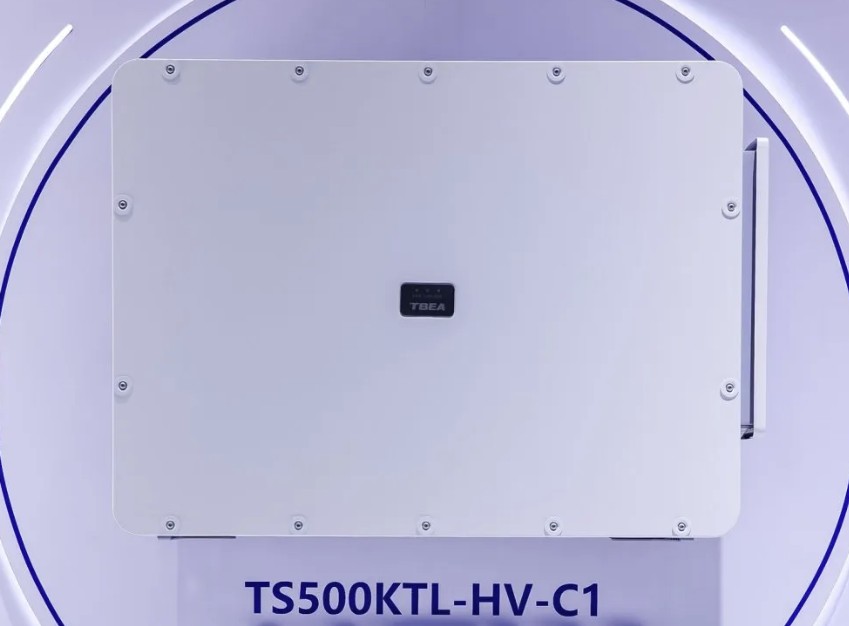
The new inverter is designed around standardized 5 MW and 5.5 MW PV subarrays with the aim of reducing system balance costs. It has a maximum efficiency of 99.0% and a high-voltage architecture up to 1,600 Vdc and 1,000 Vac.
Chinese power transformer manufacturer TBEA has unveiled a 500 kW string inverter for utility-scale solar bases and integrated solar-plus-storage projects.
The company said the TS500KTL-HV-C1 inverter is designed around standardized 5 MW and 5.5 MW PV subarrays and aims to reduce Balance-of-System (BOS) costs while improving network support capabilities.
The new inverter uses a high-voltage architecture up to 1,600 Vdc and 1,000 Vac, a configuration intended to reduce cable usage, reduce line losses and reduce the number of equipment compared to more conventional solutions from the 330 kW class.
TBEA said this approach can reduce initial installation investments and simplify implementation in large ground-mounted projects, where component count and construction efficiency have become increasingly important.
At the device level, the TS500KTL-HV-C1 uses third-generation silicon carbide (SiC) power semiconductors. According to the company’s published specifications, the inverter offers a maximum efficiency of 99.0% and a European efficiency of 98.8%, while also increasing power density and maintaining a compact footprint.
The product is designed to operate at temperatures from -40 C to 70 C and according to TBEA can operate at altitudes up to 5,000 meters without derating.
One of the main design goals of the product is grid interaction. TBEA said the inverter uses voltage source control and can respond within 20 milliseconds, while also providing reactive power compensation and active voltage and frequency support. This gives the unit a role beyond simple power conversion, especially in regions with a weak electricity grid and energy systems with a high share of variable renewable generation.
The company is also positioning the inverter for solar-storage hybrid installations, where it can work alongside grid-forming power conversion systems to improve system stability and increase the use of renewable energy.
In addition to large desert solar plants, TBEA says the model is suitable for high-altitude, cold-climate, coastal and salt spray environments, as well as large commercial and industrial PV installations.
This content is copyrighted and may not be reused. If you would like to collaborate with us and reuse some of our content, please contact: editors@pv-magazine.com.
