

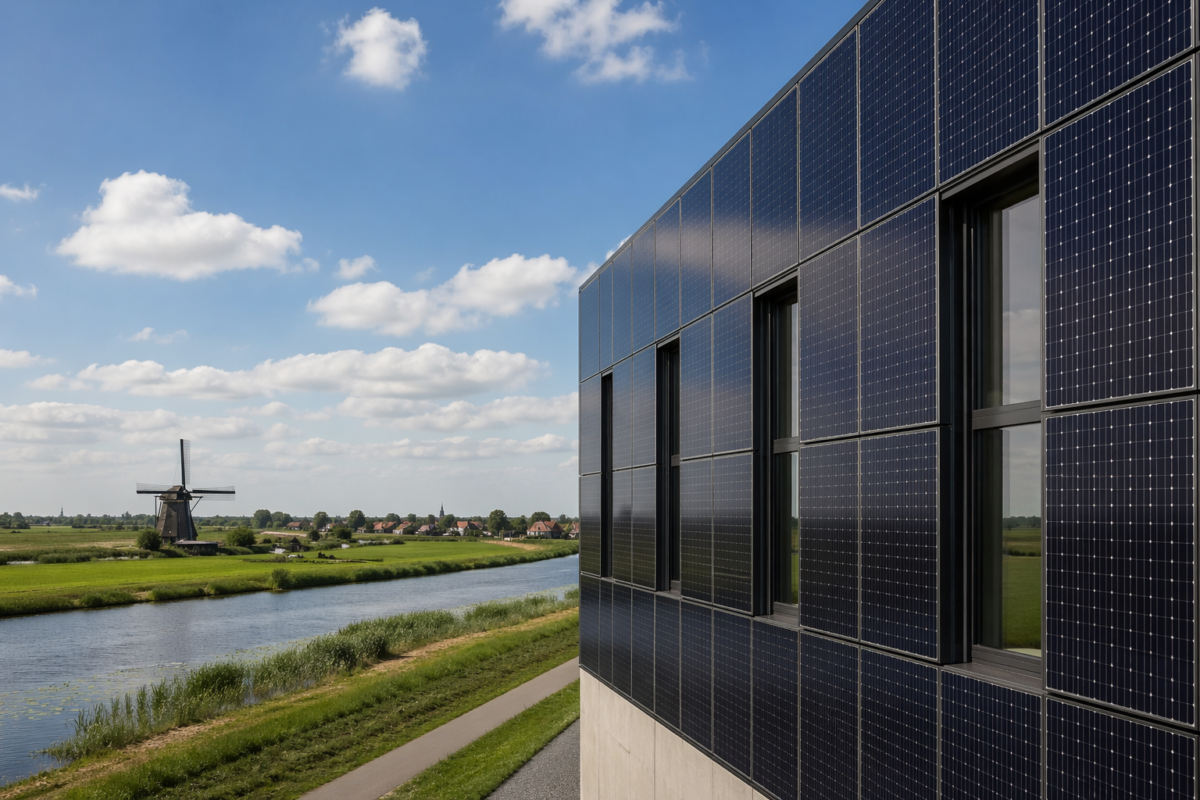
A new report from the Netherlands Enterprise Agency (RVO) estimates that building facades can offer up to 36 GW of technical solar PV potential, representing a significant but largely untapped resource. However, high costs, regulatory complexity and lower performance compared to roof systems limit widespread adoption, making facade PV currently a niche solution for specific building types.
Building-applied photovoltaic solar energy (BAPV) on facades could unlock significant additional solar capacity in the Netherlands, according to a new study by the Netherlands Enterprise Agency (RVO).
The study highlights that while facade PV is unlikely to compete with roof systems in the short term, solar facades should be viewed as a complementary solution, especially in countries with limited space or grid constraints, such as the Netherlands, where permitting issues and grid congestion are increasing.
The researchers identified a technical potential of 36 GW for PV facades in the country, but warned that implementation in practice currently remains minimal, with less than 0.1% of installed PV systems currently on facades.
Despite these limitations, the report identifies two building archetypes for which facade PV can still be a viable option.
The first includes buildings with unsuitable or fully used roofs. In this category, structures such as distribution centers or large commercial halls, where roof space is limited or already occupied, can benefit from vertical PV installations, especially when their electricity demand peaks in the morning or evening, better matching facade generation profiles.
The second archetype includes buildings where architectural or visibility considerations play a key role. In these cases, facade PV is often less about maximizing energy yield and more about design integration, branding or corporate sustainability goals. Examples include government buildings and high-end office developments, where visible solar installations can serve as a statement of environmental commitment while contributing to on-site generation.
Typical designs of existing solar facades in the Netherlands include ‘blue’ PV panels commonly used in residential applications and colored PV panels designed for architectural integration and aesthetic flexibility, offering a range of colors and even printed layouts.
In addition, there are so-called PV panels in cassette systems, which mainly differ in mounting method and not so much in appearance. These systems, as developed by Dutch company ZigZagSolar, allow panels to be installed at an angle instead of flush against the facade, improving energy yield and allowing combinations of colored and conventional modules.
The reports emphasize that cassette systems also better match production to demand patterns, generating relatively more electricity in the morning and evening hours. Overall, they can achieve up to 50% higher yields compared to flat vertical facades, although actual performance depends on design choices such as angle, materials and color integration.
The report identifies several key barriers to the wider adoption of facade PV, including higher installation and maintenance costs compared to roof systems, caused by technical complexity and limited accessibility. Regulatory challenges also hinder implementation, as facade projects often require permits and are subject to unclear aesthetic and municipal design rules. Furthermore, limited awareness of available subsidies, such as the SDE++ scheme, slows down market acceptance.
To address these issues, the study recommends a targeted approach that prioritizes rooftop PV while selectively deploying facade systems, supported by more demonstration projects for public buildings, improved transparency of costs and business cases, simplified permitting and better communication on financial incentives. Municipalities and national authorities are encouraged to lead by example through facade PV implementation on public real estate.
This content is copyrighted and may not be reused. If you would like to collaborate with us and reuse some of our content, please contact: editors@pv-magazine.com.
