

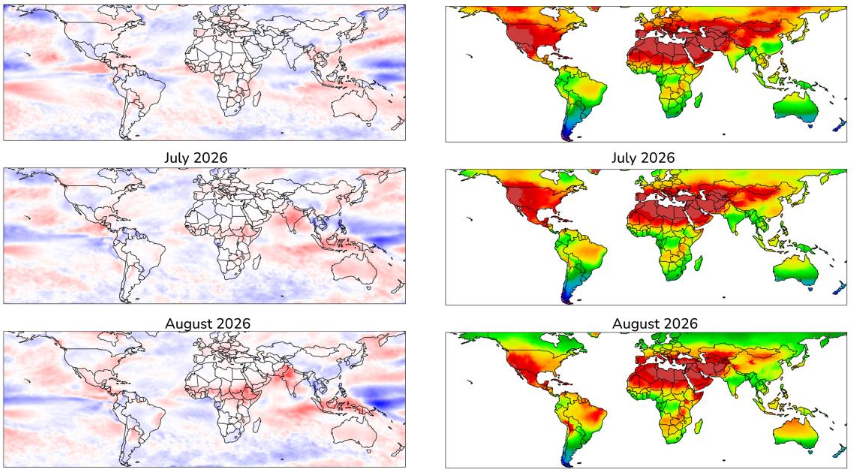
In a new weekly update for pv magazineSolcast, a DNV company, provides outlooks for June-August 2026, which indicate mostly neutral to positive solar radiation globally, with stronger gains in regions such as Australasia, South Asia, West Africa and Central America – patterns consistent with a developing El Niño. Negative deviations are limited and mainly early in the season, while Europe and the US show modest or mixed signals, with improvements or neutrality dominating as the season progresses.
The seasonal outlook for June, July and August 2026 indicates largely neutral to positive solar radiation conditions in many key solar regions, with several associated regional signals consistent with a developing El Niño, according to analysis using the Solcast API. The strongest positive anomalies are concentrated on the Maritime Continent and Australasia, parts of South Asia later in the season, the Sahel and parts of West Africa, and Central America in August. The European trend is overall neutral to modestly positive. Negative anomalies are mainly concentrated in the monsoon regions at the beginning of the season, but in several cases weaken or return as the season progresses.
On the Maritime Continent and in Australasia, the outlook shows clear progress towards higher than average insolation over the three-month period. Conditions in June are already slightly positive compared to the long-term average, but the positive anomalies strengthen in July and become even more pronounced in August, with parts of Malaysia, Indonesia, northern Australia and the Coral Sea nearly 20% above average. This pattern is consistent with reduced cloud cover across the region, a known early signal of the development of El Niño conditions. For solar, this points to a generally favorable winter period in Australia and surrounding markets, although the early season signal remains relatively mild.

In South Asia, the signal of seasonal deviations evolves more sharply. June is forecast to be cloudier across India, as the summer monsoon usually brings around this time, keeping insolation near normal or slightly below average. However, in July and August that pattern reverses and clearer conditions emerge across much of India and Pakistan. August shows the strongest positive deviations; in some areas it is almost 20% above the long-term average. A similar suppression of cloud cover is evident in the Sahel and parts of West Africa, where above-average insolation persists for much of the season. In both regions, the pattern has been associated with weaker monsoon activity, which can occur during El Niño development.

Europe presents a calmer but still constructive signal. June shows mild positive anomalies in the Iberian Peninsula and parts of Eastern Europe, while Southern Europe and Great Britain remain close to average. In July and August, positive anomalies extend across much of the continent, from France to Central and Eastern Europe, with most areas expected to be around 5% to 10% above average. There are still areas of neutrality and mild weakness, especially around Britain and parts of southern Europe at the start of the period, but no major sustained negative signal dominates the European outlook.

In America, Central America stands out for its late seasonal shift. June starts with below-average insolation, but conditions are expected to improve quickly, turning positive in July and strengthening further in August when anomalies approach 20% above average. This is again largely consistent with an El Niño background. The United States shows a weaker and more mixed signal. The trends in the southeast are slightly positive, while the southwest may see a slight increase later in the season. In contrast, the Pacific Northwest is trending slightly negative, indicating more persistent cloud cover and little sign of a strong seasonal signal for utility-scale solar in the country’s key southwestern markets.

Solcast produces these figures by tracking clouds and aerosols worldwide at a resolution of 1-2 km, using proprietary satellite data AI/ML algorithms. This data is used to drive irradiance models, allowing Solcast to calculate high-resolution irradiance, with a typical deviation of less than 2%, as well as cloud tracking predictions. This data is used by more than 350 companies that manage more than 300 GW of solar energy worldwide.
The views and opinions expressed in this article are those of the author and do not necessarily reflect those of the author pv magazine.
This content is copyrighted and may not be reused. If you would like to collaborate with us and reuse some of our content, please contact: editors@pv-magazine.com.
Popular content

