

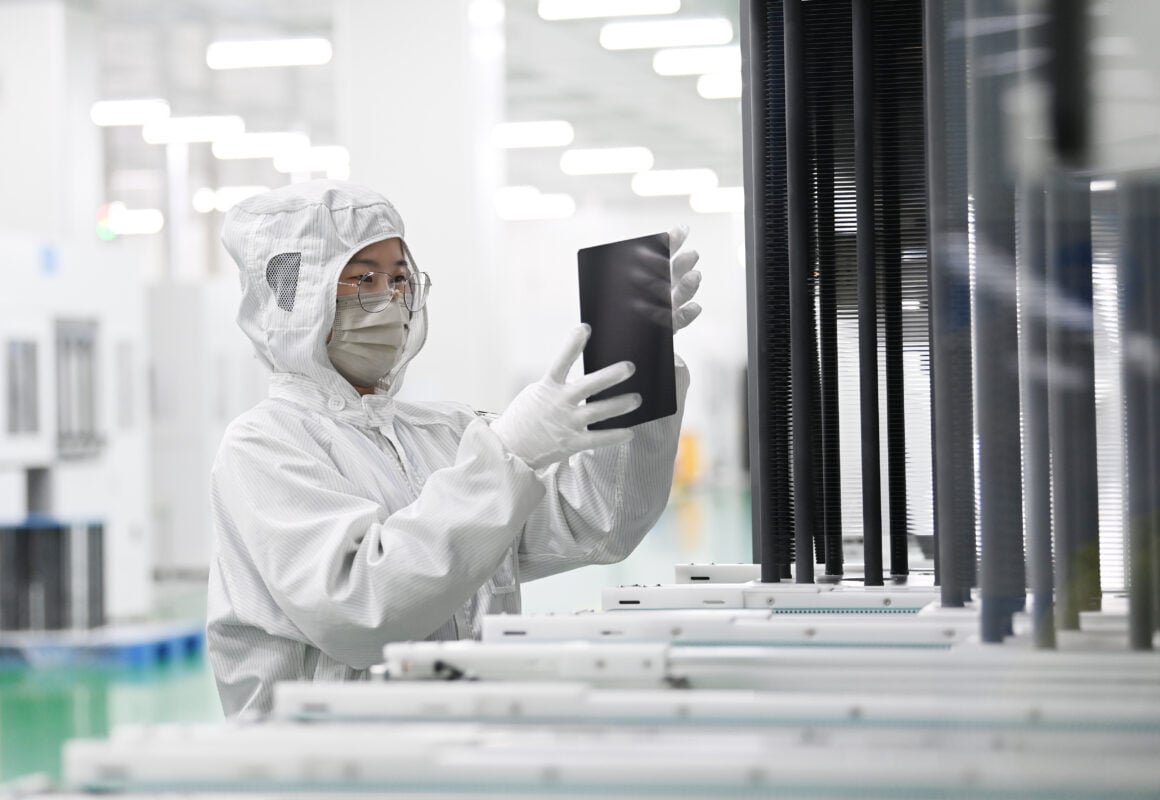
The Chinese manufacturer said its TOPCon-compatible hybrid back-contact solar cell achieved an energy conversion efficiency of 28.0%. The result was confirmed by the German Institute for Solar Energy Research Hamelin (ISFH).
Chinese solar panel manufacturer Trina Solar announced yesterday that it has achieved an energy conversion efficiency of 28.00% for its new TOPCon-compatible hybrid back-contact solar cell (THBC), with the result certified by the German Institute for Solar Energy Research Hamelin (ISFH).
The company said this achievement marks the first time a large-area 210R crystalline silicon cell has exceeded the 28% threshold, setting a new benchmark for this class of devices.
According to Trina, THBC technology combines several mainstream high-efficiency concepts in one architecture. It is described as a hybrid design that combines the passivated contact capability of TOPCon, heterojunction (HJT) style passivation advantages, and a back contact (BC) electrode structure. That means moving both electrodes to the back of the cell, eliminating metal shadows at the front and increasing light utilization at the front.
Trina says the approach is intended not only to increase efficiency, but also to improve appearance and product differentiation in premium distributed generation applications.
For TOPCon, the result is significant because it suggests that the technology still has an upgrade path beyond conventional front-contact designs. Rather than completely replacing TOPCon, THBC is positioned as a TOPCon-compatible extension that can reuse much of the current manufacturing base while moving toward higher single-junction efficiency.
Trina says the cell is compatible with thin wafers from 110 μm to 130 μm and is highly compatible with today’s mainstream TOPCon production lines, potentially reducing the cost and complexity of commercialization compared to building a brand new platform from scratch.
The company has also outlined a product roadmap. Based on the existing THBC pilot line, Trina said a standard size module of 2,382mm x 1,134mm could exceed 700W, adding that a new generation of THBC-based products will be released soon.
A source close to Trina also said this pv magazine that the company already has mass production plans for the THBC cell.
The new result surpasses the previous BC cell benchmark from Longi, whose hybrid interdigitated back contact (HIBC) cell achieved an efficiency of 27.81% in April 2025, also with ISFH certification. Longi described this at the time as a world record for monocrystalline silicon solar cells. Trina’s latest announcement therefore once again raises the certified ceiling for back-contact crystalline silicon cell designs, while reinforcing the broader industry push to combine higher efficiency with greater manufacturability.
This content is copyrighted and may not be reused. If you would like to collaborate with us and reuse some of our content, please contact: editors@pv-magazine.com.
