

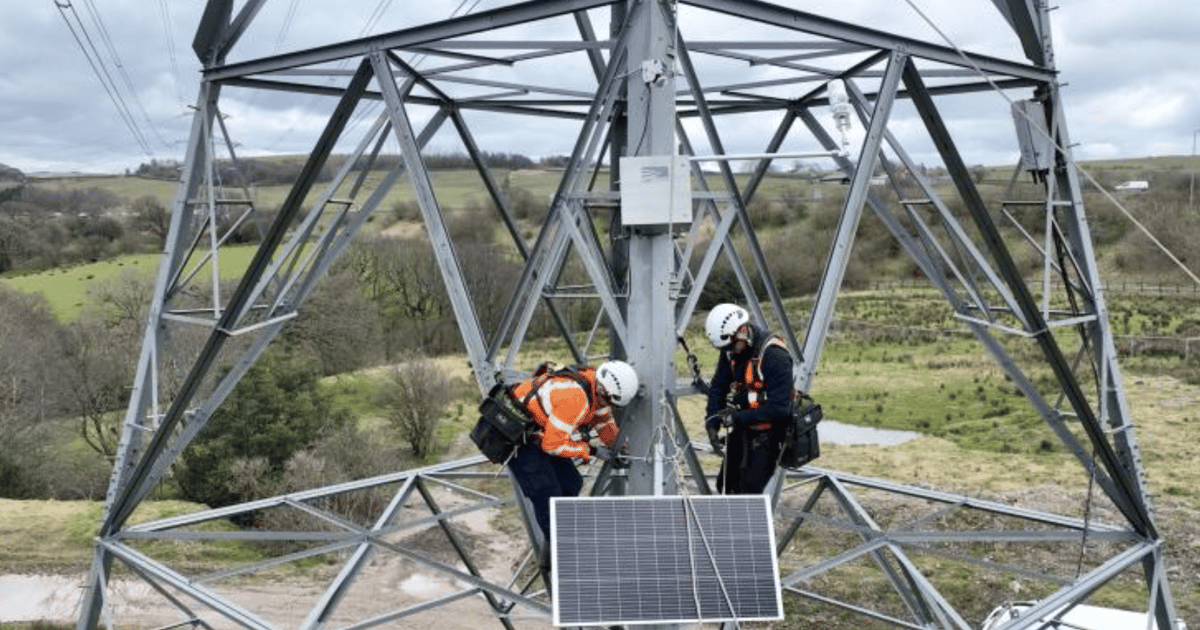
National Grid will extend its Dynamic Line Rating (DLR) technology to 585km of existing transmission routes, which is expected to save consumers up to £50 million in mitigation costs over the next five years.
The DLR system involves the deployment of sensors that continuously monitor the function of electricity transmission lines, to calculate a dynamic line rating, from which the system takes its name. This rating includes variables such as the wire specifications and weather conditions to generate a figure representing a wire’s maximum safe rating, which is often lower and much more accurate than conventional assumptions made without the use of continuous monitoring.
National Grid estimates that the use of DLR technology will allow transmission lines to carry an average of 8% more electricity without posing any additional risk, and has initially deployed the technology on a trial basis along its networks in the US states of New York and Massachusetts, in partnership with US-based DLR provider LineVision. National Grid then brought the technology to Britain through a two-year pilot program in Cumbria, starting in 2022. expanded the DLR system last year, adding 275 km of new transmission routes.
The network operator estimates that the use of DLR technology has saved £21 million over the past five years by eliminating the need to pay fees.
The next generation of DLR technology will be rolled out over the next five years through a contract with LineVision, Belgian grid monitoring company Ampacimon and Danish cybersecurity company Heimdall. National Grid expects “the majority” of the upgrades to be completed by 2028, and expects the work will also include the use of drones to mount sensors on power lines.
“By embracing innovation and using advanced technology like DLR, we are unlocking greater capacity on our existing network and allowing more renewable energy to flow to homes and businesses,” said Alice Delahunty, president of National Grid Electricity Transmission.
“Integrating grid-enhancing technologies like these will deliver significant savings for consumers by reducing curtailment costs and is an important part of our work to upgrade the grid to deliver a resilient, future-proof energy system.”
The expansion of the UK’s operational network infrastructure would be a significant benefit given the growing problem of a lack of available network capacity. Earlier this year, Toby Virno, investment manager at Foresight Solar Fund, said: wrote a blog for Solar Power Portal highlighting that the cost of containment measures in Britain has risen to £2.3 billion as Britain commissions more renewable energy capacity than the country has the network infrastructure to use effectively.
