A German research team has developed a non-destructive on-site method to quantify water ingress into photovoltaic modules using near-infrared absorption (NIRA) spectroscopy calibrated with Karl-Fischer titration (KFT). The approach enables accurate measurement of absolute moisture content in sealed modules without disassembly, improving inspection, failure analysis and service life prediction.
A German research group has developed a new, non-destructive method to quantify water penetration into solar panels on site. The technique uses near-infrared absorption spectroscopy (NIRA), calibrated based on absolute water content measured via Karl-Fischer titration (KFT), allowing inspectors to determine the moisture level in modules without opening them.
“The methodology is non-invasive, does not require changes to the bill of materials, such as additional sensors, and is broadly applicable to field-deployed modules, provided prior calibration has been performed,” corresponding author Anton Mordvinkin told us. pv magazine. “Unlike conventional approaches, it is not based on assumptions such as Henry’s law or on approximations of evolving barrier properties or uncertainties associated with a module’s internal microclimate.”
Mordvinkin said the approach lays the foundation for more accurate modeling of moisture intrusion and improves the reliability of module life predictions. “It provides actionable insights for manufacturers to optimize the design and qualification of products that can withstand moisture-induced degradation mechanisms, including moisture-induced degradation (MID) and potential-induced degradation (PID), especially in challenging environments such as floating PV systems and tropical climates, but also for emerging technologies such as tandem cells,” he added.
He also noted that the method improves the inspection of solar farms by enabling the identification of modules with insulation deficiencies, supporting targeted mitigation measures. “These advances directly contribute to better bankability of assets and provide a robust technical foundation for future guarantee and recovery processes,” he said.
Image: Fraunhofer Center for Silicon Photovoltaics (CSP), Progress in Photovoltaics: Research and Applications, CC BY 4.0
The new method involves exposing polymer materials commonly used in PV modules to varying moisture levels through moisture-heat testing. Each sample is then measured using near-infrared absorption spectroscopy (NIRA), where water is detected by the strong absorption of infrared light. However, because NIRA only provides a relative signal, the same samples are then analyzed using Karl-Fischer titration (KFT), a technique that heats the material and accurately quantifies the amount of water released. By correlating the NIRA signal with the absolute water content determined by KFT, the researchers establish calibration curves for each material.
The materials tested include encapsulants such as ethylene vinyl acetate (EVA), polyolefin elastomer (POE), thermoplastic polyolefin (TPO) and thermoplastic polyurethane (TPU), as well as backing layers such as polyethylene terephthalate (PET), polypropylene (PP), polyamide-aluminum-polyamide (AAA), polyvinylidene fluoride (PVDF) and fluorine-coated PET.
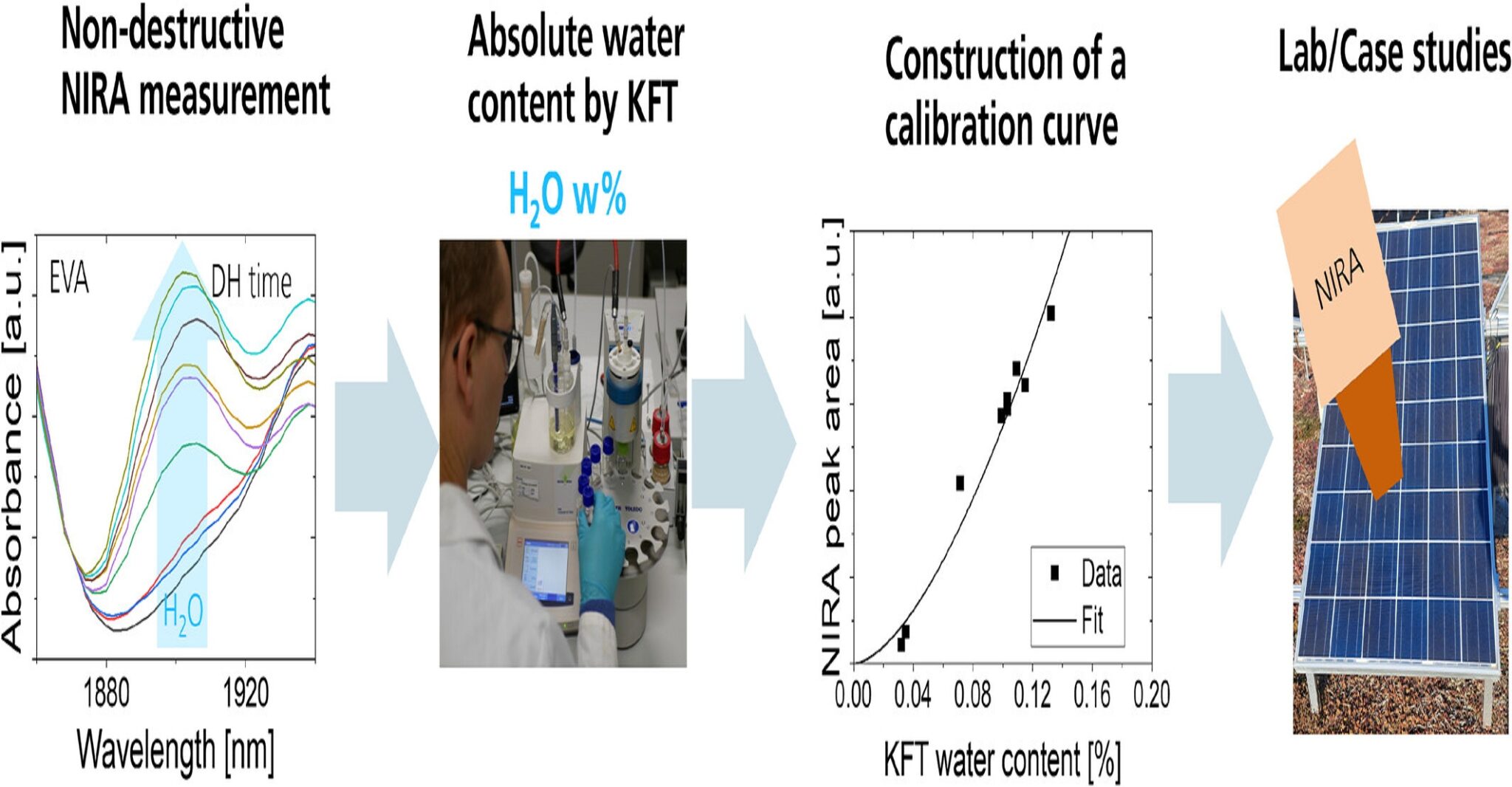
Image: Fraunhofer Center for Silicon Photovoltaics (CSP), Progress in Photovoltaics: Research and Applications, CC BY 4.0
Once calibrated, a portable NIRA spectroscopy device can be used directly on the installed modules. To demonstrate this capability, the research team tested mini-modules with PET and PP-based backsheets under humid and warm conditions, polymer coupons exposed to accelerated ultraviolet (UV) radiation and moisture aging, roof modules exhibiting backsheet cracks and slag marks, and field-retrieved modules with both cracked and intact AAA backsheets to compare real-world penetration and degradation behavior.
The tests showed that PET-based modules absorbed more water than PP-based modules. In field studies, modules with cracks in the backsheet and cells showed up to 50% higher water content, while modules with cracked AAA backsheets absorbed water up to ten times faster than intact reference modules.
“This work showed that the improved barrier performance of PP is mainly driven by its lower solubility in water, while the diffusion coefficients of both materials are comparable,” says Mordvinkin. “This provides a more detailed mechanistic explanation for the previously observed differences and is consistent with trends reported in the literature.”
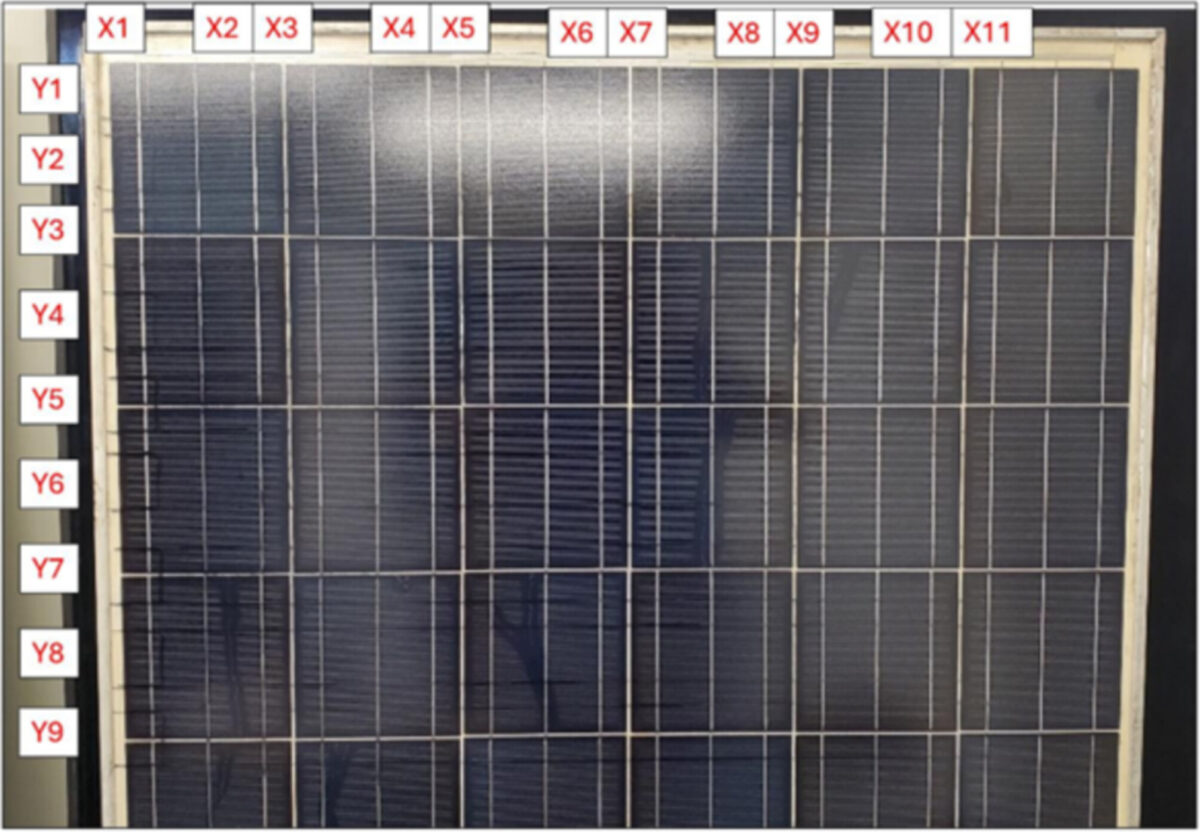
“Another particularly illuminating observation is the presence of a non-homogeneous water content distribution in modules with severely degraded backplates after long-term exposure to outdoor air of more than 7 years,” he added. “Localized moisture accumulation was significantly enhanced in areas of cell microcracks, which correlate with visually observable snail track patterns. This finding indicates a link between mechanical degradation and localized moisture ingress behavior.”
The new method was presented in “Non-destructive quantification of water ingress into PV modules via spectroscopic and chemical analysis for improved quality assurance and on-site inspection”, published in Advances in solar photovoltaics: research and applications. Researchers from the German Fraunhofer Center for Silicon Photovoltaics (CSP), Fraunhofer Institute for Microstructure and Systems (IMWS) and Forschungszentrum Jülich contributed to the research.
This content is copyrighted and may not be reused. If you would like to collaborate with us and reuse some of our content, please contact: editors@pv-magazine.com.
Popular content