

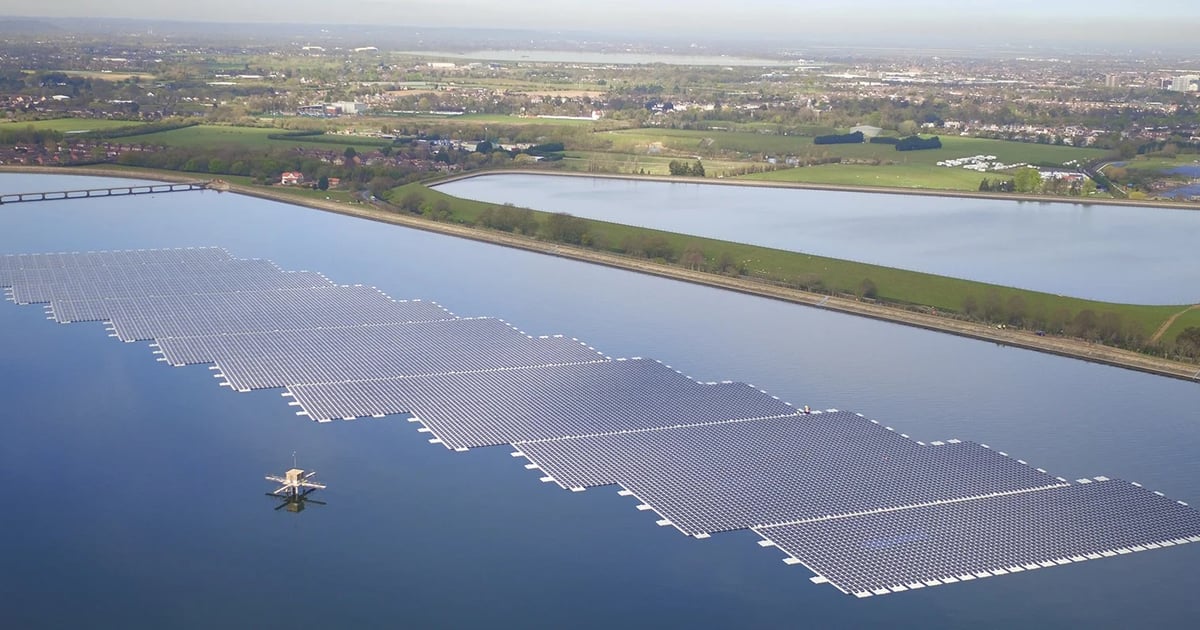
After commissioning an analysis that found 40GW of floating solar could be delivered in Britain by 2050, Bluefield Solar has launched a new business unit focused on the technology.
The owner-operator of utility-scale solar launched the floating solar PV (FPV) business through its development arm and said it will now advance a pipeline of utility-scale FPV projects across the UK.
Bluefield commissioned analysis from independent consultancy CBI Economics which found that FPV is a “key growth area” for renewables in the UK.
The company already owns and operates an FPV facility at the Queen Elizabeth II Reservoir, the largest floating solar power plant in the UK, with a capacity of 6.3 MW, and said it sees FPV as a strategic complement to ground-mounted solar, offering rapid deployment and the ability to work in tandem with industrial and water treatment demand.
The largest approved solar power plant in Britain is a 40MW project by port operator Associated British Portswhich was granted planning permission shortly before the Scottish tidal energy company Nova Innovation has announced it will install a 400kW FPV on a man-made lake in Cheshire.
Minister of Energy supports floating solar technology
Responding to the report commissioned by Bluefield, Energy Secretary Michael Shanks said: “It is time for Britain to stop letting our solar potential drift by.
“As this report shows, floating solar could generate the equivalent of around eleven gas-fired power stations by 2040, reducing our dependence on the volatile global gas markets that we do not control.”
The CBI Economics report shows that, with the right policy environment, FPV could scale to 3.6 GW by 2030, 18.3 GW by 2040 and more than 40 GW by 2050. Bluefield noted that because reservoirs and similarly managed water bodies are often located close to population centers, industrial clusters and AI growth zones, securing private-wire arrangements for high-energy users to utilize energy generated by FPV installations can be simple and can bypass the network connection. roadblocks.
In addition to the commercial and operational benefits for water utilities and industrial users, CBI Economics also highlighted the environmental and system-level benefits that FPV brings.
These include improved drought resistance, as the floating arrays slow evaporation; reduced algae blooms; and, thanks to the natural cooling of the water body, higher panel efficiency.
Aram Wood, appointed senior director of floating solar at Bluefield, said that to realize the potential of floating solar, “we need a policy framework that matches the urgency of the challenge,” but did not say what that framework might entail.
Floating solar projects are currently not eligible for government support through the Contracts for Difference (CfD) scheme, which provides income security for renewable energy projects.
One from the government Actions on the Solar Roadmap is to address the feasibility of including FPV in the mechanism.
