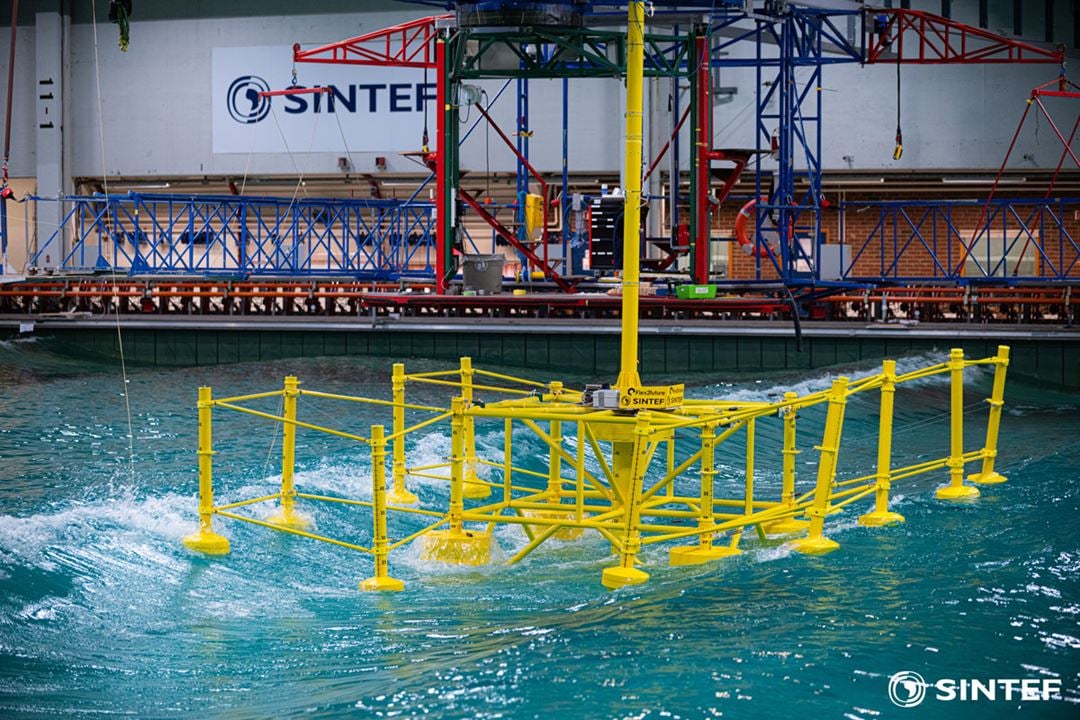
The reduced model of Flex2Future
Image: SINTEF
Norwegian startup Flex2Future has started testing its offshore energy system that integrates solar, wave and wind energy. The company used a test ocean basin from Norwegian research agency SINTEF to test a scaled-down model of its structure.
George Katsikogiannis, project manager and scientist for Ships and Ocean Structures at SINTEF, explains pv magazine The research included laboratory tests mainly focused on the hydrodynamic behavior of the structure, as well as on the power take-off performance of the wave energy modules.
“We connect numerical models based on weather data and decades of hydrodynamic expertise to the engines that pull and push the structure. This allows us to simulate realistic offshore conditions in the ocean basin,” explains Katsikogiannis. “While the wave makers work according to predefined patterns to generate realistic sea conditions, we use wires attached to the structure on one side and sensors and motors on the other.”
Erik Svanes, CEO of Flex2Future, explained that the system provides power at a relatively low cost per kWh because it uses three energy sources within a relatively small area. “What SINTEF managed to achieve with the power take-off and energy extraction from the tested cube in the towing tank was absolutely excellent,” says Svanes.
Flex2Future is working to complete a 19.2 MW pilot demonstration of its system, consisting of 5 MW of wind turbine capacity, 14 MW of multi-motion wave energy converter capacity and 0.2 MW of PV capacity within a footprint of 136.6 m x 136.6 m x 52.8 m by 2030. It then plans to start delivering the system thereafter.
Another concept system theorized by the startup includes a 40 MW wind turbine array, 59 MW of wave capacity and 1 MW of PV, for a total of 100 MW of power capacity within a 500 m x 500 m x 52.8 m system.
This content is copyrighted and may not be reused. If you would like to collaborate with us and reuse some of our content, please contact: editors@pv-magazine.com.
Popular content