

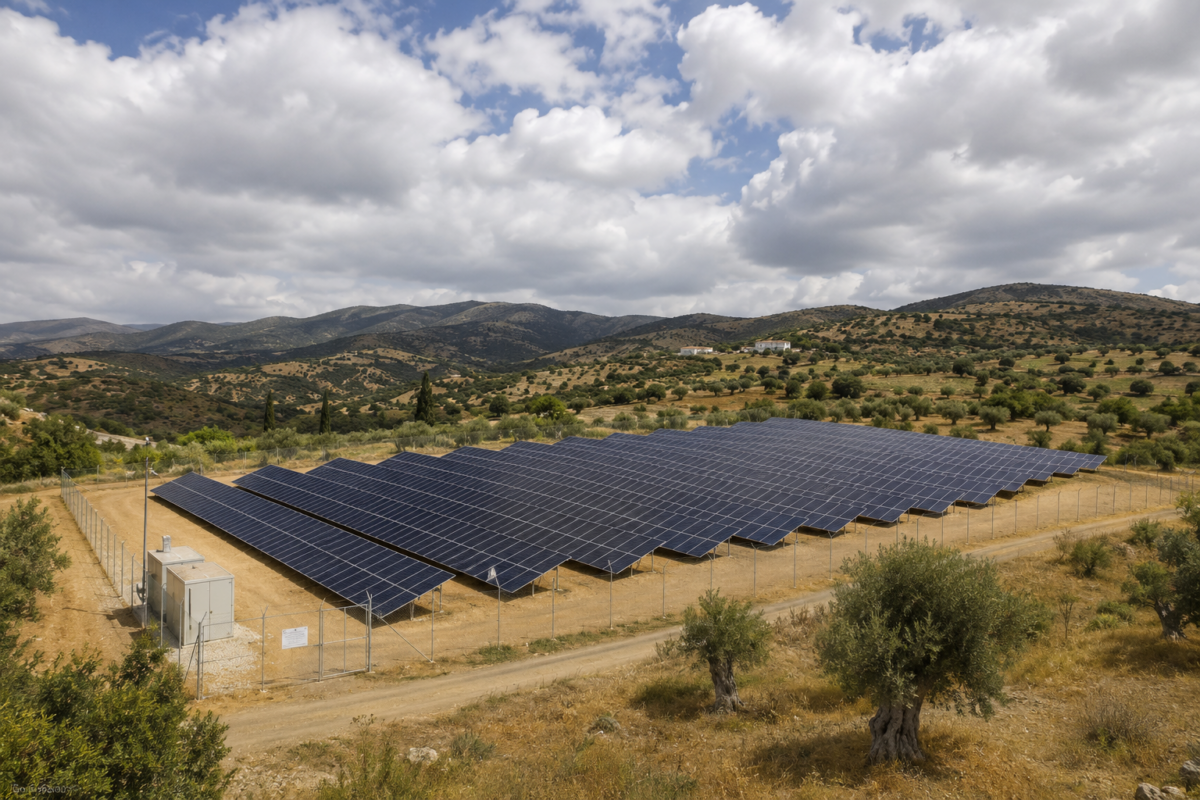
Continued negative and zero wholesale electricity prices, weak demand and inadequate Greek energy storage policies leave small and medium PV investors vulnerable, despite abundant solar energy resources.
Wholesale electricity prices in Greece between 8am and 6pm, when solar radiation is highest and photovoltaic systems generate the most output, have collapsed, often reaching zero or negative levels.
At the same time, significant amounts of renewable generation are curtailed during these hours. Preliminary data from Greece’s energy regulator shows that 876.5 GWh of renewable energy was curtailed between January and April this year, compared to 588.5 GWh in the same period a year earlier. For the whole of 2024, the total limitation was approximately 900 GWh.
“This situation is the new normal,” Petros Tsikouras, organizational secretary of POSPIEF, a Thessaloniki-based association of Greek solar energy producers, told pv magazine. He added that small PV parks lost 62% of their revenue in March, rising to 70% in April. “7,500 small producers – the backbone of the country’s decentralized energy system – will be pushed into financial suffocation within months,” he said.
Tsikouras warned that many investors may soon be unable to pay off their debts, leading to bankruptcies or forced asset sales and exits from the market.
The Hellenic Association of Photovoltaic Energy Producers (Spef), one of Greece’s other main photovoltaic associations, had already asked the government in 2024 to stop issuing new grid connection permits for renewable energy systems to tackle the escalating power curtailment problem in the country.
Konstantinos Tsirekis, director of the Strategy and System Planning Department at the Greek Transmission System Operator, said at a recent POSPIEF event that Greece had installed 17.9 GW of renewable capacity by the end of February. Of this, 11.7 GW comes from solar energy, 5.6 GW from wind energy and 0.6 GW from other renewable energy sources, such as small hydroelectric power stations. Large hydropower capacity was not included in these figures.
He added that approximately 14.1 GW of renewable energy has already received connection offers to the transmission and distribution networks, while another 48 GW has applied for grid connection at the transmission level and is still under assessment. Peak electricity demand in Greece, meanwhile, is around 11 GW.
At the same event, Pantelis Biskas, professor at the Department of Electrical and Computer Engineering at Aristotle University of Thessaloniki, noted that electricity demand in Greece has remained largely flat, despite the country’s recovery from the recent economic crisis. Annual consumption is stable at around 50 to 51 TWh, a level that he believes will not change significantly in the coming years.
Biskas said Greece exported around 3 TWh of electricity last year, powered by cheap domestic renewable generation. However, he stressed that this remains marginal compared to total annual demand and does not materially change the overall consumption outlook.
Tsikouras argued that the current imbalance is the result of policy decisions. “Over the past six years, the government has pushed for massive over-licensing of renewable energy projects – up to 25 GW – in a system that consumes between 4 and 11 GW daily,” he said. He also criticized delays in establishing a functioning energy storage framework as having undermined market stability.
Greece held its first battery storage auction in 2023, awarding 412 MW of capacity to 12 projects with significant subsidy support. Investors participated despite uncertainty about future market design, while the regulatory framework for battery operation was expected to be completed in the following two years, with operational deadlines for 2025.
However, implementation remained behind schedule. According to industry participants, regulatory delays left approved projects without a clear route to market participation. Some battery installations were completed in December 2025, but could not connect to the grid due to the lack of final operational rules. Authorities have cited the newness of the technology and limited previous experience, although critics argue that sufficient time was available to prepare the framework.
Nevertheless, of the 412 MW of storage capacity awarded in the 2023 auctions, only two projects totaling around 16 MW have started participating in the Greek electricity markets since April. The system operator has said that approximately 200 MW of additional standalone battery projects are now connected to the grid and are being tested ahead of upcoming market entry. However, there is still no clear timetable for when these projects, or the remaining allocated capacity, will be fully operational in the market.
Tsikouras states that the situation goes beyond administrative delays. “This isn’t just incompetence. It’s politics,” he said. He described a system in which electricity is increasingly generated when it is not needed, while a lack of storage prevents that energy from being shifted to peak times. “This creates winners and losers. Small and medium-sized investors are the biggest losers, while a few energy companies that can generate power in the evening are the winners.”
He noted that in the evening hours – around 7pm to 10pm – solar power generation drops to zero, leaving gas-fired power stations and large hydropower plants to set prices, which can reach €170-€250 per MWh. “This is why the government has been delaying energy storage for years,” he said.
All photovoltaic installations sold on the wholesale markets are subject to restrictions and periods of zero or negative prices, although larger operators are generally better equipped to manage volatility through advanced trading strategies. Revenue exposure also depends on the reward model: subsidy-free installations sold directly on the day-ahead market can benefit from high price spikes when they occur, while smaller installations with fixed or premium rates cannot fully absorb the upward volatility. In the case of Contracts for Difference (CfDs), any income above the strike price must be returned, further limiting profits from price spikes.
This content is copyrighted and may not be reused. If you would like to collaborate with us and reuse some of our content, please contact: editors@pv-magazine.com.
