

In a new weekly update for pv magazineOPIS, a Dow Jones company, provides a brief overview of the major price trends in the global PV industry.
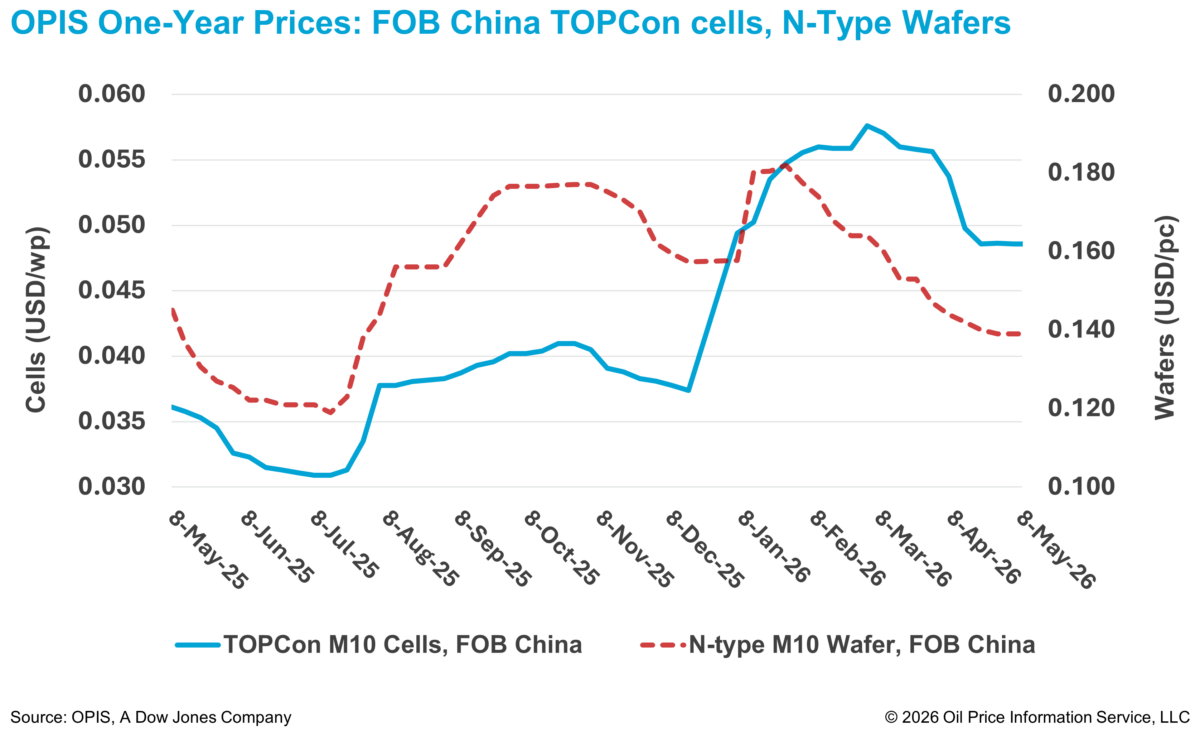
Chinese TOPCon cell prices held steady in the first week of May amid weak trading activity as China entered a weeklong Labor Day holiday period. Prices have recently stabilized after several consecutive weeks of declines, following the movements of the upstream markets.
According to the OPIS Global Solar Markets Report published on May 5, Free-On-Board (FOB) China TOPCon M10 cell prices were stable week-on-week at $0.0486/W, down 15.7% from their early March peak to date.
In addition to the holiday break, supply-side developments could put further pressure on Chinese cell prices in the second quarter of 2026. Industry sources say a major cell manufacturer is expected to complete upgrades to its TOPCon cell production lines in May. Some sources expect capacity utilization to increase once the upgraded lines become operational again, potentially increasing the industry’s overall cell production capacity.
However, the pressure can be partly offset by planned maintenance at other cell manufacturers. Another cell manufacturer source told OPIS that weaker demand had prompted some manufacturers to schedule maintenance in May, which could result in a slight reduction in supply.
The same source said visibility into the amount of capacity going into maintenance remained limited, but expected a clearer picture after the long break as many factories had halted operations over the holiday period.
On the cost side, sentiment in the wafer market has shown signs of improvement in recent weeks as purchasing activity has increased over the past two weeks against the backdrop of stabilizing polysilicon prices. Downstream buyers generally believe that current polysilicon price levels pose limited downside risk, with some industry sources believing prices may have bottomed out.
According to OPIS data, the upstream prices of EXW China Mono Premium polysilicon and FOB China N-type M10 wafers have fallen 36.1% and 22.8% respectively this year.
The increase in purchasing activity has helped wafer inventory levels gradually decline as supply is increasingly transferred downstream from wafer manufacturers, market sources said. While stabilizing wafer prices on the cost side could provide support for downstream cell and module prices, broader fundamentals on the wafer side remain weak.
Factors such as weaker foreign demand, lower-than-expected domestic demand, existing inventory at cell factories and the May holiday continue to weigh on wafer demand, according to the China Nonferrous Metals Industry Association (CNMIA).
CNMIA added that while wafer operating rates have remained stable, the market is at an impasse in the short term, with upstream suppliers remaining firm on their prices while downstream buyers continue to push for discounts.
OPIS, a Dow Jones company, provides energy prices, news, data and analysis on gasoline, diesel, jet fuel, LPG/NGL, coal, metals and chemicals, as well as renewable fuels and environmentally friendly feedstocks. It acquired price data assets from Singapore Solar Exchange in 2022 and now publishes the OPIS APAC Solar Weekly Report.
The views and opinions expressed in this article are those of the author and do not necessarily reflect those of the author pv magazine.
This content is copyrighted and may not be reused. If you would like to collaborate with us and reuse some of our content, please contact: editors@pv-magazine.com.
