

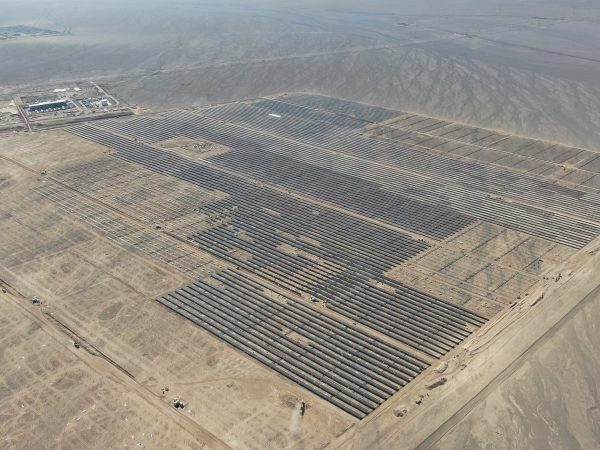
Solar photovoltaics generated 2,141 GWh in Chile’s National Electricity System (SEN) in March 2026, equivalent to 28.7% of total monthly generation, according to the latest bulletin from Generadoras de Chile, the trade association representing electricity generation companies. During the month, solar production reached an immediate peak share of 75.1% at noon on March 14.
Operating photovoltaic capacity stood at 11,999 MW at the end of March, with a further 10,203 MW of renewable capacity under construction, mainly solar projects and storage systems.
The report shows that renewables accounted for 62% of SEN’s monthly generation, with the renewable share exceeding 50% for all 31 days of March. At 2:00 PM on March 1, renewables reached an immediate peak of 92.6%.
Regionally, Antofagasta contributed 35% of total solar generation, followed by Atacama with 22% and the Metropolitan Region with 7%.
The total installed capacity in the SEN amounted to 38,005 MW in March 2026, of which 26,553 MW corresponded to renewable technologies or 69.9% of the total. Solar PV remained the largest renewable source at 11,999 MW, followed by wind power at 5,965 MW and run-of-river hydropower at 4,005 MW.
In terms of development, Generadoras de Chile reports that 10,474 MW are under construction in the SEN, of which 2,753 MW corresponds to solar PV and 6,358 MW to battery energy storage systems (BESS), including standalone projects and hybrid solar storage facilities. Renewable projects account for 97.4% of all capacity under construction.
Energy storage continues to expand alongside the development of solar energy. Chile currently has 2,529 MW / 8,786 MWh in operation, 6,361 MW / 22,479 MWh under construction and 10,560 MW / 52,833 MWh in environmental assessment. A significant part of the operational systems consists of BESS units located next to photovoltaic installations, designed to shift solar energy generation to the evening hours and reduce curtailment.
In the environmental permit pipeline, 14,587 MW of renewable capacity is being explored, including 10,366 MW of solar PV (57.5% of the total), 4,005 MW of BESS and 1,957 MW of solar-wind hybrid projects.
The report also highlights the operational challenges associated with the high penetration of renewable energy sources. In March, the curtailment amounted to 595.8 GWh, or 20% of total solar and wind energy generation. Of this, 430.3 GWh corresponded to solar energy and 165.5 GWh to wind energy.
Generadoras de Chile attributes the curtailment mainly to grid safety restrictions and transmission congestion, particularly along the Charrúa-Puerto Montt corridor, which experienced congestion for 39.7% of hours in March.
