

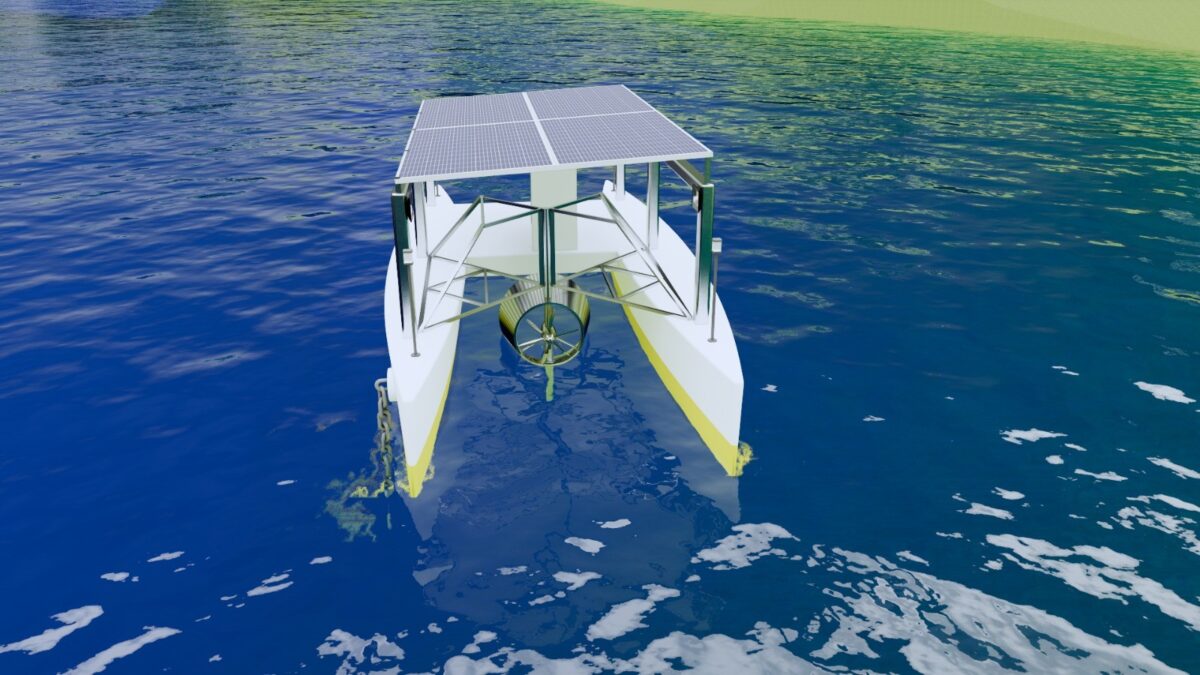
Researchers in Brazil have developed and simulated a hybrid tidal PV floating farm concept for estuarine channels, analyzing wake effects, turbine spacing and hybrid energy trade-offs. The results show that integrating PV with hydrokinetic turbines improves overall energy yield by offsetting wake-related losses and optimizing modular farm configurations.
Researchers from Brazil have developed a hybrid tidal PV generation concept for the modular deployment of renewable energy in estuarine channels.
In their simulation study, the team examined longitudinal wake recovery, its effect on array efficiency, and the tradeoffs between turbine spacing, installed power, and energy yield. Wake refers to the turbulent water flow downstream of a turbine after energy harvesting, which can reduce the performance of downstream turbines.
“Although the current work is illustrated through a case study in the Boqueirão Channel, the proposed methodology is not site-specific and can be extended to other estuarine channels with similar characteristics, such as geometric constraints, large tidal ranges, strong currents and favorable solar energy availability,” the team said. “Therefore, the framework provides a useful basis for the pre-feasibility assessment of modular hydrokinetic and hybrid energy farms in estuarine environments.”
According to the researchers, the tidal regime in the Boqueirão Channel is semidiurnal, with a period of about 12.4 hours. The region experiences tidal ranges of more than 6 m and current velocities often exceeding 2.5 m/s, resulting in a maximum power density of 7.63 kW/m² and an annual energy density of 17.96 MWh/m². About 82.5% of the annual flow velocities fall within the 0.5–2.0 m/s operating range of the turbine. Regarding the PV component, the area receives strong solar radiation of about 5–5.5 kWh/m² per day, or about 1,900 kWh/m² per year.
The tidal current generation component was based on the Yarama hydrokinetic turbine, a six-blade turbine with horizontal axis and diffuser, designed for low-speed estuarine and fluvial conditions. It has a nominal hydraulic power of 5 kW, an effective electrical power of 4 kW, an on speed of 0.5 m/s and a off speed of 2.4 m/s. The turbine has a throat diameter of 1.21 m, an external diameter of 1.64 m and a diffuser length of 1 m.
Before integrating PV into the system, the researchers first estimated the wake of the turbines using numerical simulations. Based on this, they found that a lateral distance of 3D (where D indicates the turbine diameter) resulted in virtually no performance loss. In contrast, longitudinal spacing had a strong effect: when turbines were placed 40D apart along the flow direction, the power coefficient of the downstream turbine decreased from 0.88 to 0.64 due to wake losses. Increasing the distance to 50D and 60D improved the downstream power coefficient to 0.76 and 0.80, respectively, demonstrating that increased distance allows better wake recovery and higher energy yield.
However, spacing the turbines reduces the number of units that can be installed within the available area, creating a trade-off between energy output and installed power. So the scientists decided to install solar panels on top of each turbine on a floating catamaran-type platform. Each hybrid unit is 4.5 m long and 2.0 m wide, with 0.45 m diameter pontoons and a 1.5 m vertical support connecting the floating structure to the submerged turbine. The PV system consists of four panels mounted above the platform, with a combined power of 2.48 kW and an efficiency of 23%.
The researchers simulated the hybrid system as a floating farm, installed in a 0.5 km x 3 km test area in the Boqueirão Canal. Each farm contained between one and seventeen columns, with each column consisting of 138 hybrid tidal PV units arrayed side by side across the canal. For each farm configuration, the team also tested the longitudinal distances of 40D, 50D and 60D between the columns.
The simulation series showed that a farm with a longitudinal spacing of 40D and three columns would generate 5.186 GWh of energy per year, with a levelized cost of energy (LCOE) of $0.36/kWh. Expanding the layout to four columns would increase annual generation to 6.401 GWh, with an LCOE of $0.37/kWh, while a five-column configuration would reach 7.468 GWh/year with an LCOE of $0.38/kWh.
For the 50D configuration, six columns would generate 10.043 GWh/year at an LCOE of $0.33/kWh, eight columns would generate 12.466 GWh/year at $0.33/kWh, and the 11-column layout would generate 15.605 GWh/year at $0.35/kWh. For the 60D configuration, nine columns would generate 15.002 GWh/year at $0.30/kWh, 12 columns would generate 18.680 GWh/year at $0.31/kWh, and the maximum layout with 17 columns would generate 23.956 GWh/year at $0.32/kWh.
The results also indicated that although wake effects lead to reduced energy production from downstream hydrokinetic turbines, the integration of photovoltaic generation helps partially offset these losses. As a result, the hybrid configuration improves the overall productivity of the site, increasing total energy yield and making more effective use of available natural resources.
“Overall, the study confirms that hybrid hydrokinetic-photovoltaic systems represent a technically feasible and economically promising solution for the modular deployment of renewable energy in estuarine channels,” the academics concluded. “The proposed methodology provides a robust decision support framework for early-stage project assessment, enabling realistic comparisons between array layouts, spacing strategies and hybridization levels.”
The system was presented in “Design and techno-economic assessment of a hybrid hydrokinetic-PV array with diffuser in an estuarine channel”, published in Energy conversion and management. Scientists from Brazil’s Federal University of Maranhão, Federal University of Itajubá, Federal Institute of Maranhão and University of Campinas contributed to the study.
This content is copyrighted and may not be reused. If you would like to collaborate with us and reuse some of our content, please contact: editors@pv-magazine.com.
