

The UK government’s Clean Power 2030 target and its approach to renewable energy are one of the clearest priorities on its agenda.
That is the view of Giles Wilkes, senior fellow at think tank the Institute for Government. He will moderate a panel discussion at Solar Media’s Clean Power 2030 Summit in London on June 30 and July 1, ‘The New Demand Reality: Where UK Electricity Growth Is Real Coming From’. View the full agenda on the event website And book your ticket to attend. Our readers can get a 20% discount on tickets with the code SPP20.
The Institute for Government is an apolitical think tank that advises the civil service and politicians on how to work as efficiently as possible.
He will be joined by Alex Gilbert, head of energy at Transport for London, Rachel Cary, head of industrial strategy at Energy UK, and Matt Parry, head of energy and energy demand at the REA to discuss the sectors driving growth in the UK’s electricity demand and how to plan for it.
Solar energy portal spoke to Wilkes about how the government’s industrial strategy will play a role.
Tickets are still available for the Clean Power 2030 Summit, which will bring together policymakers, developers, investors, network operators and other industry players to tackle the scale of growth in Britain up to 2030.
Solar Power Portal: The government is responsible for energy infrastructure planning, industrial strategy and network investments, in addition to the actions it takes to achieve the 2030 Clean Energy target. Do you see the UK Industrial Strategy as something that can be successfully delivered alongside CP30?
Giles Wilkes: Absolutely; one of the key sectors in the industrial strategy is the clean growth sector. It is one of the growth-driving sectors of the Industrial Strategy (the IS-8 sectors), and the aim is for them all to be aligned.
There are a lot of things in the Industrial Strategy that are not clean growth, and you could argue that while some of them call for cheaper energy, clean growth requires investment in cleaner energy, which could create a conflict. But the government certainly does not think there is a contradiction; they think this is a world of ‘and’ and not of ‘or’. There are trade-offs to be made, but that is part of politics; you are constantly managing trade-offs and making resource decisions.
As for the implementation of the industrial strategy, it is a new way of conducting political and economic policy, which involves being aware and directing carefully selected parts of the economy. The government will therefore achieve that strategy not so much by whether certain goals are achieved, but by whether the way in which it implements policy is changed.
There is absolutely no contradiction between that and clean energy. If you want to achieve clean growth and reach net zero, you need to be consciously committed to the economy in exactly the same way.
Energy itself could be considered one of the resources on which the government has to make decisions, although the demand forecast is not particularly accurate. How can demand be planned effectively if there is no definitive answer to energy demand?
Demand is always an uncertain variable in all parts of the economy. Companies have to supply all kinds of goods without being absolutely sure what the demand is. I think the point of planning our energy system in the future is that the government should have wide margins in how they make their plans.
It’s about capacity planning and not about exact delivery, I think. That’s why they have capacity mechanisms. So I don’t think that the inherent uncertainty in economic life makes it absolutely impossible, but as a result there is clearly a large-scale debate about the future and the answers to those questions are always going to change depending on geopolitical events, technological paths and all these different things. You should never expect anyone to say, “We’re sure it will happen this way.” There must be a certain degree of flexibility. But that doesn’t stop people from moving forward.
For example, we know that we’re going to have a lot more renewable and intermittent energy on the grid, so we know that we’re going to need, for example, a greater investment in the grid to manage that. I don’t see uncertainty making it impossible.
What is the status of progress in clean energy within the Industrial Strategy?
Clean growth is going well because it is one of the sectors where the government already had an idea of what it wanted to do before it came in: it had the National Wealth Fund and Great British Energy as ideas ready to go; it had mechanisms from previous governments, such as the Contracts for Difference mechanism; and it had a legal framework in net-zero legislative institutions such as the Climate Change Committee.
It is a fairly clear part of the government’s agenda, and the government is not known for being clear about everything it is trying to do.
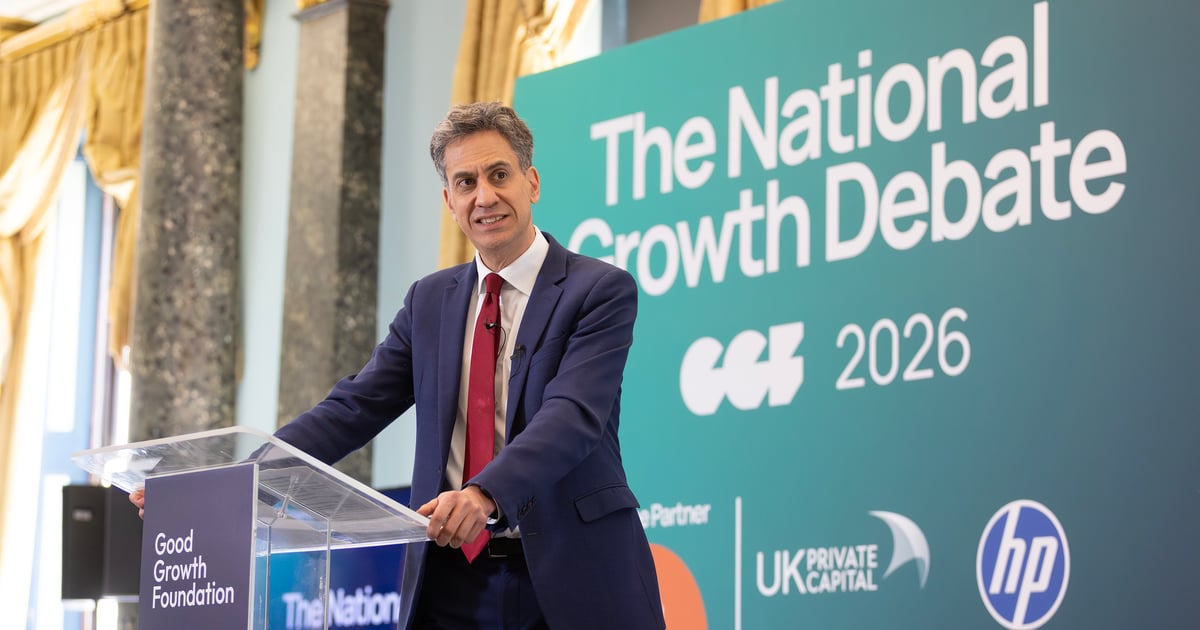
Ed Miliband really knows what he wants and goes hard for it. At the same time, the government is clearly in a real dilemma as energy costs rise, so it’s not an easy topic, but I don’t think our energy costs are caused by us moving too quickly towards renewables at the moment.
Personally, I think the clean growth mission is probably one of the missions that is doing better, where the government seems to know what it wants to do and is facing some of the tough decisions. There are still many difficult issues, such as the zero-emission vehicle mandate and the pace at which certain things should be implemented.
To properly execute the clean growth mission, you need hundreds of thousands of well-trained people in certain jobs. That seems like a great opportunity, but it is also a great challenge. A lot of money is needed. For example, look at Sizewell C, which will require a lot of state funding.
I think it will be uncontroversial to 65-75% of the political spectrum. And that is a good thing to continue with.
