

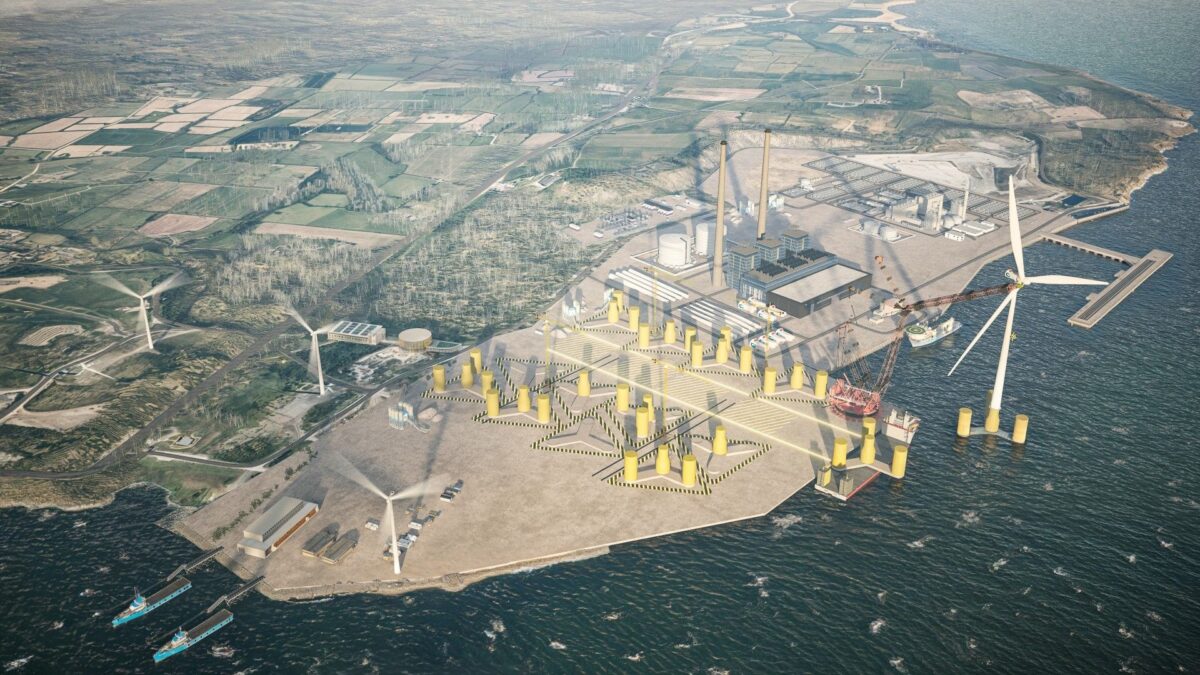
Fraunhofer ISE, in collaboration with Irish energy company ESB, has developed a methodology that demonstrates Ireland is a competitive location for sustainable energy-to-X and green hydrogen production with costs comparable to Morocco, South Africa and Brazil, supported by strong wind energy resources, policy support and infrastructure potential.
Germany Fraunhofer Institute for Solar Energy Systems (Fraunhofer ISE) has developed a methodology to identify suitable locations in Ireland for renewable energy and large-scale power-to-X production. The study examined several hydrogen-based products, including liquid hydrogen, ammonia, methanol, dimethyl ether and e-kerosene (SAF), while also calculating full supply chain costs from production to delivery in Rotterdam, Duisburg and Stade. The results show that Ireland’s green hydrogen production costs are broadly comparable to countries such as Morocco, South Africa and Brazil, although in some cases slightly higher. However, Ireland has several strategic advantages, including strong renewable energy expansion plans, the need for network flexibility due to rising electricity demand, a skilled workforce, established industrial expertise and a stable investment climate. The researchers concluded that wind conditions and government support could make Ireland a major player in the hydrogen economy. “One finding of the research is that Ireland’s cost of producing green hydrogen is on par with or only slightly higher than other potential export countries such as Morocco, South Africa and Brazil.” said Fraunhofer ISE. The German research institute worked with the Irish energy company Electricity Supply Board (ESB) and found that the most favorable option is via pipeline transport to the ports of Rotterdam, the Netherlands, or Stade in Germany. The hydrogen supplied to Germany would cost between €160 and €205 per megawatt hour, including transport costs.
The Australian Renewable Energy Agency (Arena) has announced seven projects shortlisted for Round 2 of the Hydrogen Headstart Program. “The projects selected to advance to the next phase in the application process are some of the most advanced large-scale renewable hydrogen proposals in the country, spanning multiple states and encompassing a range of end uses including ammonia and alternative fuels,” said Adding it, Arena will now invite shortlisted projects to submit full applications.
Qair inaugurated its first hydrogen filling stations (HRS) in France, located in Béziers and Narbonne. They will each supply up to 600kg of renewable hydrogen per day, mainly for light and heavy trucks, coaches, buses and commercial fleets. According to the independent energy company, the project positions Occitanie as a strategic hub for zero-emission logistics in Southern Europe.
based in Estonia Elcogen has launched its solid oxide fuel cell and electrolysis platform, the elcoStack E3000 G2. “The defining advantage is a design optimized for scalable mass production, allowing rapid industrial deployment at significantly higher volumes and lower unit costs than the previous generation,” the European technology manufacturer said. In fuel cell mode (SOFC), the E3000 G2 can use hydrogen, biofuels and natural gas. “This enables on-site power generation tailored to regional energy availability, delivering up to 75% electrical efficiency and up to 90% when using waste heat,” the company said, noting that the system also operates in electrolysis mode (SOEC) to produce green hydrogen, with an efficiency of 33 kWh/kg. “It operates at significantly lower temperatures than most conventional solid oxide technologies (approximately 650–750 C compared to 700–850 C), allowing the use of more cost-effective materials.”
In the second quarter of 2025/2026 thyssenkrupp nucera the group’s order intake almost quadrupled to €316 million ($370 million), compared to €83 million in the second quarter of 2024/2025. “Large new orders in the two business segments Green Hydrogen (gH2) and Chlor-Alkali (CA) resulted in the order book reaching €732 million as of March 31, 2026 (September 30, 2025: €606 million),” said the Germany-based company. In the first six months of reporting year 2025/2026, the value of new customer orders increased by 119 percent to € 391 million.
This content is copyrighted and may not be reused. If you would like to collaborate with us and reuse some of our content, please contact: editors@pv-magazine.com.
