

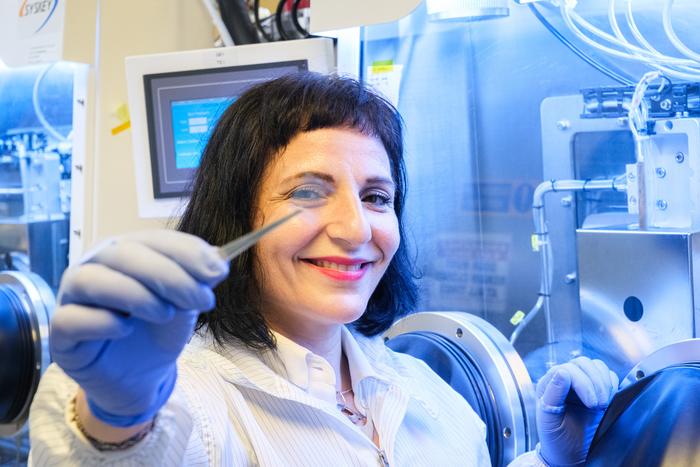
Researchers at NTU Singapore have developed ultra-thin perovskite solar cells that are approximately 50 times thinner than conventional designs using a vacuum-based thermal evaporation process. The devices can be semi-transparent and generate energy under diffused light, making them promising for integration into windows and building facades.
A research team from Singapore’s Nanyang Technological University (NTU) has developed perovskite solar cells that are “about 10,000 times thinner than a human hair and about 50 times thinner than conventional hair,” according to a study published in ACS Energy Letters.
“Buildings are responsible for around 40% of global energy consumption, so technologies that unobtrusively transform building surfaces into energy-generating assets are becoming increasingly urgent,” says Professor Annalisa Bruno from NTU’s School of Physical and Mathematical Sciences and School of Materials Science and Engineering.
“Our perovskite cells offer clear advantages as they can be manufactured using simple processes and at relatively low temperatures. They can also be tuned to absorb specific wavelengths while remaining transparent, and can be scaled up for use on large surfaces, reducing their carbon footprint,” Bruno added.
The researcher noted that unlike conventional silicon solar cells, the perovskite devices can generate electricity under indirect or diffuse light. “This makes them particularly suitable for Singapore’s urban environment, where vertical surfaces and frequent cloud cover limit direct sun exposure,” says Bruno.
Preliminary estimates suggest that installing the technology on a glass-fronted building could generate hundreds of MWh per year, although the underlying assumptions and independent validation have not yet been published.
The cells are manufactured using an industry-compatible thermal evaporation process, in which materials are heated in a vacuum chamber until they vaporize and deposit as thin films on a substrate. Their semi-transparency and neutral color support integration into architectural glass applications.
The process also avoids toxic solvents and reduces defects in the solar cells, improving energy conversion efficiency. By adjusting the deposition parameters, the researchers controlled the thickness of the perovskite layer and produced both opaque and semi-transparent devices.
The team says this is the first demonstration of ultra-thin perovskite solar cells manufactured exclusively using vacuum-based processes, a development that could enable scalable industrial production. Using this approach, they achieved perovskite absorber layers as thin as 10 nanometers while maintaining functional performance.
In opaque devices, the cells achieved conversion efficiencies of 7%, 11%, and 12% for 10 nm, 30 nm, and 60 nm layers, respectively. A semi-transparent device with a 60 nm layer transmitted approximately 41% of visible light while achieving a conversion efficiency of 7.6%.
The researchers reported no accelerated stability data or performance on large surfaces larger than a few square centimeters.
“By precisely controlling thermal evaporation, we can fine-tune the transparency of the solar cells. This opens up new possibilities for sustainable architecture, such as tinted windows that generate electricity,” explains lead author Luke White.
A patent has been filed for the ultra-thin perovskite film structure through NTUitive, NTU’s innovation arm.
The researchers are now working with industry partners to validate and standardize the thermal evaporation process and improve its long-term stability, sustainability and scalability, ahead of potential commercialization.
This content is copyrighted and may not be reused. If you would like to collaborate with us and reuse some of our content, please contact: editors@pv-magazine.com.
