

Scientists in Sweden have experimentally evaluated a prototype Carnot battery (SECB) based on a Stirling engine, using low-cost sand as thermal energy storage, with the aim of validating electricity-to-heat-to-electricity storage concepts. Tests showed that higher engine temperatures improved power and duration, but return efficiency remained low, mainly due to thermal losses and limited heat transfer in the sand bed.
Researchers from Finland’s Aalto University have conducted experimental and numerical evaluations of a prototype Carnot battery (SECB) based on a Stirling engine, which uses sand as a thermal energy storage (TES) material. SECB is a system that uses a Carnot battery to store electricity as heat and then uses a Stirling engine to convert the stored heat back into electricity.
A Stirling engine is a closed cycle regenerative heat engine with a permanent gaseous working fluid such as gas or air. It generates mechanical motion from the heat-driven compression and expansion of the fluid, using a heat transfer fluid to meet demand.
“Theoretical and numerical studies predict high efficiencies but lack experimental validation, while experimental Stirling-based Carnot batteries rely almost exclusively on costly metal-based phase change materials (PCMs),” the researchers said. “Although sand has been identified as a promising alternative medium for thermal storage, its performance within a complete, integrated Carnot battery system has not yet been experimentally demonstrated.”
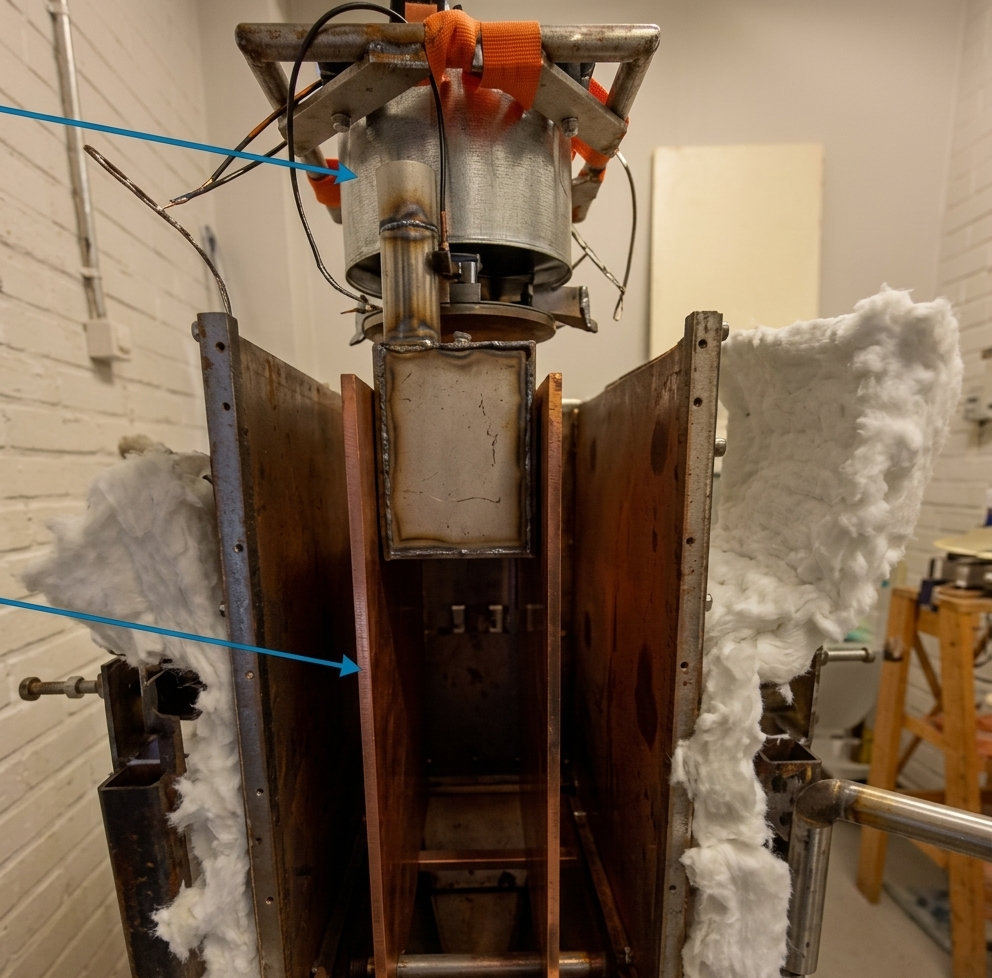
The prototype consisted of an insulated thermal storage tank of 0.2 m³ filled with brown quartz sand with a grain size of 0.6–2 mm as a storage medium for thermal energy. The sand had a specific heat capacity of 703 J/(kg·K), a thermal conductivity of 0.2–0.7 W/(m·K), and a bulk density of 1,800 kg/m³.
Image: Aalto University, Journal of Energy Storage, CC BY 4.0
Ten electric heating elements provided the charge, each rated at 3 kW and 230 V. The heat transfer from the sand to the engine was via a copper block of 0.14 m x 0.225 m x 0.225 m, connected to two copper plates of 0.65 m x 0.65 m x 0.01 m. The system used a 1 kWe and 26% efficient commercial Microgen Stirling engine with free piston, manufactured by Microgen Engine Corporation.
The researchers tested the prototype under two operating conditions, with an engine head temperature set point of 300 C or 350 C.

Image: Aalto University, Journal of Energy Storage, CC BY 4.0
In addition, the researchers also developed a three-dimensional numerical model in the COMSOL Multiphysics environment to simulate the thermal behavior and performance of the SECB. The simulation was first validated against the experimental cases of 300 C and 350 C. It was then extended to investigate higher operating temperatures of 400 C and 500 C, which could not be tested experimentally.
“Increasing the motor head set temperature from 300 C to 350 C increased the peak electrical power from approximately 500 W to 690 W and extended the discharge period from approximately 9 hours to 14 hours,” the results showed. “Despite this, return efficiency remained relatively low: 4.4–5.9% at 300 C and 6.8–8.3% at 350 C. These results demonstrate clear temperature-driven performance improvements, but also indicate that significant design and integration improvements are required before this approach can achieve competitiveness for electricity-to-electricity storage.”
According to the energy balance results, losses outside the conversion phase dominated the outcome. For a 300 C cycle, 53 kWh of electrical input produced 2.33 kWh of electrical output, with 16.54 kWh dissipated through the cooling loop and 34.13 kWh lost to the environment or through structural heat paths. In addition, the low effective thermal conductivity of the sand bed limited heat flow to the motor head, leading to temperature drops and intermittent operation.
“The numerical model suggests that higher round-trip efficiencies between 19.1% and 31.6% for 300 C to 500 C are achievable if heat leaks and boundary losses are minimized,” the team concluded. “These figures should serve as design goals and sensitivity guidelines rather than actual performance benchmarks, especially for operations above 400 C, which cannot be experimentally validated with the current prototype.”
The system was presented in “Stirling engine-based Carnot battery with sand as heat storage medium: 1 kWe prototype”, published in the Journal of Energy Storage.
This content is copyrighted and may not be reused. If you would like to collaborate with us and reuse some of our content, please contact: editors@pv-magazine.com.
Popular content

